Rev. Bennett raises the great concerns over Evangelical-Catholic Together. (More articles available using the "search" button the right near the bottom.) We believe assimilation and dulled senses are resulting to 1) lowered interests in doctrine, 2) lowered views of Biblical authority, 3) Pentecostalists--a growing phenomenon--and their incurable, persistent anti-doctrine, anti-intellectual, and anti-Bible perspectives, 4) gross indifferentism to biblical doctrine in the mainline Protestant groups, 5) Billy Graham's defection from Confessional Protestant Churchmanship and misled ecumenism, 6) Contempory Christian music that indoctrinates congegations with Biblical literacy, 7) Declension from Reformed and solid Prayer Book Churchmanship, 8) human nature, which has always inclined to corruption (e.g. Judges, the book of the kings, Rev.1.-3), 9) absence of catechesis in the Reformed Confessions and Catechisms, 10) Theology professors, e.g. James Packer and Timothy Geroge, who have lost touch with the facts "on the ground." 11) Shepherd doctrine on "justification by sanctification" in Prebyterian circles and an independentist outift like Doug Wilson's denomination, has prompted some, e.g. Scott Hahn, to become Romanist. Christianity Today has been a major publication puffing ECT.
As such, assimilation and affirmation of Rome is made easier. While outright departure may not always result, ECT lays a foundation for it.
Then, Rev. Bennett comes along and confronts ECT. Drs. Sproul, Horton, MacArthur and other have arisen to critique ECT. James Packer has all but disappeard from speaking at Reformed conferences.
Rev. Bennett includes this citation with his video and we quote:
"We have posted a new video documenting the fact that several well respected and influential Evangelicals have compromised with the false gospel of Papal Rome. Michael de Semlyen and Richard Bennett make the presentation along with Brian Haskin's narration and professional editing. We ask that you have this video shown to your church and friends. We believe that what is required is biblical separation from those who have perverted the Gospel of Christ. Christians must first know the facts, what has happened and is happening before our eyes. We pray to the all holy and righteous God that despite all of this His Gospel may be made even more splendidly clear to many for the glory of His name and the salvation of souls. Your comments placed on the website where the video is located will greatly help in this endeavor as we jointly earnestly contend for the faith once given to the saints."
Showing posts with label Papacy. Show all posts
Showing posts with label Papacy. Show all posts
Tuesday, November 9, 2010


Lest We Forget: "Peter and the Rock"
Richard Bennett, former Catholic priest, explains the teaching of Peter as the rock of the church. Three areas are examined: 1) Matthew 16:16-20, 2)Peter went to Rome and 3) Apostolic succession.
The Pope Denounces True Christians
The Pope's denunciation of true Christian was carried across the world as a major news item on July 10-11, 2007. For example, the UK Times declared, "If it isn't Roman Catholic then it's not a proper Church, Pope tells Christians." Other headlines were, "Vatican text angers Protestants" and "Pope Benedict XVI Detours Salvation Through Catholic Church." Because of the consequences of the Pope's decree, and the change of Vatican policy involved, it is necessary to analyze the document and its after effects on true believers. This careful scrutiny of what has happened is evaluated on this DVD by Richard Bennett and Michael de Semlyen; professionally produced and narrated by Brian Haskin.
Let ECT-signatories, like Dr. James Innes Packer and others, digest this and related materials for further inquiry.
Let ECT-signatories, like Dr. James Innes Packer and others, digest this and related materials for further inquiry.
Roman Inquisition and The Torture Tools
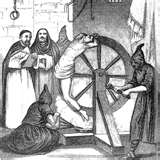
Rev. Bennett, former Romanist priest, has made a special indepth study of the Roman Inquisition and the torture tools. Chilling, grievous, and merits further study. So little is mentioned about it. Rev. Bennett, though a Baptist, nevertheless has made Romanism a special area of study.
Thursday, March 18, 2010
2nd Quote of the Day: Martin Luther

"The Pope is the archblasphemer of God in that he applies to himself the noble passage which is spoken of Christ alone. He wants to be that rock, and the church should rest in him....Therefore we must see to it that we stay with the simple meaning, namely, that Christ is the Foundation on which the church is to stand.
Martin Luther
What Luther Says (St. Louis, MO: Concordia, 1959), 2.1070, para.3412
Wednesday, March 17, 2010
R.C. Sproul, Roman Catholic, Church, Salvation--Part Two

http://www.ligonier.org/rym/broadcasts/audio/church-and-salvation-pt-2/
R.C. Sproul, Roman Catholic, Church, Salvation--Part Two
R.C. Sproul, Roman Catholic, Church and Salvation--Part One

http://www.ligonier.org/rym/broadcasts/audio/church-and-salvation-pt-1/
Romanism, the Church and Salvation, Part One


Thursday, January 28, 2010
Pope John Paul II Whipped Himself as Act of Penance, Book Claims - International News | News of the World | Middle East News | Europe News - FOXNews.com

Pope John Paul II Whipped Himself as Act of Penance, Book Claims - International News News of the World Middle East News Europe News - FOXNews.com
The late Pope John Paul II, who has been put on the fast track to sainthood by the Vatican, regularly whipped himself as an act of penance to feel closer to God, and signed a secret document saying that he would step down as pontiff if he became incurably ill, according to a new book.
"Why a Saint?" by Monsignor Slawomir Oder, the Vatican "postulator" in charge of the canonization process, says the Polish-born Pope performed self flagellation as a bishop in Krakow and continued to do so in the Vatican after being elected Pope in 1978.
"In his wardrobe, among his vestments, there hung on a clothes hanger a special belt for trousers which he used as a whip," Monsignor Oder says. He said self flagellation was "an instrument of Christian perfection" emulating the sufferings of Jesus Christ.
He added that in Poland the former Bishop Karol Wojtyla often slept on the bare floor to practice self-denial and asceticism, often disturbing his bed in the morning to pretend he had slept in it and so avoid drawing attention to his act of penitence.
LIVESHOTS: Pope Ready for Resignation, Whip
The fact that John Paul whipped himself in "bodily penance" was first revealed last November by Sister Tobiana Sobodka, a Polish nun who worked for Pope John Paul in his Vatican apartment and at the papal summer residence at Castel Gandolfo in the hills south of Rome.
In "Santo Subito" (A Saint Now) by Andrea Tornielli, the Pope's biographer and Vatican correspondent of Il Giornale, Sister Sobodka, who belongs to the Order of the Sacred Heart of Jesus said “We would hear it –- we were in the next room at Castel Gandolfo. You could hear the sound of the blows when he would flagellate himself. He did it when he was still capable of moving on his own."
In 1986, in his annual Letter to Priests, John Paul wrote: “What one must see in these forms of penance –- which, unfortunately, our times are not accustomed to –- are the motives: the love of God and the conversion of sinners.” Saints who flagellated themselves include St. Francis of Assisi, St. Teresa of Avila, St. Ignatius of Loyola, Mother Teresa and St. Thomas More.
Last month Pope Benedict XVI recognized John Paul II’s "heroic virtues," a step towards beatification, which is expected in the autumn after the Pope has approved a miracle attributed to John Paul involving a French nun inexplicably cured of Parkinson's disease after praying to him. This will then be followed by canonization, which requires proof of a second miracle.
Monsignor Oder confirms that in 1989 John Paul, who suffered from Parkinson's disease, prepared a document stating that he would resign "in the case of infirmity which is presumed incurable, long-lasting and which impedes me from sufficiently carrying out the functions of my apostolic ministry." Popes are normally elected for life.
The last Pope to step down voluntarily was Celestine V in 1294. Pope John Paul asked Cardinal Joseph Ratzinger, then head of the Vatican's Congregation for the Doctrine of the Faith and now Pope Benedict, to study the theological implications of papal resignation.
The book also says John Paul forgave Mehmet Ali Agca, his would-be assassin, in the ambulance on the way to the hospital moments after he was shot on May 13, 1981, in St. Peter's Square. Agca was released from prison in Turkey this month and has vowed to pray at John Payul's tomb in Rome.
Monday, January 25, 2010
John Jewel's "Apology for the Church of England," Part IV: The Roman Antichrist

John Jewel tackles the corrupt, decadent, sacreligious, darkened, pornocratic, immoral, self-justifying and self-aggrandizing Vaticanists. Jewel alludes to Gregory the Great, Bernard (like Calvin in the Institutes, 4.7.22, inter alia), Roger Bacon, Petrarch, Gerson, Savanarola and others who freely applied the term "Anti-Christ" to the Pope who regaled and heralded himself as the "Head of the Church," "King of kings," and "Lord of lords" on earth. Jewel refers to the heinous opposition to the light of God's Word and truth, burning Scriptures and believers during the Reformation. For non-historical types, this opposition remained into the late 20th century...not just before and during the Reformation, but down to post-Vatican Two days. For younger readers, this cannot be forgotten. We still must hold the feet of these false sectaries, these Papists, the antichrists, and false gospellers to the fire. Relentlessly. As an aside, Jewel refers favourably to Zwinglian and Lutheran scholars without oppugnment or disagreement. We would add to Jewel's list the cancer of worldwide paedophilia amongst Papists that has fallen off the media radar screen, but remains as a wicked cancer in our times.
 The photos below are from Salisbury Cathedral, Wilthsire, UK, the see of John Jewel.
Here's Part IV.
------------------
Part IV.
But will these men, I pray you, think nothing at all of themselves, while they accuse us so maliciously? And while they have leisure to behold so far off, and see both what is done in Germany and in England, have they either forgotten, or can they not see what is done at Rome? or be they our accusers, whose life is such as no man is able to make mention thereof but with shame and uncomeliness? Our purpose here is, not to take in hand, at this present, to bring to light and open to the world those things which were meet rather to be hid and buried with the workers of them. It beseemeth neither our religion, nor our modesty, nor our shamefastness. But yet he, which giveth commandment that he should be
called the "Vicar of Christ," and the "Head of the Church;" who also heareth that such things be done in Rome, who seeth them, who suffereth them (for we will go no further), he can easily consider with himself what manner of things they be. Let him on God's Name call to mind, let him remember that they be of his own canonists, which have taught the people that fornication between single folk is no sin (as though they had fette that doctrine from Mitio in Terence), whose words be: "It is no sin (believe me) for a young man to haunt harlots." Let him remember they be of his own which have decreed, that a priest ought not to be put out of his cure for fornication. Let him remember also how Cardinal Campegius, Albertus Pighius, and others many more of his own, have taught, that the priest which "keepeth a concubine" doth live more holily and chastely than he which hath a "wife in matrimony." I trust he hath not yet forgotten that there be many thousands of common harlots in Rome; and that himself doth gather yearly of the same harlots upon, a thirty thousand ducats, by the way of an annual pension. Neither can he forget, how himself doth maintain openly brothel houses, and by a most filthy lucre doth filthily and lewdly serve his own lust. Were all things then pure and holy in Rome, when "Joan a woman," rather of perfect age than of perfect life, was Pope there, and bare herself as the "head of the Church:" and after that for two whole years in that holy see she had
played the naughty pack, at last, going in procession about the city, in the sight of all the cardinals and bishops, fell in travail openly in the streets.
But what need we rehearse concubines and bawds? as for that is now an ordinary and a gainful sin at Rome. For harlots sit there now-a-days, not as they did in times past, without the city walls, and with their faces hid and covered, but they dwell in palaces and fair houses: they stray about in court and market, and that with bare and open face: as who say, they may not only lawfully do it, but ought also to be praised for so doing. What should we say any more of this? Their vicious and abominable life is now thoroughly known to the whole world. Bernard writeth roundly and truly of the Bishop of Rome's house, yea, and of the Bishop of Rome himself. "Thy palace," saith he, "taketh in good men, but it maketh none; naughty persons thrive there, and the good appayre and decay." And whosoever he were which wrote the Tripartite work, annexedto the Council Lateranense, saith thus: "So excessive at this day is the riot, as well in the prelates and bishops as in the clerks and priests, that it is horrible to be told."
But these things be not only grown in ure, and so by custom and continual time well allowed, as all the rest of their doings in manner be, but theyare now waxen old and rotten ripe. For who hath not heard what a heinous act Peter Aloisius, Pope Paul the Third's son, committed against Cosmus Cherius, the Bishop of Fanum; what John, Archbishop of Beneventum, the Pope's legate at Venice, wrote in the commendation of a most abominable filthiness: and how he set forth, with most loathsome words and wicked eloquence, the matter which ought not once to proceed out of anybody's mouth! To whose ears hath it not come, that N. Diasius, a Spaniard, being purposely sent from Rome into Germany, so shamefully and devilishly murdered his own brother John Diasius, a most innocent and a most godly
man, only because he had embraced the Gospel of Jesu Christ, and would not return again to Rome?
But it may chance to this they will say: These things may sometime happen in the best governed commonwealths, yea, and against the magistrates' wills: and besides, there be good laws made to punish such. I grant it be so: but by what good laws (I would know) have these great mischiefs
been punished amongst them? Petrus Aloisius, after he had done that notorious act that I spake of, was always cherished in his father's bosom, Pope Paul the Third, and made his very derling. Diasius, after he had murdered his own brother, was delivered by the Pope's means, to the end he might not be punished by good laws. John Casus, the Archbishop of Beneventum, is yet alive, yea, and liveth at Rome, even in the eyes and sight of the most holy father.
They have put to death infinite numbers of our brethren, only because they believed truly and sincerely in Jesu Christ. But of that great and foul number of harlots, fornicators, adulterers, what one have they at any time (I say not killed, but) either excommunicated, or once attached? Why! voluptuousness, adultery, ribaldry, whoredom, murdering of kin, incest, and others more abominable parts, are not these counted sin at Rome? Or, if they be sin, ought "Christ's vicar, Peter's successor, the most holy father," so lightly and slightly to bear them, as though they were no sin, and that in the city of Rome, and in that principal tower of all holiness?
O holy Scribes and Pharisees, which knew not this kind of holiness! what a Catholic faith is this! Peter did not thus teach at Rome: Paul did not so live at Rome: they did not practise brothelry, which these do openly: they made not a yearly revenue and profit of harlots: they suffered no common adulterers and wicked murderers to go unpunished. They did not receive them into their entire familiarity, into their council, into their household, nor yet into the company of Christian men. These men ought not therefore so unreasonably to triumph against our living. It had been more wisdom for them either first to have proved good their own life before the world, or at least to have cloaked it a little more cunningly. For we do use still the old and ancient laws, and (as much as men may do, in the manners used at these days, all things are so wholly corrupt) we diligently and earnestly put in execution the ecclesiastical discipline: we have not common brothel-houses of strumpets, nor yet flocks of concubines, nor herds of harlot-hunters: neither do we prefer adultery before matrimony: neither do we exercise beastly sensuality: neither do we gather ordinary rents and stipends of stews: nor do we suffer to escape unpunished incest and abominable naughtiness, nor yet such manquellers as the Aloisians, Casians, and Diazians were. For if these things would have pleased us, we needed not to have departed from these men's fellowship, amongst whom such enormities be in their chief pride and price. Neither needed we, for leaving them, to run into the hatred of men, and into most wilful dangers. Paul the Fourth, not many months sithence, had at Rome in prison certain Augustine friars, many bishops, and a great number of other devout men, for religion's sake. He racked them and tormented them: to make them confess, he left no means unassayed. But in the end how many brothels, how many whoremongers, how many adulterers, how many incestuous persons could he find of all those? Our God be thanked, although we be not the men we ought and profess to be, yet, whosoever we be, compare us with these men, and even our own life and innocency will soon prove untrue and condemn their malicious surmises. For we exhort the people to all virtue and well-doing, not only by books and preachings, but also with our examples and behaviour. We also teach that the Gospel is not a boasting or bragging of knowledge, but that it is the law of life, and that a Christian man (as Tertullian saith) "ought not to speak honourably, but ought to live honourably; nor that they be the hearers of the law, but the doers of the law, which are justified before God."
Besides all these matters wherewith they charge us, they are wont also to add this one thing, which they enlarge with all kind of spitefulness: that is, that we be men of trouble, that we pluck the "sword and sceptre out of kings' hands;" that we arm the people: that we overthrow judgment places, destroy the laws, make havoc of possessions, seek to make the people princes, turn all things upside down: and, to be short, that we would have nothing in good frame in a commonwealth. Good Lord, how often
have they set on fire princes' hearts with these words, to the end they might quench the light of the Gospel in the very first appearing of it, and might begin to hate the same ere ever they were able to know it, and to the end that every magistrate might think he saw his deadly enemy as often as he saw any of us!
Surely it should exceedingly grieve us to be so maliciously accused of most heinous treason, unless we knew that Christ Himself, the Apostles, and a number of good and Christian men, were in times past blamed and envied in manner for the same faults. For although Christ taught "they should give unto Caesar that which was Caesar's," yet was He charged with sedition, in that He was accused to devise some conspiracy and covet the kingdom. And hereupon they cried out with open mouth against him in the place of judgment: "If thou let this man escape, thou art not Caesar's friend." And though the Apostles did likewise evermore and steadfastly teach, that magistrates ought to be obeyed, "that every soul ought to be subject to the higher powers, not only for fear of wrath and punishment, but even for conscience sake;" yet bare they the name to disquiet the people, and to stir up the multitude to rebel. After this sort did Haman specially bring the nation of the Jews into the hatred of the king Assuerus, because, said he, "they were a rebellious and stubborn people, and despised the ordinances and commandments of princes." Wicked King Ahab said to Elie [Elijah] the prophet of God, "It is thou that troublest Israel." Amasias, the priest at Bethel, laid a conspiracy to the prophet Amos' charge before King Jeroboam, saying, "See, Amos hath made a conspiracy against thee in the midst of the house of Israel." To be brief, Tertullian saith, this was the general accusation of all Christians while he lived, that they were traitors, they were rebels, and the enemies of mankind. Wherefore, if now-a-days the truth be likewise evil spoken of, and being the same truth it was then, if it be now like despitefully used as it was in times past, though it be a grievous and unkind dealing, yet can it not seem unto us a new or an unwonted matter.
Forty years ago and upward, was it an easy thing for them to devise against us these accursed speeches, and other, too, sorer than these; when, in the midst of the darkness of that age, first began to spring and to give shine some one glimmering beam of truth, unknown at that time and unheard of: when also Martin Luther and Hulderic Zuinglius, being most excellent men, even sent of God to give light to the whole world, first came unto the knowledge and preaching of the Gospel; whereas yet the
thing was but new, and the success thereof uncertain; and when men's minds stood doubtful and amazed, and their ears open to all slanderous tales; and when there could be imagined against us no fact so detestable, but the people then would soon believe it for the novelty and strangeness of the matter. For so did Symmachus, so did Celsus, so did Julianus, so did Porphyrius, the old foes to the Gospel, attempt in times past to accuse all Christians of sedition and treason, before that either prince
or people were able to know who those Christians were, what they professed, what they believed, or what was their meaning. But now, sithence our very enemies do see, and cannot deny, but we ever in all our words and writings have diligently put the people in mind of their duty, to obey their princes and magistrates, yea, though they be wicked (for this doth very trial and experience sufficiently teach, and all men's eyes, whosoever and wheresoever they be, do well enough see and witness for us), it was a foul part of them to charge us with these things; yea, seeing they could find no new and late faults, therefore to seek to procure us envy only with stale and out worn lies.
We give our Lord God thanks, whose only cause this is, there hath yet at no time been any such example in all the realms, dominions, and commonweals, which have received the Gospel. For we have overthrown no kingdom, we have decayed no man's power or right, we have disordered no commonwealth. There continue in their own accustomed state and ancient dignity, the kings of our country of England, the kings of Denmark, the kings of Sweden, the dukes of Saxony, the counts palatine, the marquesses of Brandenburg, the landgraves of Hesse, the commonwealth of the
Helvetians and Rhaetians, and the free cities, as Argentine, Basil,Frankfort, Ulm, Augusta, and Nuremberg; do all, I say, abide in the same authority and estate wherein they have been heretofore, or rather in a much better, for that by means of the Gospel they have their people more obedient unto them. Let them go, I pray you, into those places where at this present through God's goodness the Gospel is taught. Where is there more majesty? Where is there less arrogancy and tyranny? Where be the prince more honoured? Where is the people less unruly? Where hath there at any time the commonwealth or the Church been in more quiet? Perhaps ye will say, from the first beginning of this doctrine the common sort everywhere began to rage and to rise throughout Germany. Allow it were
so, yet Martin Luther, the publisher and setter forward of this doctrine, did write marvellous vehemently and sharply against them, and reclaimed them, home to peace and obedience.
But whereas it is wont sometime to be objected by persons wanting skill touching the Helvetians' change of state, and killing of Leopoldus the Duke of Austria, and restoring by force their country to liberty, that
was done, as appeareth plainly by all stories, for two hundred and threescore years past or above, under Boniface the Eighth, when the authority of the "Bishop of Rome" was in greatest jollity; about two
hundred years before Huldericus Zuinglius either began to teach the Gospel, or yet was born: and ever since that time they have had all things still and quiet, not only from foreign enemies, but also from
civil dissension. And if it were a sin in the Helvetians to deliver their own country from foreign government, specially when they were so proudly and tyrannously oppressed, yet to burden us with other men's faults, or them with the faults of their forefathers, is against all right and reason.
But O immortal God! and will the Bishop of Rome accuse us of treason? Will he teach the people to obey and follow their magistrates? or hath he any regard at all of the majesty of princes? Why doth he then, as none of the old bishops of Rome heretofore ever did, suffer himself to be called of his flatterers "lord of lords," as though he would have all kings and princes, who and whatsoever they are, to be his underlings? Why doth he vaunt himself to be "king of kings," and to have kingly royalty over his subjects? Why compelleth he all emperors and princes to swear to him fealty and true obedience? Why doth he boast that the "emperor's majesty's is a thousandfold inferior to him:" and for this reason
specially, because God hath made two lights in heaven, and because heaven and earth were created not at two beginnings, but in one? Why hath he and his complices (like Anabaptists and Libertines, to the end they might run on more licentiously and carelessly) shaken off the yoke, and exempted themselves from being under a civil power? Why hath he his legates (as much to say as most subtle spies) lying in wait in all kings' courts, councils, and privy chambers? Why doth he, when he list, set
Christian princes one against another, and at his own pleasure trouble the whole world with debate and discord? Why doth he excommunicate, and command to be taken as a heathen and a Pagan any Christian prince that renounceth his authority? And why promiseth he his "indulgences and his
pardons" so largely to any that will (what way soever it be) kill any of his enemies? Doth he maintain empires and kingdoms? or doth he once desire that common quiet should be provided for? You must pardon us, good reader, though we seem to utter these things more bitterly and bitingly than it becometh divines to do. For both the shamefulness of the matter, and the desire of rule in the Bishop of Rome is so exceeding and outrageous, that it could not well be uttered with other words, or more mildly. For he is not ashamed to say in open assembly, "that all jurisdiction of all kings doth depend upon himself." And to feed his ambition and greediness of rule, he hath pulled in pieces the "empire of
Rome," and vexed and rent whole Christendom asunder. Falsely and traitorously also did he release the Romans, the Italians, and himself too, of the oath whereby they and he were straitly bound to be true to the "emperor of Greece," and stirred up the emperor's subjects to forsake him: and calling Carolus Martellus out of France into Italy, made him emperor, such a thing as never was seen before. He put Chilpericus, the French king, being no evil prince, beside his realm, only because he fancied him not, and wrongfully placed Pipin in his room. Again, after he had cast out King Philip, if he could have brought it to pass, he had determined and appointed the kingdom of France to Albertus King of Romans. He utterly destroyed the state of the most nourishing city and commonweal of Florence, his own native country, and brought it out of a free and peaceable state, to be governed at the pleasure of one man: he brought to pass by his procurement, that whole Savoy on the one side was miserably spoiled by the Emperor Charles the Fifth, and on the other side by the French king, so as the unfortunate duke had scant one city left him to hide his head in.
We are cloyed with examples in this behalf, and it should be very tedious to reckon up all the notorious deeds of the bishops of Rome. Of which side were they, I beseech you, which poisoned Henry the Emperor even in the receiving of the sacrament? which poisoned Victor the Pope even in the receiving of the chalice? which poisoned our King John, king of England, in a drinking cup? Whosoever at least they were and of what sect soever, I am sure they were neither Lutherans nor Zuinglians. What is he at this day, which alloweth the mightiest kings and monarchs of the world to kiss his blessed feet? What is he that commandeth the emperor to go by him at his horse bridle, and the French king to hold his
stirrup? Who hurled under his table Francis Dandalus the duke of Venice, king of Crete and Cyprus, fast bound with chains, to feed of bones among his dogs? Who set the imperial crown upon the Emperor Henry the Sixth's head, not with his hand, but with his foot; and with the same foot again cast the same crown off, saying withal, "he had power to make emperors, and to unmake them again at his pleasure"? Who put in arms Henry the son against the emperor his father Henry the Fourth, and wrought so that the father was taken prisoner of his own son, and being shorn and shamefully handled, was thrust into a monastery, where with hunger and sorrow he pined away to death? Who so ill-favouredly and monstrously put the Emperor Frederick's neck under his feet, and, as though that were not sufficient, added further this text out of the Psalms, "Thou shalt go upon the adder and cockatrice, and shalt tread the lion and dragon under thy feet"? Such an example of scorning and contemning a prince's majesty, as never before that was heard tell of in any remembrance; except, I ween, either of Tamerlane's, the king of Scythia, a wild and barbarous creature, or else of Sapor king of the Persians.
All these notwithstanding were Popes, all Peter's successors, all most holy fathers, whose several words we must take to be as good as several Gospels. If we be counted traitors which do honour our princes, which give them all obedience, as much as is due to them by God's word, and which do pray for them, what kind of men then be these, which have not only done all the things before said, but also allow the same for specially well done? Do they then either this way instruct the people, as we do, to reverence their magistrate? Or can they with honesty appeach us as seditious persons, breakers of the common quiet, and despisers of princes' majesty?
Truly, we neither put off the yoke of obedience from us; neither do we disorder realms; neither do we set up or pull down kings; nor translate governments; nor give our kings poison to drink; nor yet hold to them our feet to be kissed; nor, opprobriously triumphing over them, leap into their necks with our feet. This rather is our profession; this is our doctrine: that every soul, of what calling soever he be--be he monk, be he preacher, be he prophet, be he Apostle--ought to be subject to kings and magistrates; yea, and that the Bishop of Rome himself--unless he will seem greater than Evangelists, than the Prophets, or the Apostles--ought both to acknowledge and to call the emperor his lord and master, which
the old Bishops of Rome, who lived in times of more grace, ever did. Our common teaching also is, that we ought so to obey princes as men sent of God; and that whoso withstandeth them, withstandeth God's ordinance. This is our showing, and this is well to be seen, both in our books and in our preachings, and also in the manners and modest behaviour of our people.
But where they say we have gone away from the unity of the Catholic Church, this is not only a matter of malice, but, besides, though, it be most untrue, yet hath it some show and appearance of truth. For the common people and ignorant multitude give not credit alone to things true and of certainty, but even to such things also, if any chance, which may seem to have but a resemblance of truth. Therefore, we see that subtle and crafty persons, when they had no truth on their side, have ever
contended and hotly argued with things likely to be true, to the intent they which were not able to espy the very ground of the matter, might be carried away at least with some pretence and probability thereof. In times past, where the first Christians, our forefathers, in making their prayers to God, did turn themselves towards the east, there were that said, "they worshipped the sun, and reckoned it as God." Again, where our forefathers said, that as touching immortal and everlasting life, they lived by no other means, but by the "flesh and blood of that Lamb who was without spot," that is to say, of our Saviour Jesus Christ, the envious creatures and foes of Christ's Cross, whose only care was to bring Christian religion into slander by all manner of ways, made people believe that they were wicked persons, that they "sacrificed men's flesh, and drunk men's blood." Also, where our forefathers said that before God "there is neither man nor woman," nor, for attaining to the true righteousness, there is no distinction at all of persons, and that they did call one another indifferently by the name of sisters and brothers: there wanted not men which forged false tales upon the same, saying that the Christians made no difference among themselves either of age or of kind, but like brute beasts without regard had to do one with another. And where, for to pray and hear the Gospel, they met often together in secret and bye places, because rebels sometime were wont to do the like, rumours were everywhere spread abroad, how they made privy confederacies, and counselled together either to kill the magistrates or to subvert the commonwealth. And where, in celebrating the holy mysteries after Christ's institution, they took bread and wine, they were thought of many not to worship Christ, but Bacchus and Ceres; forsomuch as those vain gods were worshipped of the heathens in like sort, after a profane superstition, with bread and wine.
These things were believed of many, not because they were true, indeed (for what could be more untrue?), but because they were like to be true, and through a certain shadow of truth might the more easily deceive the simple. On this fashion likewise do these men slander us as heretics, and say that we have left the Church and fellowship of Christ: not because they think it is true--for they do not much force of that, but because to ignorant folk it might, perhaps, some way appear true. We have, indeed, put ourselves apart not as heretics are wont, from the Church of Christ, but as all good men ought to do, from the infection of naughty persons and hypocrites.
Nevertheless, in this point they triumph marvellously--"that they be the Church, that their Church is Christ's spouse, the pillar of truth, the ark of Noah;" and that without it there is no hope of salvation.
Contrariwise they say, "that we be renegades; that we have torn Christ's seat;" that we are plucked quite off from the body of Christ, and have forsaken the Catholic faith. And when they leave nothing unspoken that may never so falsely and maliciously be said against us, yet this one thing are they never able truly to say, that we have swerved either from the Word of God, or from the Apostles of Christ, or from the primitive Church. Surely we have ever judged the primitive Church of Christ's time, of the Apostles and of the holy fathers, to be the Catholic Church; neither make we doubt to name it, "Noah's ark, Christ's spouse, the pillar and upholder of all truth;" nor yet to fix therein the whole mean of our salvation. It is doubtless an odious matter for one to leave the fellowship whereunto he hath been accustomed, and specially of those men, who, though they be not, yet at least seem and be called Christians. And, to say truly, we do not despise the Church of these men (howsoever it be ordered by them now-a-days), partly for the name's sake itself, and partly for that the Gospel of Jesus Christ hath once been therein truly and purely set forth. Neither had we departed therefrom, but of very necessity, and much against our wills. But I put case, an idol be set up in the Church of God, and the same desolation, which Christ prophesied to come, stood openly in the holy place. What if some thief or pirate invade and possess "Noah's ark?" These folks, as often as they tell us of the Church, mean thereby themselves alone, and attribute all these titles to their own selves, boasting, as they did in times past which cried, "The temple of the Lord, the temple of the Lord;" or as the Pharisees and Scribes did, which craked they were "Abraham's children."
Thus with a gay and jolly show deceive they the simple, and seek to choke us with the very name of the Church. Much like as if a thief, when he had gotten into another man's house, and by violence either hath thrust out or slain the owner, should afterward assign the same house to himself, casting forth of possession the right inheritor; or if Anti-Christ, when he had once entered into "the temple of God," should afterward say, "This house is mine own, and Christ hath nothing to do withal." For these men now, after they have left nothing remaining in the Church of God that hath any likeness of this Church, yet will they seem the patrons and valiant maintainers of the Church, very like as Gracchus amongst the Romans stood in defence of the treasury, notwithstanding with his prodigality and fond expenses he had utterly wasted the whole stock of the treasury. And yet was there never anything so wicked, or so far out of reason, but lightly it might be covered and defended by the name of the Church. For the wasps also make honey-combs as well as bees, and wicked men have companies like to the Church of God: yet, for all that, "they be not straightway the people of God which are called the people of God; neither be they all Israelites as many as are come of Israel the father." The Arians, notwithstanding they were heretics, yet bragged they that they alone were Catholics, calling all the rest now Ambrosians, now Athanasians, now Johannites. And Nestorius, as saith Theodoret, for all that he was an heretic, yet covered he himself [Greek text]: that is, to wit, with a certain cloak and colour of the true and right faith. Ebion, though he agreed in opinion with the Samaritans, yet, as saith Epiphanius, he would needs be called a Christian. The Mahometists at this day, for all that all histories make
plain mention, and themselves also cannot deny, but they took their first beginning of "Agar the bond-woman," yet for the very name and stock's sake, chose they rather to be called Saracens, as though they came of "Sarah the free woman, and Abraham's wife."
So likewise the false prophets of all ages, which stood up against the prophets of God, which resisted Esaias, Jeremy, Christ, and the Apostles, at no time craked of anything so much as they did of the name of the Church. And for no other cause did they so fiercely vex them, and call them runaways and apostates, than for that they forsook their fellowship, and kept not the ordinances of the elders. Wherefore, if we would follow the judgments of those men only who then governed the Church, and would respect nothing else, neither God nor His word, it must needs be confessed, that the Apostles were rightly and by just law condemned of them to death, because they fell from the bishops and priests, that is, you must think, from the "Catholic Church:" and because they made many new alterations in religion, contrary to the bishops' and priests' wills, yea, and for all their spurning so earnestly against it. Wherefore, like as it is written that Hercules in old time was forced in striving with
Antaeus, that huge giant, to lift him quite up from the earth that was his mother, ere he could conquer him, even so must our adversaries be heaved from their mother, that is, from this vain colour and shadow of the Church, wherewith they so disguise and defend themselves: otherwise they cannot be brought to yield unto the word of God. "And therefore," saith Jeremy the prophet, "make not such great boast that the temple of the Lord is with you. This is but a vain confidence: these are lies."
The angel also saith in the Apocalypse, "They say they be Jews; but they be the synagogue of Satan." And Christ said to the Pharisees when they vaunted themselves of the kindred and blood of Abraham, "Ye are of your father, the devil;" for you resemble not your father Abraham; as much to
say as ye are not the men ye would so fain be called: ye beguile the people with vain titles, and abuse the name of the Church to the overthrowing of the Church.
So that these men's part had been, first to have clearly and truly proved that the Romish Church is the true and right instructed Church of God, and that the same as they do order it at this day doth agree with the primitive Church of Christ, of the Apostles, and of the holy fathers, which we doubt not but was indeed the true Catholic Church. For our parts, if we could have judged ignorance, error, superstition, idolatry, men's inventions, and the same commonly disagreeing with the Holy Scriptures, either to please God or to be sufficient for the obtaining everlasting salvation; or if we could ascertain ourselves, that the word of God was written but for a time only, and afterward again ought to be
abrogated and put away: or else that the sayings and commandments of God ought to be subject to man's will, that whatsoever God saith and commandeth, except the Bishop of Rome willeth and commandeth the same, it must be taken as void and unspoken: if we could have brought ourselves to
believe these things, we grant there had been no cause at all why we should have left these men's company. As touching that we have now done to depart from that Church, whose errors were proved and made manifest to the world, which Church also had already evidently departed from God's word: and yet not to depart so much from itself, as from the errors thereof; and not to do this disorderly or wickedly, but quietly and soberly; we have done nothing herein against the doctrine either of Christ or of His Apostles. For neither is the Church of God such as it may not be dusked with some spot, or asketh not sometime reparation. Else what needeth there so many assemblies and councils, without the which, as saith AEgidius, the Christian faith is not able to stand? "For look," saith he: "how often councils are discontinued, so often is the Church destitute of Christ." Or if there be no peril that harm may come to the Church, what need is there to retain to no purpose the names of bishops, as is now commonly used among them? For if there be no sheep that may stray, why be they called shepherds? If there be no city that may be betrayed, why be they called watchmen? If there be nothing that may run to ruin, why be they called pillars? Anon after the first creation of the world the Church of God began to spread abroad, and the same was instructed with the heavenly word which God Himself pronounced with His own mouth. It was also furnished with Divine ceremonies. It was taught by the Spirit of God, by the patriarchs and prophets, and continued so even till the time that Christ showed Himself to us in the flesh.
This notwithstanding, how often, O good God, in the meanwhile, and how horribly was the same Church darkened and decayed! Where was that Church then, when "all flesh upon earth had denied their own way?" Where was it, when amongst the number of the whole world there were only eight persons (and they neither all chaste and good) whom God's will was should be saved alive from that universal destruction and mortality? when Elie the prophet so lamentably and bitterly made moan, that "only himself was left" of all the whole world which did truly and duly worship God? and when Esay said, "The silver of God's people (that is, of the Church) was become dross: and that the same city, which aforetime had been faithful, was now become a harlot: and that in the same there was no part sound
throughout the whole body, from the head to the foot?" or else, when Christ Himself said, "that the house of God was made by the Pharisees and priests a den of thieves?" Of a truth, the Church, even as a corn-field, except it be eared, manured, tilled, and trimmed, instead of wheat it will bring forth thistles, darnel, and nettles. For this cause did God send ever among both Prophets and Apostles, and last of all His "own Son," who might bring home the people into the right way, and repair anew the tottering Church after she had erred.
But lest some man should say, that the aforesaid things happened in the time of the law only, of shadows, and of infancy, when truth lay hid under figures and ceremonies, when nothing as yet was brought to perfection, when the law was not graven in men's hearts, but in stone: and yet is that but a foolish saying, for even at those days was there the very same God that is now, the same Spirit, the same Christ, the same faith, the same doctrine, the same hope, the same inheritance, the same
league, and the same efficacy and virtue of God's word: Eusebius also saith: "All the faithful, even from Adam until Christ, were in very deed Christians" (though they were not so termed), but, as I said, lest men should thus speak still, Paul the Apostle found the like faults and falls even then in the prime and chief of the Gospel in chief perfection, and in the light; so that he was compelled to write in this sort to the Galatians, whom he had well before that instructed: "I fear me," quoth he, "lest I have laboured among you in vain, and lest ye have heard the Gospel in vain." "O my little children, of whom I travail anew till Christ be fashioned again in you." And as for the Church of the Corinthians, how foully it was denied, is nothing needful to rehearse. Now tell me, might the Churches of the Galatians and Corinthians go amiss, and the Church of Rome alone may not fail, nor go amiss? Surely Christ prophesied long before of His Church, that the time should come when desolation should stand in the holy place. And Paul saith, that Antichrist should once set up his own tabernacle and stately seat in the
temple of God: and that the time should be, "when men should not away with wholesome doctrine, but be turned back unto fables and lies," and that within the very Church. Peter likewise telleth, how there should be teachers of lies in the Church of Christ. Daniel the Prophet, speaking of the latter times of Antichrist: "Truth," saith he, "in that season shall be thrown under foot, and trodden upon in the world." And Christ saith, how the calamity and confusion of things shall be so exceeding great, "that even the chosen, if it were possible, shall be brought into error;" and how all these things shall come to pass, not amongst Gentiles and Turks, but that they should be in the holy place, in the temple of God, in the Church, and in the company and fellowship of those which profess the name of Christ.
Albeit these same warnings alone may suffice a wise man to take heed he do not suffer himself rashly to be deceived with the name of the Church, and not to stay to make further inquisition thereof by God's word; yet beside all this, many fathers also, many learned and godly men, have often and carefully complained how all these things have chanced in their lifetime. For even in the midst of that thick mist of darkness, God would yet there should be some, who, though they gave not a clear and bright light, yet should they kindle, were it but some spark, which men might espy, being in the darkness.
Hilarius, when things as yet were almost uncorrupt, and in good ease too: "Ye are ill deceived," saith he, "with the love of walls: ye do ill worship the Church, in that ye worship it in houses and buildings: ye do ill bring in the name of peace under roofs. Is there any doubt but Antichrist will have his seat under the same? I rather reckon hills, woods, pools, marshes, prisons, and quagmires, to be places of more
safety: for in these the prophets, either abiding of their accord or forced thither by violence, did prophesy by the Spirit of God."
Gregory, as one which perceived and foresaw in his mind the wrack of all things, wrote thus to "John, Bishop of Constantinople," the first of all others that commanded himself to be called by this new name, the "universal bishop of whole Christ's Church:" "If the Church," saith he, "shall depend upon one man, it will at once fall down to the ground." Who is he, that seeth not how this is come to pass long since? For long agone hath the Bishop of Rome willed to have the "whole Church depend upon" himself alone. Wherefore it is no marvel though it be clean fallen down long agone.
Bernard the abbot, above four hundred years past, writeth thus: "Nothing is now of sincerity and pureness amongst the clergy: wherefore it resteth, that the man of sin should be revealed." The same Bernard, in his work of the conversion of Paul; "It seemeth now," saith he, "that persecution hath ceased: no, no; persecution seemeth but now to begin, even from them which have chief pre-eminence in the Church. Thy friends and neighbours have drawn near, and stood up against thee: from the sole
of thy foot to the crown of thy head there is no part whole. Iniquity is proceeded from the elders, the judges, and deputies, which pretend to rule thy people. We cannot say now, Look how the people be, so is the priest. For the people is not so ill as the priest is. Alas, alas, O Lord God, the selfsame persons be the chief in persecuting thee, which seem to love the highest place, and bear most rule in Thy Church!" The same Bernard again, upon the Canticles, writeth thus: "All they are thy friends, yet are they all thy foes: all thy kinsfolk, yet are they all thy adversaries. Being Christ's servants, they serve Antichrist. Behold, in my rest, my bitterness is most bitter." Roger Bacon, also a man of great fame, after he had in a vehement oration touched to the quick the woeful state of his own time: "These so many errors," saith he, "require and look for Antichrist." Gerson complaineth, that in his days all the
substance and efficacy of sacred divinity was brought unto a glorious contention and ostentation of wits, and to very sophistry. The friars of Lyons, men, as touching the manner of their life, not to be misliked, were wont boldly to affirm, that the Romish Church (from whence alone all counsel and order was then sought) was the very same "harlot of Babylon and rout of devils," whereof is prophesied so plainly in the Apocalypse.
I know well enough the authority of these foresaid persons is but lightly regarded among these men. How then if I call forth those for witness, whom they themselves have used to honour? What if I say that Adrian, the Bishop of Rome, did frankly confess that all these mischiefs brast out first from the high throne of the Pope? Pighius acknowledgeth herein to be a fault, that many abuses are brought in, even into the very mass, which mass otherwise he would have seem to be a reverend matter. Gerson saith, that through the number of most fond ceremonies, all the virtue of the Holy Ghost, which ought to have operation in us, and all true godliness, is utterly quenched and dead. Whole Greece and Asia complain,
how the bishops of Rome, with the marts of their purgatories and pardons, have both tormented men's consciences and picked their purses.
As touching the tyranny of the bishops of Rome, and their barbarous Persian-like pride, to leave out others, whom perchance they reckon for enemies, because they freely and liberally find fault with their vices, the same men which have led their life at Rome in the holy city, in the face of the most holy father, who also were able to see all their secrets and at no time departed from the Catholic faith: as, for example, Laurentius Valla, Marsilius Patavinus, Francis Petrarch, Hierom Savonarola, Abbot Joachim, Baptist of Mantua, and, before all these, Bernard the abbot, have many a time and much complained of it, giving the world also sometime to understand that the Bishop of Rome himself (by your leave) is very Antichrist. Whether they spake it truly or falsely, let that go. Sure I am they spake it plainly. Neither can any man allege that those authors were Luther's or Zuinglius' scholars: for they were not only certain years, but also certain ages ere ever Luther's or Zuinglius' names were heard of. They well saw that even in their days errors had crept into the Church, and wished earnestly they might be amended.
And what marvel if the Church were then carried away with errors in that time, specially when neither the Bishop of Rome, who then only ruled the roost, nor almost any other, either did his duty, or once understood what was his duty? for it is hard to be believed, while they were idle and fast asleep, that the devil also all that while either fell asleep or else continually lay idle. For how they were occupied in the meantime, and with what faithfulness they took care of God's house, though we hold our peace, yet I pray you, let them hear Bernard their own friend. "The bishops," saith he, "who now have the charge of God's Church, are not teachers, but deceivers: they are not feeders, but beguilers: they are
not prelates, but Pilates." These words spake Bernard of that bishop who named himself the highest bishop of all, and of the other bishops likewise which then had the place of government. Bernard was no
Lutheran: Bernard was no heretic. He had not forsaken the Catholic Church: yet nevertheless he did not let to call the bishops that then were, deceivers, beguilers, and Pilates. Now when the people was openly deceived, and Christian men's eyes were craftily bleared, and when Pilate sat in judgment-place, and condemned Christ and Christ's members to sword and fire, O good Lord, in what case was Christ's Church then? But yet tell me, of so many and so gross errors, what one have these men at any time reformed? or what fault have they once acknowledged and confessed?
But, forsomuch as these men avouch the universal possession of the Catholic Church to be their own, and call us heretics, because we agree not in judgment with them, let us know, I beseech you, what proper mark and badge hath that Church of theirs, whereby it may be known to be the Church of God. I wiss it is not so hard a matter to find out God's Church, if a man will seek it earnestly and diligently. For the Church of God is set upon a high and glittering place, in the top of a hill, and built upon the "foundation of the Apostles and Prophets:" "There," saith Augustine, "let us seek the Church; there let us try our matters." "And," as he saith again in another place, "the Church must be showed out of the holy and canonical Scriptures: and that which cannot be showed out of them is not the Church." Yet, for all this, I wot not how, whether it be for fear, or for conscience, or despair of victory, these men alway abhor and fly the Word of God, even as the thief flieth the gallows. And no wonder truly. For, like as men say, the cantharus by-and-bye perisheth and dieth as soon as it is laid in balm: notwithstanding balm be otherwise a most sweet-smelling ointment; even so these men well see their own matter is damned and destroyed in the Word of God, as if it were in poison.
Therefore the Holy Scriptures, which our Saviour Jesus Christ did not only use for authority in all His speech, but did also at last seal up the same with His own blood, these men, to the intent they might with less business drive the people from the same, as from a thing dangerous and deadly, have used to call them a bare letter, uncertain, unprofitable, dumb, killing, and dead: which seemeth to us all one as if
they should say, "The Scriptures are to no purpose, or as good as none." Hereunto they add a similitude not very agreeable, how the Scriptures be like to a nose of wax, or a shipman's hose: how they may be fashioned and plied all manner of ways, and serve all men's turns. Woteth not the Bishop of Rome, that these things are spoken by his own minions? or understandeth he not he hath such champions to fight for him? Let him hearken then how holily and how godly one Hosius writeth of this matter, a bishop in Polonia, as he testifieth of himself; a man doubtless well spoken and not unlearned, and a very sharp and stout maintainer of that side. One will marvel, I suppose, how a good man could either conceive
so wickedly or write so despitefully of those words which he knew proceeded from God's mouth, and specially in such sort as he would not have it seem his own private opinion alone, but the common opinion of all that band. He dissembleth, I grant you indeed, and hideth what he is, and setteth forth the matter so, as though it were not he and his side, but the Zuenckfeldian heretics that so did speak. "We," saith he, "will bid away with the same Scriptures, whereof we see brought not only divers
but also contrary interpretations; and we will hear God speak, rather than we will resort to the naked elements, and appoint our salvation to rest in them. It behoveth not a man to be expert in the law and
Scripture, but to be taught of God. It is but lost labour that a man bestoweth in the Scriptures. For the Scripture is a creature, and a certain bare letter." This is Hosius' saying, uttered altogether with the same spirit and the same mind wherewith in times past Montane and Marcion were moved, who, as men report, used to say, when with a contempt they rejected the Holy Scriptures, that themselves knew many more and better things than either Christ or the Apostles ever knew.
What then shall I say here, O ye principal posts of religion, O ye arch-governors of Christ's Church! Is this that your reverence which ye give to God's Word? The Holy Scriptures, which, St. Paul saith, came by the inspiration of God, which God did commend by so many miracles, wherein are the most perfect prints of Christ's own steps, which all the holy fathers, Apostles, and Angels, which Christ Himself the Son of God, as often as was needful, did allege for testimony and proof; will ye, as though they were unworthy for you to hear, bid them avaunt away? That is, will ye enjoin God to keep silence, who speaketh to you most clearly by His own mouth in the Scriptures? or that Word, whereby alone, as Paul
saith, we are reconciled to God, and which the prophet David saith, is "holy and pure, and shall last for ever;" will ye call that "but a bare and dead letter?" or will ye say that all our labour is lost which is
bestowed in that thing which Christ hath commanded us diligently to search, and to have evermore before our eyes? And will ye say that Christ and the Apostles meant with subtlety to deceive the people when they exhorted them to read the Holy Scriptures, that thereby they might flow in all wisdom and knowledge? No marvel at all though these men despise us and all our doings, which set so little by God Himself and His infallible sayings. Yet was it but want of wit in them, to the intend they might hurt us, to do so extreme injury to the Word of God.
But Hosius will here make exclamation, saying we do him wrong, and that these be not his own words, but the words of the heretic Zuenckfeldius. But how then, if Zuenckfeldius make exclamation on the other side, and say, that the same very words be not his, but Hosius' own words? For tell me where hath Zuenckfeldius ever written them? or, if he have written them, and Hosius have judged the same to be wicked, why hath not Hosius spoken so much as one word to confute them? Howsoever the matter
goeth, although Hosius peradventure will not allow of those words, yet he doth not disallow the meaning of the words For well near in all controversies, and namely touching the use of the holy "communion under both kinds," although the words of Christ be plain and evident, yet doth Hosius disdainfully reject them, as no better than "cold and dead elements;" and commandeth us to give faith to certain new lessons, appointed by the Church, and to I wot not what revelations of the Holy Ghost. And Pighius saith: "Men ought not to believe, no not the most clear and manifest words of the Scriptures, unless the same be allowed for good by the interpretation and authority of the Church."
And yet, as though this were too little, they also burn the Holy Scriptures, as in times past wicked King Aza did, or as Antiochus or Maximinus did, and are wont to name them heretics' books. And out of
doubt, to see too, they would fain do as Herod in old time did in Jewry, that he might with more surety keep still his dominion: who being an Idumaean born, and a stranger to the stock and kindred of the Jews, and yet coveting much to be taken for a Jew, to the end he might establish to him and his posterity the kingdom of that country, which he had gotten of Augustus Caesar, he commanded all the genealogies and pedigrees to be burnt, and made out of the way, so that there should remain no record
whereby he might be known to them that came after that he was an alien in blood: whereas even from Abraham's time these monuments had been safely kept amongst the Jews, and laid up in their treasury; because in them it might easily and most assuredly be found of what lineage everyone did descend. So (in good faith) do these men, when they would have all their own doings in estimation, as though they had been delivered to us even from the Apostles, or from Christ Himself: to the end there might be
found nowhere anything able to convince such their dreams and lies, either they burn the Holy Scriptures, or else they craftily convey them from the people surely.
Very rightly and aptly doth Chrysostom write against these men. "Heretics," saith he, "shut up the doors against the truth: for they know full well, if the door were open, the Church should be none of theirs."
Theophylact also: "God's Word," saith he, "is the candle whereby the thief is espied." And Tertullian saith, "The Holy Scripture manifestly findeth out the fraud and theft of heretics." For why do they hide, why do they keep under the Gospel which Christ would have preached aloud from the housetop? Why whelm they that light under a bushel which ought to stand on a candlestick? Why trust they more to the blindness of the unskilful multitude, and to ignorance, than to the goodness of their cause? Think they their sleights are not already perceived, and that they can walk now unespied, as though they had Gyges' ring, to go invisibly by, upon their finger? No, no. All men see now well and well again, what good stuff is in that chest of the "Bishop of Rome's bosom." This thing alone of itself may be an argument sufficient that they work not uprightly and truly. Worthily ought that matter seem suspicious
which flieth trial, and is afraid of the light. "For he that doeth evil," as Christ saith, "seeketh darkness, and hateth the light." A conscience that knoweth itself clear cometh willingly into open show, that the works which proceed of God may be seen. Neither be they so very blind but they see this well enough, that their own kingdom straightway is at a point if the Scriptures once have the upper hand: and that, like as men say, the idols of devils in times past, of whom men in doubtful matters were then wont to receive answers, were suddenly stricken dumb at the sight of Christ, when He was born and came into the world: even so they see that now all their subtle practices will soon fall down headlong upon the sight of the Gospel. For Antichrist is not overthrown but by the brightness of Christ's coming.
As for us, we run not for succour to the fire, as these men's guise is, but we run to the Scriptures; neither do we reason with the sword, but with the Word of God: and therewith, as saith Tertullian "do we feed our faith; by it do we stir up our hope, and strengthen our confidence." For we know that the "Gospel of Jesus Christ is the power of God unto salvation;" and that therein consisteth eternal life. And as Paul warneth us, "We do not hear, no, not an Angel of God coming from Heaven, if he go about to pull us from any part of this doctrine." Yea, more than this, as the holy martyr Justin speaketh of himself, we would give no credence to God Himself, if He should teach us any other Gospel.
For where these men bid the Holy Scriptures away, as dumb and fruitless, and procure us to come to God Himself rather, who speaketh in the Church and in councils, which is to say, to believe their fancies and opinions; this way of finding out the truth is very uncertain and exceeding dangerous, and in manner a fantastical and mad way, and by no means allowed of the holy fathers. Chrysostom saith, "There be many oftentimes which boast themselves of the Holy Ghost; but truly whoso speak of their own head do falsely boast they have the Spirit of God. For like as (saith he) Christ denied He spake of Himself, when He spake out of the law and Prophets, even so now, if anything be pressed upon us in the Name of the Holy Ghost, save the Gospel, we ought not to believe it. For as Christ is the fulfilling of the law and Prophets, so is the Holy Ghost the fulfilling of the Gospel." Thus far goeth Chrysostom.
Tuesday, January 19, 2010
Treatise on the Power and Primacy of the Pope - Book of Concord

Treatise on the Power and Primacy of the Pope - Book of Concord
A Treatise on the Power and Primacy of the Pope
Treatise Compiled by the Theologians Assembled at Smalcald - 1537
1] The Roman Pontiff claims for himself [in the first place] that by divine right he is [supreme] above all bishops and pastors [in all Christendom].
2] Secondly, he adds also that by divine right he has both swords, i.e., the authority also of bestowing kingdoms [enthroning and deposing kings, regulating secular dominions etc.].
3] And thirdly, he says that to believe this is necessary for salvation. And for these reasons the Roman bishop calls himself [and boasts that he is] the vicar of Christ on earth.
4] These three articles we hold to be false, godless, tyrannical, and [quite] pernicious to the Church.
5] Now, in order that our proof [reason and opinion] may be [better] understood, we shall first define what they call being above all [what it means that he boasts of being supreme] by divine right. For they mean that he is universal [that the Pope is the general bishop over the entire Christian Church], or, as they say, ecumenical bishop, i.e., from whom all bishops and pastors throughout the entire world ought to seek ordination and [confirmation, who [alone] is to have the right of electing, ordaining, confirming, deposing all bishops [and pastors].
6] Besides this, he arrogates to himself the authority to make [all kinds of] laws concerning acts of worship, concerning changing the Sacraments [and] concerning doctrine, and wishes his articles, his decrees, his laws [his statutes and ordinances] to be considered equal to the divine laws [to other articles of the Christian Creed and the Holy Scriptures], i.e., he holds that by the papal laws the consciences of men are so bound that those who neglect them, even without public offense, sin mortally [that they cannot be omitted without sin. For he wishes to found this power upon divine right and the Holy Scriptures; yea, he wishes to have it preferred to the Holy Scriptures and God's commands]. And what he adds is still more horrible, namely, that it is necessary to believe all these things in order to be saved [all these things shall and must be believed at the peril of forfeiting salvation].
7] In the first place, therefore, let us show from the [holy] Gospel that the Roman bishop is not by divine right above [cannot arrogate to himself any supremacy whatever over] other bishops and pastors.
8] I. Luke 22:25. Christ expressly prohibits lordship among the apostles [that no apostle should have any supremacy over the rest]. For this was the very question, namely, that when Christ spake of His passion, they were disputing who should be at the head, and as it were the vicar of the absent Christ. There Christ reproves this error of the apostles and teaches that there shall not be lordship or superiority among them, but that the apostles should be sent forth as equals to the common ministry of the Gospel. Accordingly, He says: The kings of the Gentiles exercise lordship over them, and they that exercise authority upon them are called benefactors, but ye shall not be so; but he that is greatest among you, let him be as the younger; and he that is chief, as he that doth serve. The antithesis here shows [By holding these matters against one another, one sees] that lordship [among the apostles] is disapproved.
II. Matt. 18:2. The same is taught by the parable when Christ in the same dispute concerning the kingdom places a little child in the midst, signifying that among ministers there is not to be sovereignty, just as a child neither takes nor seeks sovereignty for himself.
9] III. John 20:21. Christ sends forth His disciples on an equality, without any distinction [so that no one of them was to have more or less power than any other], when He says: As My Father hath sent Me, even so send I you. [These words are clear and plain:] He says that He sends them individually in the same manner as He Himself was sent; hence He grants to no one a prerogative or lordship above the rest.
10] IV. Gal. 2:7f St. Paul manifestly affirms that he was neither ordained nor confirmed [and endorsed] by Peter, nor does he acknowledge Peter to be one from whom confirmation should be sought. And he expressly contends concerning this point that his call does not depend upon the authority of Peter. But he ought to have acknowledged Peter as a superior if Peter was superior by divine right [if Peter, indeed, had received such supremacy from Christ]. Paul accordingly says that he had at once preached the Gospel [freely for a long time] without consulting Peter. Also: Of those who seemed to be somewhat (whatsoever they were, it maketh no matter to me; God accepteth no man's person). And: They who seemed to be somewhat in conference added nothing to me. Since Paul, then, clearly testifies that he did not even wish to seek for the confirmation of Peter [for permission to preach] even when he had come to him, he teaches that the authority of the ministry depends upon the Word of God, and that Peter was not superior to the other apostles, and that it was not from this one individual Peter that ordination or confirmation was to be sought [that the office of the ministry proceeds from the general call of the apostles, and that it is not necessary for all to have the call or confirmation of this one person, Peter, alone].
11] V. In 1 Cor. 3:6, Paul makes ministers equal, and teaches that the Church is above the ministers. Hence superiority or lordship over the Church or the rest of the ministers is not ascribed to Peter [in preference to other apostles]. For he says thus: All things are yours, whether Paul, or Apollos, or Cephas, i.e., let neither the other ministers nor Peter assume for themselves lordship or superiority over the Church; let them not burden the Church with traditions; let not the authority of any avail more than the Word [of God]; let not the authority of Cephas be opposed to the authority of the other apostles, as they reasoned at that time: "Cephas, who is an apostle of higher rank, observes this; therefore, both Paul and the rest ought to observe this." Paul removes this pretext from Peter, and denies [Not so, says Paul, and makes Peter doff his little hat, namely, the claim] that his authority is to be preferred to the rest or to the Church.
12] VI. The Council of Nice resolved that the bishop of Alexandria should administer the churches in the East, and the Roman bishop the suburban, i.e., those which were in the Roman provinces in the West. From this start by a human law, i.e. the resolution of the Council, the authority of the Roman bishop first arose. If the Roman bishop already had the superiority by divine law, it would not have been lawful for the Council to take any right from him and transfer it to the bishop of Alexandria; nay, all the bishops of the East ought perpetually to have sought ordination and confirmation from the bishop of Rome.
13] VII. Again the Council of Nice determined that bishops should be elected by their own churches, in the presence of some neighboring bishop or of several.
14] The same was observed [for a long time, not only in the East, but] also in the West and in the Latin churches, as Cyprian and Augustine testify. For Cyprian says in his fourth letter to Cornelius: Accordingly, as regards the divine observance and apostolic practice, you must diligently keep and practice what is also observed among us and in almost all the provinces, that for celebrating ordination properly, whatsoever bishops of the same province live nearest should come together with the people for whom a pastor is being appointed, and the bishop should be chosen in the presence of the people, who most fully know the life of each one, which we also have seen done among us at the ordination of our colleague Sabinus, that by the suffrage of the entire brotherhood, and by the judgment of the bishops who had assembled in their presence, the episcopate was conferred and hands laid on him.
15] Cyprian calls this custom a divine tradition and an apostolic observance, and affirms that it is observed in almost all the provinces.
Since, therefore, neither ordination nor confirmation was sought from a bishop of Rome in the greater part of the world in the Latin and Greek churches, it is sufficiently apparent that the churches did not then accord superiority and domination to the bishop of Rome.
16] Such superiority is impossible. For it is impossible for one bishop to be the overseer of the churches of the whole world, or for churches situated in the most distant lands to seek ordination [for all their ministers] from one. For it is manifest that the kingdom of Christ is scattered throughout the whole world; and to-day there are many churches in the East which do not seek ordination or confirmation from the Roman bishop [which have ministers ordained neither by the Pope nor his bishops]. Therefore, since such superiority [which the Pope, contrary to all Scripture, arrogates to himself] is impossible, and the churches in the greater part of the world have not acknowledged [nor made use of] it, it is sufficiently apparent that it was not instituted [by Christ, and does not spring from divine law].
17] VIII. Many ancient synods have been proclaimed and held in which the bishop of Rome did not preside; as that of Nice and most others. This, too, testifies that the Church did not then acknowledge the primacy or superiority of the bishop of Rome.
18] IX. Jerome says: If the question is concerning authority, the world is greater than the city. Wherever there has been a bishop, whether at Rome, or Eugubium, or Constantinople, or Rhegium, or Alexandria, he is of the same dignity and priesthood.
19] X. Gregory, writing to the patriarch at Alexandria, forbids that he be called universal bishop. And in the Records he says that in the Council of Chalcedon the primacy was offered to the bishop of Rome, but was not accepted.
20] XI. Lastly, how can the Pope be over the entire Church by divine right when the Church has the election, and the custom gradually prevailed that bishops of Rome were confirmed by the emperors?
21] Also, when for a long time there had been contests concerning the primacy between the bishops of Rome and Constantinople, the Emperor Phocas finally determined that the primacy should be assigned to the bishop of Rome. But if the ancient Church had acknowledged the primacy of the Roman Pontiff, this contention could not have occurred, neither would there have been need of the decree of the emperor.
22] But they cite against us certain passages, namely, Matt. 16:18f : Thou art Peter, and upon this rock I will build My Church; also: I will give unto thee the keys; also John 21:15: Feed My sheep, and some others. But since this entire controversy has been fully and accurately treated elsewhere in the books of our theologians, and everything cannot be reviewed in this place, we refer to those writings, and wish them to be regarded as repeated. Yet we shall reply briefly concerning the interpretation [of the passages quoted].
23] In all these passages Peter is the representative of the entire assembly of apostles [and does not speak for himself alone, but for all the apostles], as appears from the text itself. For Christ asks not Peter alone, but says: Whom do ye say that I am? And what is here said [to Peter alone] in the singular number: I will give unto thee the keys; and whatsoever thou shalt bind, etc., is elsewhere expressed [to their entire number], in the plural Matt. 18:18: Whatsoever ye shall bind, etc. And in John 20:23: Whosesoever sins ye remit, etc. These words testify that the keys are given alike to all the apostles and that all the apostles are alike sent forth [to preach].
24] In addition to this, it is necessary to acknowledge that the keys belong not to the person of one particular man, but to the Church, as many most clear and firm arguments testify. For Christ, speaking concerning the keys adds, Matt. 18:19: If two or three of you shall agree on earth, etc. Therefore he grants the keys principally and immediately to the Church, just as also for this reason the Church has principally the right of calling. [For just as the promise of the Gospel belongs certainly and immediately to the entire Church, so the keys belong immediately to the entire Church, because the keys are nothing else than the office whereby this promise is communicated to every one who desires it, just as it is actually manifest that the Church has the power to ordain ministers of the Church. And Christ speaks in these words: Whatsoever ye shall bind, etc., and indicates to whom He has given the keys, namely, to the Church: Where two or three are gathered together in My name. Likewise Christ gives supreme and final jurisdiction to the Church, when He says: Tell it unto the Church.]
Therefore it is necessary that in these passages Peter is the representative of the entire assembly of the apostles, and for this reason they do not accord to Peter any prerogative or superiority, or lordship [which he had, or was to have had, in preference to the other apostles].
25] However, as to the declaration: Upon this rock I will build My Church, certainly the Church has not been built upon the authority of man, but upon the ministry of the confession which Peter made, in which he proclaims that Jesus is the Christ, the Son of God. He accordingly addresses him as a minister: Upon this rock, i.e., upon this ministry. [Therefore he addresses him as a minister of this office in which this confession and doctrine is to be in operation and says: Upon this rock, i.e., this preaching and ministry.]
26] Furthermore, the ministry of the New Testament is not bound to places and persons as the Levitical ministry, but it is dispersed throughout the whole world, and is there where God gives His gifts, apostles, prophets, pastors, teachers; neither does this ministry avail on account of the authority of any person, but on account of the Word given by Christ.
27] [Nor does the person of a teacher add anything to this word and office; it matters not who is preaching and teaching it; if there are hearts who receive and cling to it, to them it is done as they hear and believe.] And in this way, not as referring to the person of Peter, most of the holy Fathers, as Origen, Cyprian, Augustine,
28] Hilary, and Bede, interpret this passage: Upon this rock. Chrysostom says thus: "Upon this rock," not upon Peter. For He built His Church not upon man, but upon the faith of Peter. But what was his faith? "Thou art the Christ, the Son of the living God." And Hilary says: To Peter the Father revealed that he should say, "Thou art the Son of the living God."
29] Therefore the building of the Church is upon this rock of confession; this faith is the foundation of the Church.
30] And as to that which is said John 21:15ff : Feed My sheep, and, Lovest thou Me more than these? it does not as yet follow hence that a peculiar superiority was given Peter. He bids him "feed," i.e., teach the Word [the Gospel], or rule the Church with the Word [the Gospel], which Peter has in common with the other apostles.
31] The second article is still clearer, that Christ gave to the apostles only spiritual power, i.e., the command to teach the Gospel, to announce the forgiveness of sins, to administer the Sacraments, to excommunicate the godless without bodily force [by the Word], and that He did not give the power of the sword, or the right to establish, occupy or confer kingdoms of the world [to set up or depose kings]. For Christ says, Matt. 28:19. 20: Go ye, teaching them to observe all things whatsoever I have commanded you; also John 20:21: As My Father hath sent Me, even so send I you.
Now, it is manifest that Christ was not sent to bear the sword or possess a worldly kingdom [rule in a worldly fashion], as He Himself says, John 18:36: My kingdom is not of this world. And Paul says, 2 Cor. 1:24: Not for that we have dominion over your faith; and 2 Cor. 10:4: The weapons of our warfare are not carnal, etc.
32] Accordingly, that Christ in His passion is crowned with thorns and led forth to be derided in royal purple, this signified that in the future, after His spiritual kingdom was despised, i.e., the Gospel was suppressed, another kingdom of a worldly kind would be set up [in its place] with the pretext of ecclesiastical power.
33] Therefore the Constitution of Boniface VIII and the chapter Omnes, Dist. 22, and similar opinions which contend that the Pope is by divine right the ruler of the kingdoms of the world, are [utterly] false and godless.
34] From this persuasion horrible darkness has been brought into the Church, and after that also great commotions have arisen in Europe. For the ministry of the Gospel was neglected, the knowledge of faith and the spiritual kingdom became extinct, Christian righteousness was supposed to be that external government which the Pope had established.
35] Next, the Popes began to seize upon kingdoms for themselves; they transferred kingdoms, they vexed with unjust excommunications and wars the kings of almost all nations in Europe, but especially the German emperors, sometimes for the purpose of occupying cities of Italy, at other times for the purpose of reducing to subjection the bishops of Germany, and wresting from the emperors the conferring of episcopates. Yea, in the Clementines it is even written: When the empire is vacant, the Pope is the legitimate successor.
36] Thus the Pope has not only usurped dominion, contrary to Christ's command, but has also tyrannically exalted himself above all kings. And in this matter the deed itself is not to be reprehended as much as it is to be detested, that he assigns as a pretext the authority of Christ; that he transfers the keys to a worldly government; that he binds salvation to these godless and execrable opinions, when he says it is necessary to salvation for men to believe that this dominion belongs to him by divine right.
37] Since these great errors obscure [the doctrine of] faith and [of] the kingdom of Christ, they are in no way to be concealed. For the result shows that they have been great pests to the Church.
38] In the third place, this must be added: Even though the bishop of Rome had the primacy and superiority by divine right, nevertheless obedience would not be due those pontiffs who defend godless services, idolatry, and doctrine conflicting with the Gospel. Nay; such pontiffs and such a government ought to be held accursed, as Paul clearly teaches, Gal. 1:8: Though an angel from heaven preach any other gospel unto you than that which we have preached unto you, let him be accursed. And in Acts 5:29: We ought to obey God rather than men. Likewise the canons also clearly teach that a heretical Pope is not to be obeyed.
The Levitical high priest was the chief priest by divine right, and yet godless high priests were not to be obeyed, as Jeremiah and other prophets dissented from the high priests, the apostles dissented from Caiaphas and did not have to obey them.
39] Now, it is manifest that the Roman pontiffs, with their adherents, defend [and practice] godless doctrines and godless services. And the marks [all the vices] of Antichrist plainly agree with the kingdom of the Pope and his adherents. For Paul, in describing Antichrist to the Thessalonians, calls him 2 Thess. 2:3-4: an adversary of Christ, who opposeth and exalteth himself above all that is called God or that is worshiped, so that he as God sitteth in the temple of God. He speaks therefore of one ruling in the Church, not of heathen kings, and he calls this one the adversary of Christ, because he will devise doctrine conflicting with the Gospel, and will assume to himself divine authority.
40] Moreover, it is manifest, in the first place, that the Pope rules in the Church, and by the pretext of ecclesiastical authority and of the ministry has established for himself this kingdom. For he assigns as a pretext these words: I will give to thee the keys. Secondly, the doctrine of the Pope conflicts in many ways with the Gospel, and [thirdly] the Pope assumes to himself divine authority in a threefold manner. First, because he takes to himself the right to change the doctrine of Christ and services instituted by God, and wants his own doctrine and his own services to be observed as divine; secondly, because he takes to himself the power not only of binding and loosing in this life, but also the jurisdiction over souls after this life; thirdly, because the Pope does not want to be judged by the Church or by any one, and puts his own authority ahead of the decision of Councils and the entire Church. But to be unwilling to be judged by the Church or by any one is to make oneself God. Lastly, these errors so horrible, and this impiety, he defends with the greatest cruelty, and puts to death those dissenting.
41] This being the case, all Christians ought to beware of becoming partakers of the godless doctrine, blasphemies, and unjust cruelty of the Pope. On this account they ought to desert and execrate the Pope with his adherents as the kingdom of Antichrist; just as Christ has commanded, Matt. 7:15: Beware of false prophets. And Paul commands that godless teachers should be avoided and execrated as cursed, Gal. 1:8; Titus 3:10. And he says, 2 Cor. 6:14: Be ye not unequally yoked together with unbelievers; for what communion hath light with darkness?
42] To dissent from the agreement of so many nations and to be called schismatics is a grave matter. But divine authority commands all not to be allies and defenders of impiety and unjust cruelty.
On this account our consciences are sufficiently excused; for the errors of the kingdom of the Pope are manifest. And Scripture with its entire voice exclaims that these errors are a teaching of demons and of Antichrist.
43] The idolatry in the profanation of the masses is manifest, which, besides other faults [besides being altogether useless] are shamelessly applied to most shameful gain [and trafficking].
44] The doctrine of repentance has been utterly corrupted by the Pope and his adherents. For they teach that sins are remitted because of the worth of our works. Then they bid us doubt whether the remission takes place. They nowhere teach that sins are remitted freely for Christ's sake, and that by this faith we obtain remission of sins.
Thus they obscure the glory of Christ, and deprive consciences of firm consolation, and abolish true divine services, namely, the exercises of faith struggling with [unbelief and] despair [concerning the promise of the Gospel].
45] They have obscured the doctrine concerning sin, and have invented a tradition concerning the enumeration of offenses, producing many errors and despair.
They have devised, in addition, satisfactions, whereby they have also obscured the benefit [and merit] of Christ.
46] From these, indulgences have been born, which are pure lies, fabricated for the sake of gain.
47] Then, how many abuses and what horrible idolatry the invocation of saints has produced!
48] What shameful acts have arisen from the tradition concerning celibacy!
What darkness the doctrine concerning vows has spread over the Gospel! There they feigned that vows are righteousness before God and merit the remission of sins. Thus they have transferred the benefit of Christ to human traditions, and have altogether extinguished the doctrine concerning faith. They have feigned that the most trifling traditions are services of God and perfection and have preferred these to the works of callings which God requires and has ordained. Neither are these errors to be regarded as light; for they detract from the glory of Christ and bring destruction to souls, neither can they be passed by unnoticed.
49] Then to these errors two great sins are added: The first, that he defends these errors by unjust cruelty and death-penalties. The second, that he wrests the decision from the Church, and does not permit ecclesiastical controversies [such matters of religion] to be judged according to the prescribed mode; yea he contends that he is above the Council, and can rescind the decrees of Councils, as the canons sometimes impudently speak. But that this was much more impudently done by the pontiffs, examples testify.
50] Quest. 9, canon 3, says: No one shall judge the first seat; for the judge is judged neither by the emperor, nor by all the clergy, nor by the kings, nor by the people.
51] The Pope exercises a twofold tyranny: he defends his errors by force and by murders, and forbids judicial examination. The latter does even more injury than any executions, because, when the true judgment of the Church is removed, godless dogmas and godless services cannot be removed, and for many ages they destroy innumerable souls.
52] Therefore let the godly consider the great errors of the kingdom of the Pope and his tyranny, and let them ponder, first, that the errors must be rejected and the true doctrine embraced, for the glory of God and to the salvation of souls.
53] Then let them ponder also how great a crime it is to aid unjust cruelty in killing saints, whose blood God will undoubtedly avenge.
54] But especially the chief members of the Church, kings and princes, ought to guard the interests of the Church, and to see to it that errors be removed and consciences be healed [rightly instructed], as God expressly exhorts kings, Ps. 2:10: Be wise, now, therefore, O ye kings; be instructed, ye judges of the earth. For it should be the first care of kings [and great lords] to advance the glory of God. Therefore it would be very shameful for them to lend their influence and power to confirm idolatry and infinite other crimes, and to slaughter saints.
55] And even though the Pope should hold Synods [a Council], how can the Church be healed if the Pope suffers nothing to be decreed contrary to his will, if he allows no one to express his opinion except his adherents whom he has bound by dreadful oaths and curses to the defense of his tyranny and wickedness without any exception concerning God's Word [not even the Word of God being excepted]?
56] But since the decisions of Synods are the decisions of the Church, and not of the Popes, it is especially incumbent on kings to check the license of the Popes [not allow such wantonness], and to act so that the power of judging and decreeing from the Word of God is not wrested from the Church. And as the rest of the Christians must censure all other errors of the Pope, so they must also rebuke the Pope when he evades and impedes the true investigation and true decision of the Church.
57] Therefore, even though the bishop of Rome had the primacy by divine right, yet since he defends godless services and doctrine conflicting with the Gospel, obedience is not due him; yea, it is necessary to resist him as Antichrist. The errors of the Pope are manifest and not trifling.
58] Manifest also is the cruelty [against godly Christians] which he exercises. And it is clear that it is God's command that we flee idolatry, godless doctrine, and unjust cruelty. On this account all the godly have great, compelling, and manifest reasons for not obeying the Pope. And these compelling reasons comfort the godly against all the reproaches which are usually cast against them concerning offenses, schism, and discord [which they are said to cause].
59] But those who agree with the Pope, and defend his doctrine and [false] services, defile themselves with idolatry and blasphemous opinions, become guilty of the blood of the godly, whom the Pope [and his adherents] persecutes, detract from the glory of God, and hinder the welfare of the Church, because they strengthen errors and crimes to all posterity [in the sight of all the world and to the injury of all descendants].
Of the Power and Jurisdiction of Bishops.
60] [In our Confession and the Apology we have in general recounted what we have had to say concerning ecclesiastical power. For] The Gospel assigns to those who preside over churches the command to teach the Gospel to remit sins, to administer the Sacraments and besides jurisdiction, namely, the command to excommunicate those whose crimes are known, and again to absolve those who repent.
61] And by the confession of all, even of the adversaries, it is clear that this power by divine right is common to all who preside over churches, whether they are called pastors, or elders, or bishops.
62] And accordingly Jerome openly teaches in the apostolic letters that all who preside over churches are both bishops and elders, and cites from Titus 1:5f : For this cause left I thee in Crete, that thou shouldest ordain elders in every city [and afterwards calls these persons bishops]. Then he adds: A bishop must be the husband of one wife. Likewise Peter and John call themselves elders [or priests] 1 Pet. 5:1; 2 John 1. And he then adds: But that afterwards one was chosen to be placed over the rest, this was done as a remedy for schism, lest each one by attracting [a congregation here or there] to himself might rend the Church of Christ. For at Alexandria, from Mark the evangelist to the bishops Heracles and Dionysius, the elders always elected one from among themselves, and placed him in a higher station, whom they called bishop; just as an army would make a commander for itself. The deacons, moreover, may elect from among themselves one whom they know to be active, and name him archdeacon. For with the exception of ordination, what does the bishop that the elder does not?
63] Jerome, therefore, teaches that it is by human authority that the grades of bishop and elder or pastor are distinct. And the subject itself declares this, because the power [the office and command] is the same, as he has said above.
64] But one matter afterwards made a distinction between bishops and pastors namely, ordination, because it was [so] arranged that one bishop should ordain ministers in a number of churches.
65] But since by divine authority the grades of bishop and pastor are not diverse, it is manifest that ordination administered by a pastor in his own church is valid by divine law [if a pastor in his own church ordains certain suitable persons to the ministry, such ordination is, according to divine law, undoubtedly effective and right].
66] Therefore, when the regular bishops become enemies of the Church, or are unwilling to administer ordination, the churches retain their own right. [Because the regular bishops persecute the Gospel and refuse to ordain suitable persons, every church has in this case full authority to ordain its own ministers.]
67] For wherever the Church is, there is the authority [command] to administer the Gospel. Therefore it is necessary for the Church to retain the authority to call, elect, and ordain ministers. And this authority is a gift which in reality is given to the Church, which no human power can wrest from the Church, as Paul also testifies to the Ephesians when he says, Eph 4:8: He ascended, He gave gifts to men. And he enumerates among the gifts specially belonging to the Church pastors and teachers, and adds that such are given for the ministry, for the edifying of the body of Christ. Hence, wherever there is a true church, the right to elect and ordain ministers necessarily exists. Just as in a case of necessity even a layman absolves, and becomes the minister and pastor of another; as Augustine narrates the story of two Christians in a ship, one of whom baptized the catechumen, who after Baptism then absolved the baptizer.
68] Here belong the statements of Christ which testify that the keys have been given to the Church, and not merely to certain persons, Matt. 18:20: Where two or three are gathered together in My name, etc.
69] Lastly, the statement of Peter also confirms this, 1 Pet. 2:9: Ye are a royal priesthood. These words pertain to the true Church, which certainly has the right to elect and ordain ministers since it alone has the priesthood.
70] And this also a most common custom of the Church testifies. For formerly the people elected pastors and bishops. Then came a bishop, either of that church or a neighboring one, who confirmed tho one elected by the laying on of hands; and ordination was nothing else than such a ratification.
71] Afterwards new ceremonies were added, many of which Dionysius describes. But he is a recent and fictitious author, whoever he may be [this book of Dionysius is a new fiction under a false title], just as the writings of Clement also are spurious [have a false title and have been manufactured by a wicked scoundrel long after Clement]. Then more modern writers added [that the bishop said to those whom he was ordaining]: I give thee the power to sacrifice for the living and the dead. But not even this is in Dionysius.
72] From all these things it is clear that the Church retains the right to elect and ordain ministers. And the wickedness and tyranny of bishops afford cause for schism and discord [therefore, if the bishops either are heretics, or will not ordain suitable persons, the churches are in duty bound before God, according to divine law, to ordain for themselves pastors and ministers. Even though this be now called an irregularity or schism, it should be known that the godless doctrine and tyranny of the bishops is chargeable with it], because Paul, Gal. 1:7f , enjoins that bishops who teach and defend a godless doctrine and godless services should be regarded as accursed.
73] We have spoken of ordination, which alone, as Jerome says, distinguished bishops from other elders. Therefore there is need of no discussion concerning the other duties of bishops. Nor is it indeed necessary to speak of confirmation, nor of the consecration of bells [nor other tomfoolery of this kind], which are almost the only things which they have retained. Something must be said concerning jurisdiction.
74] It is certain that the common jurisdiction of excommunicating those guilty of manifest crimes belongs to all pastors. This they have tyrannically transferred to themselves alone, and have applied it to the acquisition of gain. For it is certain that the officials, as they are called employed a license not to be tolerated and either on account of avarice or because of other wanton desires tormented men and excommunicated them without any due process of law. But what tyranny is it for the officials in the states to have arbitrary power to condemn and excommunicate men without due process of law!
75] And in what kind of affairs did they abuse this power? Indeed, not in punishing true offenses, but in regard to the violation of fasts or festivals, or like trifles! Only, they sometimes punished adulteries; and in this matter they often vexed [abused and defamed] innocent and honorable men. Besides, since this is a most grievous offense, nobody certainly is to be condemned without due process of law.
76] Since, therefore, bishops have tyrannically transferred this jurisdiction to themselves alone, and have basely abused it, there is no need, because of this jurisdiction, to obey bishops. But since there are just reasons why we do not obey, it is right also to restore this jurisdiction to godly pastors [to whom, by Christ's command, it belongs], and to see to it that it is legitimately exercised for the reformation of morals and the glory of God.
77] There remains the jurisdiction in those cases which, according to canonical law, pertain to the ecclesiastical court, as they call it, and especially in cases of matrimony. This, too, the bishops have only by human right, and that, not a very old one, as appears from the Codex and Novellae of Justinian that decisions concerning marriage at that time belonged to the magistrates. And by divine right worldly magistrates are compelled to make these decisions if the bishops [judge unjustly or] are negligent. The canons also concede the same. Therefore, also on account of this jurisdiction it is not necessary to obey bishops.
78] And, indeed, since they have framed certain unjust laws concerning marriages, and observe them in their courts, there is need also for this reason to establish other courts. For the traditions concerning spiritual relationship [the prohibition of marriage between sponsors] are unjust. Unjust also is the tradition which forbids an innocent person to marry after divorce. Unjust also is the law which in general approves all clandestine and underhanded betrothals in violation of the right of parents. Unjust also is the law concerning the celibacy of priests. There are also other snares of consciences in their laws, to recite all of which is of no profit. It is sufficient to have recited this, that there are many unjust laws of the Pope concerning matrimonial subjects on account of which the magistrates ought to establish other courts.
79] Since, therefore, the bishops, who are devoted to the Pope, defend godless doctrine and godless services, and do not ordain godly teachers, yea, aid the cruelty of the Pope, and, besides, have wrested the jurisdiction from pastors, and exercise it only tyrannically [for their own profit]; and lastly, since in matrimonial cases they observe many unjust laws, there are reasons sufficiently numerous and necessary why the churches should not recognize these as bishops.
80] But they themselves should remember that riches [estates and revenues] have been given to bishops as alms for the administration and advantage of the churches [that they may serve the Church, and perform their office the more efficiently], as the rule says: The benefice is given because of the office. Therefore they cannot with a good conscience possess these alms, and meanwhile defraud the Church, which has need of these means for supporting ministers, and aiding studies [educating learned men], and caring for the poor and establishing courts, especially matrimonial. 81] For so great is the variety and extent of matrimonial controversies that there is need of a special tribunal for these, and for establishing this, the endowments of the Church are needed. 82] Peter predicted, 2 Pet. 2:13, that there would be godless bishops, who would abuse the alms of the Church for luxury and neglect the ministry. Therefore [since the Holy Spirit in that connection utters dire threats] let those who defraud the Church know that they will pay God the penalty for this crime.
DOCTORS AND PREACHERS
Who Subscribed the Augsburg Confession and Apology, A. D. 1537.
According to the command of the most illustrious princes and of the orders and states professing the doctrine of the Gospel, we have reread the articles of the Confession presented to the Emperor in the Assembly at Augsburg, and by the favor of God all the preachers who have been present in this Assembly at Smalcald harmoniously declare that they believe and teach in their churches according to the articles of the Confession and Apology. They also declare that they approve the article concerning the primacy of the Pope and his power, and the power and jurisdiction of bishops, which was presented to the princes in this Assembly at Smalcald. Accordingly, they subscribe their names.
1] I, Dr. John Bugenhagen, Pomeranus, subscribe the Articles of the Augsburg Confession, the Apology, and the Article presented to the princes at Smalcald concerning the Papacy.
2] I also, Dr. Urban Rhegius, Superintendent of the churches in the Duchy of Lueneburg, subscribe.
3] Nicolaus Amsdorf of Magdeburg subscribed.
4] George Spalatin of Altenburg subscribed.
5] I, Andrew Osiander, subscribe.
6] Magister Veit Dieterich of Nuernberg subscribed.
7] Stephen Agricola, Minister at Hof, subscribed with his own hand.
8] John Draconites of Marburg subscribed.
9] Conrad Figenbotz subscribed to all throughout.
10] Martin Bucer.
11] I, Erhard Schnepf, subscribe.
12] Paul Rhodius, Preacher in Stettin.
13] Gerhard Oeniken, Minister of the Church at Minden.
14] Brixius Northanus, Minister at Soest.
15] Simon Schneweis, Pastor of Crailsheim.
16] I, Pomeranus, again subscribe in the name of Magister John Brentz, as he ordered me.
17] Philip Melanchthon subscribes with his own hand.
18] Anthony Corvinus subscribes with his own hand, as well as in the name of Adam a Fulda.
19] John Schlainhauffen subscribes with his own hand.
20] Magister George Helt of Forchheim.
21] Michael Coelius, Preacher at Mansfeld.
22] Peter Geltner, Preacher of the Church of Frankfort.
23] Dionysius Melander subscribed.
24] Paul Fagius of Strassburg.
25] Wendel Faber, Pastor of Seeburg in Mansfeld
26] Conrad Oettinger of Pforzheim, Preacher of Ulric, Duke of Wuerttemberg.
27] Boniface Wolfart, Minister of the Word of the Church at Augsburg.
28] John Aepinus, Superintendent of Hamburg, subscribed with his own hand.
29] John Amsterdam of Bremen does the same.
30] John Fontanus, Superintendent of Lower Hesse, subscribed.
31] Frederick Myconius subscribed for himself and Justus Menius.
32] Ambrose Blaurer.
I have read, and again and again reread, the Confession and Apology presented at Augsburg by the Most Illustrious Prince, the Elector of Saxony, and by the other princes and estates of the Roman Empire, to his Imperial Majesty. I have also read the Formula of Concord concerning the Sacrament, made at Wittenberg with Dr. Bucer and others. I have also read the articles written at the Assembly at Smalcald in the German language by Dr. Martin Luther, our most revered preceptor, and the tract concerning the Papacy and the Power and Jurisdiction of Bishops. And in my humble opinion I judge that all these agree with Holy Scripture, and with the belief of the true and genuine catholic Church. But although in so great a number of most learned men who have now assembled at Smalcald I acknowledge that I am of all the least yet, as I am not permitted to await the end of the assembly, I ask you, most renowned man, Dr. John Bugenhagen, most revered Father in Christ, that your courtesy may add my name, if it be necessary, to all that I have above mentioned. For I testify in this my own handwriting that I thus hold, confess, and constantly will teach, through Jesus Christ, our Lord.
John Brentz, Minister of Hall.
Done at Smalcald,
February 23, 1537.
Subscribe to:
Posts (Atom)