Reformed Churchmen

We are Confessional Calvinists and a Prayer Book Church-people. In 2012, we remembered the 350th anniversary of the 1662 Book of Common Prayer; also, we remembered the 450th anniversary of John Jewel's sober, scholarly, and Reformed "An Apology of the Church of England." In 2013, we remembered the publication of the "Heidelberg Catechism" and the influence of Reformed theologians in England, including Heinrich Bullinger's Decades. For 2014: Tyndale's NT translation. For 2015, John Roger, Rowland Taylor and Bishop John Hooper's martyrdom, burned at the stakes. Books of the month. December 2014: Alan Jacob's "Book of Common Prayer" at: http://www.amazon.com/Book-Common-Prayer-Biography-Religious/dp/0691154813/ref=sr_1_1?ie=UTF8&qid=1417814005&sr=8-1&keywords=jacobs+book+of+common+prayer. January 2015: A.F. Pollard's "Thomas Cranmer and the English Reformation: 1489-1556" at: http://www.amazon.com/Thomas-Cranmer-English-Reformation-1489-1556/dp/1592448658/ref=sr_1_1?ie=UTF8&qid=1420055574&sr=8-1&keywords=A.F.+Pollard+Cranmer. February 2015: Jaspar Ridley's "Thomas Cranmer" at: http://www.amazon.com/Thomas-Cranmer-Jasper-Ridley/dp/0198212879/ref=sr_1_1?ie=UTF8&qid=1422892154&sr=8-1&keywords=jasper+ridley+cranmer&pebp=1422892151110&peasin=198212879

Showing posts with label Free Church of Scotland. Show all posts

Friday, October 3, 2014

3 October 1808 A.D. Birth of Rev. James Begg, Free Church of Scotland


3 October 1808 A.D.  Birth of Rev. James Begg, Free Church of Scotland

No author. “A Brief Biography of Rev. James Begg, D.D.”  The James Begg Society.  N.d. http://www.nesherchristianresources.org/JBS/ebooks/begg_memoir/begg_memoir_front.html.  Accessed 9 May 2014.

A Brief Biography of Rev. James Begg, D.D.


JAMES Begg was born a "son of the manse" at New Monklands, Lanarkshire, Scotland, on 3rd October 1808. While his father joined the Established Church and was minister in New Monklands for over 40 years, all his father's family were Covenanters and would not enter the "parish" Church. At an early age, James came to regard these relatives in the highest esteem for their steadfastness in religion. He thus felt honoured to have Cameronian blood in his veins. "Their conduct and determination gave me even then a strong impression of the importance of fixed principles." 1

This early impression developed throughout his life into a resolute adherence to the principles and standards for which the Free Church of Scotland stood. Men like Hugh Watt, Dr. Brown of St. John's, Dr. Stevenson MacGill, Dr. Andrew Thompson and Dr. Thomas Chalmers contributed to Begg's early education.

His solid attachment to the principles of the Free Church led him to separate in 1843, and Begg took a leading role in the early years of the Free Church.

Begg was ordained in 1830, and was preaching assistant in North Leith and then minster of churches in Maxwelltown, Dumfries; Lady Glenorchy's Church, Edinburgh; Paisley, Glasgow; Liberton, Edinburgh – all congregations of the established Church of Scotland. Then from the Disruption in 1843 until 1883 (when he died), Begg was minister of the Newington Free Church, Edinburgh.

Dr Begg wrote and spoke on innovations in worship, social issues, missions, education, ministerial training, Sabbath observance and much more.

In July 1851 the first edition of The Bulwark appeared. Begg was its leading force, and was its editor for 21 years. It was his boast that although he wrote uncompromising articles, and although the Romanists were constantly on the watch, yet they never found opportunity to libel him, such was his honesty.

He also wrote frequently to The Witness, Hugh Miller's newspaper, and formed a monthly magazine called The Watchword committed to exposing the propriety of unbiblical ecumenism.

So far as unscriptural novelties in worship were concerned, he was consistent to the end. He summed up his own position by saying that he "was neither in favour of surplices, nor liturgies, nor organs nor any other innovations whatever (that deviated) from the simple and Scriptural customs of our forefathers."

Begg's steadfast position was unpopular with some then and may be so today, but he stood foursquare on the reformed understanding of the Bible. Much of his unpopularity was due to his sincere adherence to his ordination vows, but he saw clearly his cause, his Gospel, his calling; as he said in the Assembly of 1870, "Come what will, I trust to die an honest and consistent man." Begg died in September 1883.

1 Memoirs of James Begg, D.D., by Rev. Thomas Smith, D.D., page 4.

The Memoirs of James Begg, D.D., are available as an E-book on our website here.   http://www.nesherchristianresources.org/JBS/ebooks/begg_memoir/begg_memoir_front.html

Sunday, May 18, 2014

18 May 1843 AD: Split in Church of Scotland--Formation of Free Church of Scotland


18 May 1843 A.D.   Split in Church of Scotland—Formation of the Free Church of Scotland

Archivist. “May 18: The Disruption of 1843.”  This Day in Presbyterian History.  18 May 2014. http://www.thisday.pcahistory.org/2014/05/may-18-the-disruption/.  Accessed 18 May 2014.

May 18: The Disruption of 1843


A Foundation Stone Laid—The Formation of the Free Church of Scotland

A third Reformation or a sinful schism? The power of the people in the pews or a decision by a wealthy member to choose an under shepherd for the church pulpit? The nation’s House of Lords in control or Presbyterian government? Evangelical party or moderate party? These were the questions which swirled around the Church of Scotland in the eighteenth and nineteenth centuries in the land of Knox.

Already divisions within the national church were producing separations of ministers and members.  In 1733, in what is known as the First Succession, a group led by the Rev. Ebenezer Erskine and others had separated from the Church of Scotland. It was followed by the Second Secession led by reformer Thomas Gillespie in 1761 into what was called the Relief Church. Both breakaways will have future posts in This Day in Presbyterian History.

One common issue in all these successions was an ancient tradition known as “patronage,” in which a wealthy individual in a church district had the authority to choose and install a pastor himself, despite what the people of that parish thought of the pastor. In 1834, the General Assembly would pass what was known as the Veto Act, which allowed for a majority of male heads of families to reject a patron’s sole choice of pastor. It was followed in 1842 by the General Assembly producing a Claim of Right, which stated that Jesus was the head of the church, not the government of Scotland. The latter responded by rejecting that action of the General Assembly. The background was set for a disruption in the Church of Scotland.

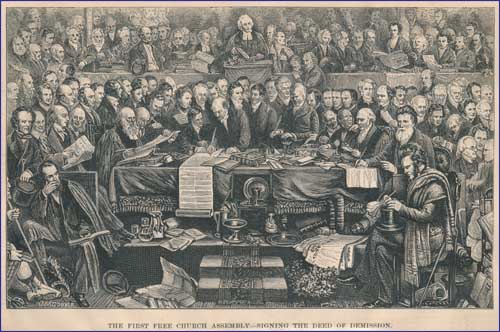
On May 18, 1843, 121 ministers and 73 elders walked out of the General Assembly at the Church of St. Andrews on George Street, Edinburgh, to form the Free Church of Scotland. Rev. Thomas Chalmers was elected to be the first Moderator of the new denomination. Eventually 475 ministers representing one-third of her clergy was joined be one-third of her members in separation from  the Church of Scotland.

FreeChurchOfScotland_Signing_the_Deed_of_Demission_1843

The First Free Church Assembly—Signing the Deed of Demission.

Since the Church of Scotland was financially supported by the government, the ministers and members who left were without salaries, pulpits, manses, and the people, their church buildings. It was very much a “let goods and kindred’s go” type of separation. To solve the immediate problem of finances, Moderator Chalmers instituted a plan for a penny a week from every member to help the new church and its ministers. From this modest beginning, other monies were raised from Scotland and churches overseas to support the need of its clergy and the buildings necessary for ministry.

Fast forward 85 years, after the Church of Scotland had dropped its link to the state and even the issue of patronage was resolved, the two churches re-united in 1929. Not every pastor and people rejoined however, as there continues to be a Free Church of Scotland in the nation.

Words to Live By: Fast forward another century in your mind, dear reader, to 2013, when the General Assembly voted to allow homosexual clergy within its ministerial ranks. It is obvious by this action that another Protestant Reformation is needed again.  Let  us pray to that end.

Image source: Frontispiece portrait for Annals of the Disruption, by Rev. Thomas Brown. Edinburgh: MacNiven & Wallace, 1884.