Reformed Churchmen

We are Confessional Calvinists and a Prayer Book Church-people. In 2012, we remembered the 350th anniversary of the 1662 Book of Common Prayer; also, we remembered the 450th anniversary of John Jewel's sober, scholarly, and Reformed "An Apology of the Church of England." In 2013, we remembered the publication of the "Heidelberg Catechism" and the influence of Reformed theologians in England, including Heinrich Bullinger's Decades. For 2014: Tyndale's NT translation. For 2015, John Roger, Rowland Taylor and Bishop John Hooper's martyrdom, burned at the stakes. Books of the month. December 2014: Alan Jacob's "Book of Common Prayer" at: http://www.amazon.com/Book-Common-Prayer-Biography-Religious/dp/0691154813/ref=sr_1_1?ie=UTF8&qid=1417814005&sr=8-1&keywords=jacobs+book+of+common+prayer. January 2015: A.F. Pollard's "Thomas Cranmer and the English Reformation: 1489-1556" at: http://www.amazon.com/Thomas-Cranmer-English-Reformation-1489-1556/dp/1592448658/ref=sr_1_1?ie=UTF8&qid=1420055574&sr=8-1&keywords=A.F.+Pollard+Cranmer. February 2015: Jaspar Ridley's "Thomas Cranmer" at: http://www.amazon.com/Thomas-Cranmer-Jasper-Ridley/dp/0198212879/ref=sr_1_1?ie=UTF8&qid=1422892154&sr=8-1&keywords=jasper+ridley+cranmer&pebp=1422892151110&peasin=198212879

Friday, October 31, 2014

31 October 2014 A.D. 497th Reformation Day Governing About 25% of Church History—Remembering Reformation Day


31 October 2014 A.D.  497th Reformation Day Governing About 25% of Church History—Remembering Reformation Day

Archivist. “October 31: Reformation Day.”  This Day in Presbyterian History.  31 Oct 2014.  http://www.thisday.pcahistory.org/2014/10/october-31/.  Accessed 31 Oct 2014.

October 31: Reformation Day


Remembering October 31

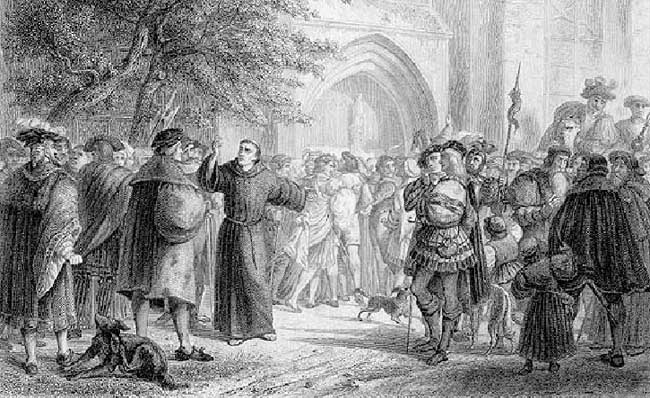
It is my earnest hope that no reader is going to wonder why this writer wants them to remember Halloween!  October 31st, and specifically October 31, 1517, is the date of the beginning of the Protestant Reformation.  On this date, an obscure Augustinian monk by the name of Martin Luther nailed ninety-five theses to the church door in Wittenburg, because that was the usual custom of advertisement for the people’s attention.  It was the twenty-first century bulletin board.   Luther nailed them up at noon sharp because it was the time of the most frequent feasts.  Professors, students, and the common people would be coming from all four corners to the church, which was filled up with relics for transfers of credit.

A lot of Protestants, while  hearing of this incident of the nailing of ninety-five theses, think that they were ringing endorsements of Protestant theology.  In reality, they were more Roman  Catholic than Protestant.  There is no protest against the Pope and the Roman Catholic church, or any of  her doctrines, not even against indulgences.  They were silent about justification by faith alone.   They were primarily opposed to the abuse of indulgences.

But while the form is Romish, the spirit and aim is Protestant.  They represent a state of transition between twilight and daylight.  We must read between the lines, as the leaders of the Roman Catholic church did in the sixteenth century.  As they did, they saw a logical drift which sought to undermine the whole fabric of Romanism.

Luther hoped that there would be a scholarly debate of the abuse of indulgences.  But no one came to debate him.  Instead, with the recent invention of the printing press, the copies of the ninety-five theses were sent all over the empire.  The pope  had a copy within two weeks.  The common people read them and rejoiced over them.  Luther was the talk of Germany.  There was a trumpet call being sounded for what later on became   the Protestant Reformation.

Words to live by: In less than five years, in 2017,  we will celebrate the five-hundredeth anniversary of the Protestant Reformation. Will there be a revival of its themes in your church and more important, in your heart, such as  Scripture alone, Christ alone, Grace Alone, Faith Alone, and Only to the Glory of God?  That sums up what Luther, and Calvin, and Knox thundered to the masses and the visible  church.  Reflect on  the story of Martin Luther and the Protestant Reformation in your heart, home, and  church.

What better reason for remembering this day. No, not Halloween. Rather, October 31st, and specifically October 31, 1517, as it marks the date of the beginning of the Protestant Reformation.  On this date, an obscure Augustinian monk by the name of Martin Luther nailed ninety-five theses to the church door in Wittenburg, because that was the usual custom of advertisement for the people’s attention.  It was in effect a public bulletin board. Luther nailed the document up at noon sharp because that was the time of the most frequent feasts.  Professors, students, and the common people would be coming from all four corners to the church on “All Saints Day,” for that was a time when it was filled up with relics for transfers of credit or “merit” under the Roman Catholic system.

A lot of Protestants, when hearing of this incident of the nailing of ninety-five theses, think that they were ringing endorsements of Protestant theology.  In reality, they were more Roman Catholic than Protestant.  There is no protest against the Pope and the Roman Catholic church, or any of her doctrines, not even against indulgences. These theses were silent about justification by faith alone.  They were primarily opposed to the abuse of indulgences.

But while the form is Romish, the spirit and aim is Protestant. They represent a state of transition between twilight and daylight. We must read between the lines, as the leaders of the Roman Catholic church did in the sixteenth century. As they did, they saw a logical drift which sought to undermine the whole fabric of Romanism.

Luther hoped that there would be a scholarly debate of the abuse of indulgences. But no one came to debate him. Instead, with the recent invention of the printing press, the copies of the ninety-five theses were sent all over the empire. The pope had a copy within two weeks. The common people read them and rejoiced over them. Luther was the talk of Germany. His ninety-five theses had gone viral! There was a trumpet call being sounded for what later on became the Protestant Reformation.
Words to live by: In less than five years, in 2017, we will celebrate the five-hundredeth anniversary of the Protestant Reformation. Will there be a revival of its themes in your church and more important, in your heart, such as Scripture alone,Christ alonegrace alonefaith alone, and glory to God alone? That sums up what Luther, and Calvin, and Knox thundered to the masses and the visible  church. Reflect on the story of Martin Luther and the Protestant Reformation in your heart, home, and church.

31 October 2014 A.D. 497th Reformation Day: Peter Vermigli & Rome as Lost Cause


31 October 2014 A.D.  497th Reformation Day: Peter Vermigli & Rome as Lost Cause

Littlejohn, Bradford. “The Road Not Taken:  Peter Martyr Vermigli and the Lost Cause of Catholic Reform.”  Reformation21.  Oct 2014.  http://www.reformation21.org/articles/the-road-not-taken-peter-martyr-vermigli-and-the-lost-cause-of-catholic-reform.php.  Accessed 30 Oct 2014.

The Road Not Taken: Peter Martyr Vermigli and the Lost Cause of Catholic Reform

Article by W. Bradford Littlejohn  October 2014

As we commemorate the 497th anniversary of the Reformation this week, those who stop to think about the anniversary (too few of us, no doubt) will probably either celebrate it as the birthday of the Protestant churches, or lament it as the beginning of the great schism that still divides the western church today. We will think of such revolutionary figures as Luther and Calvin, men iconoclastic and charismatic enough to have whole traditions named after them. This way of thinking about the Reformation, though, is liable to blind us to its most significant feature: it was a reform movement, an attempt to purify and heal the Catholic Church of its corruptions. Had events played out a bit differently, the Reformation might have been exactly what its name implies, rather than a lasting schism or the birth of a new family of churches. With contemporary ecumenical zeal finally taking hold of conservative Reformed churches, and Protestant-Catholic dialogue becoming an ever more prominent fixture of the ecclesiastical landscape, it is worth pausing to remember this road not taken, the road of Catholic reform, and reflecting briefly on the causes of its failure.

The peripatetic figure of Peter Martyr Vermigli, the Italian reformer who found himself successively in Lucca, Zurich, Strasbourg, Oxford, and then Strasbourgh and Zurich again, may serve as a useful reference point for this little-known side of the Reformation. Vermigli was born in Florence in 1499, when the ashes of Savonarola had scarcely cooled and Michelangelo was just beginning work on his David. Entering the Augustinian order in 1514 and the University of Padua in 1518, Vermigli soon acquired a reputation for piety, preaching, and phenomenal erudition. In Padua he formed a friendship with a student a few months his junior, a like-minded humanist from England by the name of Reginald Pole, one of the most fascinating and enigmatic figures of the Reformation. Given Pole's support for church reform and his closeness to the English royal family, Henry VIII repeatedly sought his support for his divorce from Catherine of Aragon and eventual break with Rome, but Pole enraged Henry by refusing to endorse these shocking moves. 

Meanwhile, however, both Pole and Vermigli had found themselves in an ever-widening circle of priests, scholars, and devout laymen committed to the cause of church reform in Italy. This movement sought a revival of lay spirituality and devotion, focusing as Luther had on the believer's direct access to Christ without legalistic intermediaries, and also on the renewed reading of Scripture, and like Luther campaigned for the abolition of abuses among the corrupt church hierarchy. Vermigli, was at the heart of this reforming network as he found himself promoted through a series of posts in Italy to become one of the highest-ranking officers of the Augustinian order. Though not directly exposed to the writings of the Protestant reformers until around 1537, from what we can tell, Vermigli had independently arrived at many of their same theological insights through his study of St. Augustine, the favorite church Father of many Protestant Reformers. In particular, he and his friend Gasparo Contarini were fleshing out a doctrine of justification by faith not far from that being taught by Luther and Melanchthon. 

The years 1536-37 were pivotal for the Italian reform movement. Vermigli was appointed consultant to a papal commisison on church reform, alongside his friends, both newly-made cardinals, Reginald Pole and Contarini, and other leading reformist Italian churchmen, Jacopo Sadoleto and Giovanni Carafa, likewise newly-appointed cardinals. The different paths of these five men symbolize the very different directions that the internal Roman reform movement soon took. Pole remained a loyal though uncomfortable son of the Catholic church, seeking to carve out space for moderates and reformists and favoring a more lenient policy toward Protestants, at least until the end of his life, when he would preside--just how willingly we are not quite sure--over Bloody Mary's attempt to extinguish the English Protestant church. Sadoleto became a committed apologist of the Catholic church, seeking to win Protestants back by persuasive writing; his most famous attempt was a letter to the people of Geneva in 1539, which provoked one of the classics of Protestant polemic, John Calvin's Reply to Sadoleto. Carafa, on the other hand, who had always harbored a fierce ascetic and disciplinary streak, concluded that the corrupting influence of Protestantizing doctrine was even worse than the corrupt lives of the clergy, and became the architect of the uncompromising Counter-Reformation. In 1542 Carafa launched the merciless Roman Inquisition, over which he presided for the next thirteen years as cardinal and then in 1555 as Pope Paul IV. 

The catalyst for Carafa's crackdown was the actions of the two most evangelical members of this quintet, Contarini and Vermigli. In 1541, Contarini was appointed as the head of the Catholic delegation to the Colloquy of Regensburg (or Ratisbon), by which the Holy Roman Emperor Charles V sought to reconcile the rival Catholic and Lutheran parties and thus stabilize his realm. The Protestant delegation was led by Luther's sidekick Philipp Melanchthon, and the Strasbourg reformer Martin Bucer; both had a reputation, unlike Luther himself, for valuing peace and seeking compromise whenever it could reasonably be achieved. Contarini was a man of similar disposition, and he had initially intended Vermigli to join him at the gathering, though this did not transpire, and the other members of his delegation were less irenic. Despite profound differences, however, the two parties came tantalizingly close to agreement on the central issue of justification, even signing off on a joint statement, though not one that would satisfy Luther. But even before Luther had rejected it as too ambiguous, however, the formula, and the Colloquy, were doomed. 

The Pope and his advisors angrily rejected articles that Contarini sent to them, and insisted that these matters could only be settled by a general council presided over by the Pope--which was to materialize as the Council of Trent five years later. Contarini was recalled to Italy, stopping to confer with his friend Vermigli in Lucca before dying a few months later in disgrace. Within a year, the Italian reform movement was scattered to the winds as the Inquisition got underway; Vermigli and many of his students openly declared for Protestantism and fled north, while Pole tried to shelter his fellow moderate reformists from the wrath of Carafa. Pole had one more opportunity to change the direction of the Roman church, coming within one vote of being elected pope in 1549. To avoid conflict, however, he withdrew his name and the hardliners gained control; by Carafa's death in 1559, almost the last vestiges of evangelical reform in Italy had been stamped out, and the Council of Trent had decisively turned its back on reconciliation with the Protestants.

One more tantalizing opportunity was to present itself in 1561, however, and Vermigli once again was involved, after an illustrious career through the Protestant centers of northern Europe. In France, a nation that, while devout, had always harbored something of an independent streak vis-à-vis the Papacy, the Queen Mother Catherine de' Medici, de facto ruler as regent of her ten-year-old son, was seeking to steer a middle course between the Huguenot and Catholic nobility vying for influence. Ignoring the decrees of Trent and the remonstrances of the papacy, Catherine determined to call a national church council, the Colloquy of Poissy, in 1561. Theodore Beza headed the Protestant delegation and was joined by Vermigli, whose Florentine background, it was hoped, would help influence the Queen. 

After inconclusive opening sessions, leading members of both Catholic and Protestant delegations convened a private conference before the Queen, where, after a couple weeks of arguments they were able to produce a statement on the divisive issue of the Eucharist that while completely satisfying no one, was cautiously accepted by all.  Unfortunately, as at Regensburg, once the formula was shared with the other Catholic prelates, it was angrily rejected and the Catholic negotiators disgraced.  The Colloquy broke up without resolution, and not long afterward, France spiralled into religious civil war.

What can we learn from these episodes (besides the realization that the Reformation was a much more complex and unpredictable affair than we might have previously imagined)?  Perhaps the clearest lesson of Regensburg, Poissy, and the failure of evangelical reform to capture the heart of the Roman church, is that while certainly embracing all opportunities for meaningful fraternal dialogue, we need to maintain a healthy skepticism about the apparent contemporary rapprochement between Protestantism and Rome.  We have seen our own version of Regensburg in the Joint Declaration on Justification--aside from the ambiguities of the formula, which would no doubt have vexed Luther, the fact remains that reconciliation remains contingent on the good pleasure of the magisterium, which reserves full right to determine the boundaries of doctrine. Progress on the material principle of the Reformation is all well and good, but remains fragile indeed so long as the formal principle, sola Scriptura, is rejected.  

Likewise, recent Protestant recovery of a robust sacramentology has held out the hope of at last transcending the great divide on transubstantiation. George Hunsinger's acclaimed exposition of Calvinist eucharistic theology toward this end, Eucharist and Ecumenism, might be considered the modern equivalent of the Reformed formula at Poissy. But whatever individual Catholic sympathizers Hunsinger may have found, the Catholic Church as a whole is not about to rewrite their catechism on the issue. Protestants, especially in America, have been cheered by the appearance of modern-day Contarinis, Catholic leaders keen to dialogue with and learn from Protestants. We should welcome such opportunities, but with a sunny cynicism. We may find that if we keep on talking and studying Scripture and tradition, we will find common ground with some on justification, the sacraments, and more. But as long as the magisterium claims (as it certainly still does!) final authority to determine the shape of that common ground, the ecumenical bridge remains suspended over a chasm little narrower than the chasm that swallowed Contarini nearly five hundred years ago. In the end, our model must be a man like Vermigli--eager to seek reform from within a corrupt institution as long as he had reasonable opportunity to do so, but not hesitant to shake the dust from his feet and preach the pure gospel when faced with the choice of submission to man or to God.

Brad Littlejohn holds a Ph.D from the University of Edinburgh and is the Managing Editor of Political Theology Today, the General Editor of The Mercersburg Theology Study Series and can be found writing regularly at bradlittlejohn.com

31 October 2014 A.D. What is Reformation Day All About?


31 October 2014 A.D.  What is Reformation Day All About?

Before citing the article, we are also reminded of All Saints’ Day, 1 Nov, appropriately remembered by the hymn “For All the Saints.”


Rothwell, Robert. “What is Reformation Day All About?”  Ligonier Ministries. 29 Oct 2014.  http://www.ligonier.org/blog/what-reformation-day-all-about/?utm_source=feedblitz&utm_medium=FeedBlitzRss&utm_campaign=ligonierministriesblog.  Accessed 29 Oct 2014.

What Is Reformation Day All About?


On Friday, much of the culture will be focused on candy and things that go bump in the night. Protestants, however, have something far more significant to celebrate on October 31. Friday is Reformation day, which commemorates what was perhaps the greatest move of God’s Spirit since the days of the Apostles. But what is the significance of Reformation Day, and how should we consider the events it commemorates?

At the time, few would have suspected that the sound of a hammer striking the castle church door in Wittenberg, Germany, would soon be heard around the world and lead ultimately to the greatest transformation of Western society since the apostles first preached the Gospel throughout the Roman empire. Martin Luther’s nailing of his ninety-five theses to the church door on October 31, 1517, provoked a debate that culminated finally in what we now call the Protestant Reformation.

An heir of Bishop Augustine of Hippo, Martin Luther is one of the most significant figures God has raised up since that time. This law student turned Augustinian monk became the center of a great controversy after his theses were copied and distributed throughout Europe. Initially protesting the pope’s attempt to sell salvation, Luther’s study of Scripture soon led him to oppose the church of Rome on issues including the primacy of the Bible over church tradition and the means by which we are found righteous in the sight of God.

This last issue is probably Luther’s most significant contribution to Christian theology. Though preached clearly in the New Testament and found in the writings of many of the church fathers, the medieval bishops and priests had largely forgotten the truth that our own good works can by no means merit God’s favor. Salvation is by grace alone through faith alone, and good works result from our faith, they are not added to it as the grounds for our right standing in the Lord’s eyes (Eph. 2:8-10). Justification, God’s declaration that we are not guilty, forgiven of sin, and righteous in His sight comes because through our faith alone the Father imputes, or reckons to our account, the perfect righteousness of Christ (2 Cor. 5:21).

Martin Luther’s rediscovery of this truth led to a whole host of other church and societal reforms and much of what we take for granted in the West would have likely been impossible had he never graced the scene. Luther’s translation of the Bible into German put the Word of God in the hands of the people, and today Scripture is available in the vernacular language of many countries, enabling lay people to study it with profit. He reformed the Latin mass by putting the liturgy in the common tongue so that non-scholars could hear and understand the preached word of God and worship the Lord with clarity. Luther lifted the unbiblical ban on marriage for the clergy and by his own teaching and example radically transformed the institution itself. He recaptured the biblical view of the priesthood of all believers, showing all people that their work had purpose and dignity because in it they can serve their Creator.
Today, Luther’s legacy lives on in the creeds and confessions of Protestant bodies worldwide. As we consider his importance this Reformation Day, let us equip ourselves to be knowledgeable proclaimers and defenders of biblical truth. May we be eager to preach the Gospel of God to the world and thereby spark a new reformation of church and culture.

31 October 2014 A.D. Reformation Day—The Thirty-nine Articles (ONLINE RESOURCES)


31 October 2014 A.D.  Reformation Day—The Thirty-nine Articles (ONLINE RESOURCES)

No author.  “The Thirty Nine Articles.”  Church Society.  N.d. http://www.churchsociety.org/issues_new/doctrine/39a/iss_doctrine_39a_intro.asp.  Accessed 28 Oct 2014.

Issues | Doctrine | The Thirty Nine Articles

Officially the Church of England accepts the full and final authority of Holy Scripture as the basis for all that it believes. Some of these beliefs were summarised in the historic creeds, and at the time of the Reformation the Church adopted the Thirty-Nine Articles of Religion as giving a concise and systematic statement of the teaching of Scripture.
 
Background        
 
The legal definition of the Doctrine of the Church of England can be found in the Church of England (Worship and Doctrine) Measure 1974 which accords with what is also stated in Canon A5.
 
These state clearly that the doctrine of the Church of England is particularly to be found in the Thirty-nine Articles of Religion, the Book of Common Prayer and the Ordinal.
Ministers of the Church of England are still required to affirm their acceptance of the Church's doctrine but the wording of the declaration is now such that many feel able to say it without meaning what a simple reading might suggest.  See the declarations below.
All members of Church Society are required to declare that they uphold the Thirty-Nine Articles of Religion 'and contend for them'.

Further pages and information on The 39 Articles

The Origin of the Thirty-nine Articles. Churchman article by Mark D. Thompson (2011).
A History of Subscription to the Thirty-nine Articles. Churchman article by Mark D. Thompson ( 2011).
The Purpose and Function of the Thirty-Nine Articles. Churchman article by G. W. Bromiley (1959)
Donald Allister in a series of Articles in Cross†Way examines why the 39 Articles are still important today.
The Doctrine of the Sacraments in the Thirty-Nine Articles. Churchman article (1991) by Roger Beckwith.
Churchman Article : Recovering Confessional Anglicanism. Gillis Harp discusses how best to apply the 39 Articles in today's church after years of neglect and misinterpretation. (Churchman 116/3) (PDF file)
 
Text of Articles and some explanation.
The official text is that to be found in the 1662 Book of Common Prayer.  A modern rendering, to be found in An English Prayer Book is also provided although this has no official standing.
The Articles cover the Doctrine of God and the human response to God's grace.
Articles 1-5 (The substance of faith)
Articles 6-8 (The rule of faith)
Articles 9-18 (Personal religion)
Articles 9-14(Doctrines connected with justification)
Articles 15-18 (Doctrines connected with sanctification)
Articles 19-39 (The Household of faith)
Articles 19-22 (The Church)
Articles 23 & 24 (The Ministry)
Articles 25-31 (The Sacraments)
Articles 32-36 (Church Discipline)
Articles 37-39 (Church and State)
Church Society sells printed versions of the Articles and a classic and substantial work on the Articles by W H Griffith-Thomas - The Principles of Theology.  See the Publications page for details. Click here for J. I. Packer's preface to The Principles of Theology.
The Text of the 39 Articles (including the modern rendering) can also be downloaded.

Extracts from the Declaration of
His Majesty King Charles I
...the Articles of the Church of England... do contain the true doctrine of the Church of England agreeable to God's Word... no man hereafter shall either print, or preach, to draw the Article aside any way, but shall submit to it in the plain and full meaning thereof: and shall not put his own sense or comment to the meaning of the Article, but shall take it in the literal and grammatical sense.

The Canons of the Church of England
THE DOCTRINE OF THE CHURCH OF ENGLAND
Canon A5  and the wording of Section 5(1) of the Worship and Doctrine Measure 1974
The doctrine of the Church of England is grounded in the Holy Scriptures, and in such teachings of the ancient Fathers and Councils of the Church as are agreeable to the said Scriptures.
In particular such doctrine is to be found in the Thirty-nine Articles of Religion, the Book of Common Prayer, and the Ordinal.
 
CANON C15 OF THE DECLARATION OF ASSENT
1(1) The Declaration of Assent to be made under this Canon shall be in the form set out below:
PREFACE
The Church of England is part of the One, Holy, Catholic and Apostolic Church worshipping the one true God, Father, Son and Holy Spirit. It professes the faith uniquely revealed in the Holy Scriptures and set forth in the catholic creeds, which faith the Church is called upon to proclaim afresh in each generation. Led by the Holy Spirit, it has borne witness to Christian truth in its historic formularies, the Thirty-nine Articles of Religion, the Book of Common Prayer and the Ordering of Bishops, Priests and Deacons. In the declaration you are about to make will you affirm your loyalty to this inheritance of faith as your inspiration and guidance under God in bringing the grace and truth of Christ to this generation and making Him known to those in your care?
DECLARATION OF ASSENT
I A B, do so affirm, and accordingly declare my belief in the faith which is revealed in the Holy Scriptures and set forth in the catholic creeds and to which the historic formularies of the Church of England bear witness; and in public prayer and administration of the sacraments, I will use only the forms of service which are authorised or allowed by Canon.

31 October 2014 A.D. Countdown: Reformation Day: Remembering the Reformation


31 October 2014 A.D.  Countdown: Reformation Day:  Remembering the Reformation

Mathison, Keith.  “Remembering the Reformation.”  Ligonier Ministries.  N.d.  http://www.ligonier.org/learn/articles/remembering-reformation/.  Accessed 3 Oct 2014. 

Remembering the Reformation


Does the Protestant Reformation still matter? If so, why? These are important questions, especially in our day and age, because for many living today in the twenty-first century, what is important is not the past, but the future. We live at an unusual time in history. In terms of technology, the world has changed faster in the last one hundred years than it did in the previous two thousand years combined. This has affected us in many ways. Our generation no longer looks to the wisdom of the past for guidance; instead, we look for the next new invention. History is “yesterday’s news.” What matters is tomorrow.

Sadly, the same way of thinking has influenced Christians. We look at church history with a jaundiced eye, finding it boring or irrelevant, but we must understand that this is an unwise approach. God has always called his people to remember his gracious works in the past. Israel was called to remember the exodus. Christians are called to remember the death of Christ. The same principle holds true with the lessons of church history. It has been rightly said that those who do not learn from history are doomed to repeat it. The church simply cannot afford to forget the lessons of the Reformation.

There are hundreds of books on the Reformation, but if one coming to the subject for the first time were looking for the best place to start, he would be hard pressed to find a better introduction than Stephen J. Nichols’ The Reformation (Crossway, 2007). For those who find history difficult, Nichols’ style of writing is a breath of fresh air. He does not fill page after page with dry lists of names and dates. Instead, his gift is the ability to draw readers into the lives of the people about whom he writes, allowing us to see these great historical figures, warts and all.

Nichols’ book features eight short chapters, each containing numerous illustrations. As is the case in many Reformation histories, the chapter topics of Nichols’ book are devoted to the various “branches” of the Reformation. Thus, there are chapters devoted to Luther and the reformation in Germany, Zwingli, the Radical Reformers, Calvin, and the English Reformation. However, unlike some books on the Reformation, Nichols also includes chapters on the Puritans, and on significant women of the Reformation.

In his chapter on Luther, Nichols offers a sketch of the important events that led up to Luther’s break with Rome, but he does not lose sight of Luther the man in all of this. We must remember that the Reformers were not ivory-tower theologians, discussing doctrines in the peace and quiet of a modern academy setting. No, the Reformers did their theology in the trenches, and Luther is no exception. Nichols describes Luther’s personal struggles in a way that helps readers understand more fully not only what Luther did, but why. He also describes Luther’s sense of humor, and his deep love for his wife Katherina. In this way, Nichols helps us to understand that Luther was not a superhuman being. He was a man providentially placed by God in the midst of extraordinary circumstances.

The same style of writing is evident in the remaining chapters of the book. We find the Reformation initiated in Switzerland during a sausage supper in Zurich with a notable young priest named Zwingli present. We discover the origins of the Anabaptists, those Christians whose convictions concerning baptism and the separation of the church and state often resulted in their martyrdom. We encounter the young John Calvin, whose overnight stop in Geneva on his way to Strasbourg ultimately changed his life and the course of church history. We see the Reformation gain a foothold in England as a result of a king’s desire for a male heir. In all of this, we are introduced to a fascinating and diverse cast of characters, from the soul-searching Martin Luther to the soul-selling Johann Tetzel, from the non-compromising John Knox to the pragmatic Thomas Cranmer.

In his chapter on the Puritans, appropriately titled “Men in Black,” Nichols clears away centuries of misrepresentation. He describes the roots of puritanism in the ups and downs of the reformation in England, agreeing with one scholar that puritanism was the “real English Reformation.” In his concluding chapter, Nichols introduces us to some of the unsung women of the Reformation, the wives of the Reformers as well as women who made significant contributions to the Reformation on their own. 

The church must not forget the lessons learned during the Reformation. We cannot forget what happens when the Gospel is obscured and distorted. The Reformation does still matter. Read Stephen Nichols’ book and discover why.  

31 October 1971 A.D. Dr. Gerhard von Rad Passes to the Next World—OT Scholar


31 October 1971 A.D.  Dr. Gerhard von Rad Passes to the Next World—OT Scholar.


Gerhard von Rad (21 October 1901 – 31 October 1971) was a German Lutheran pastor, University professor and an Old Testament scholar.

With the experience of two World Wars, the German-speaking world began to turn "anti-Old Testament". Disturbed by this, Rad turned to the study of the Old Testament and gradually started to bring back its message.[1]

His lively papers achieved a renewal of interest and research in Old Testament studies.[2] Along with Martin Noth, he applied research into the Pentateuch's oral tradition to the explanation of its origin.[3]

Life


Gerhard von Rad was born in Nuremberg, Kingdom of Bavaria, to Lutheran parents,[4] and was educated at the University of Erlangen and at the University of Tübingen.

In 1925 he became a curate in the Lutheran Landeskirche (i.e. the church in the federal state) of Bavaria.[5]

Later, he taught at the University of Erlangen in 1929 as tutor. In 1930 he was a privatdozent at the University of Leipzig.[5]

From 1934 to 1945 he served as a professor at the University of Jena and later at the University of Göttingen from 1945 to 1949.[6]

After that, he became Professor of Old Testament at the Ruprecht Karl University of Heidelberg in the state of Baden-Württemberg and taught there until his death in 1971.[5]

He was conferred honorary doctorates from the University of Lund, Sweden and the University of Wales, United Kingdom.[7]

Death


Gerhard von Rad's grave

Gerhard von Rad and his wife are buried in Heidelberg's "Handschusheim Cemetery".  On their gravestone is minimalist artwork depicting Jonah emerging from the great fish, an Old Testament symbol of resurrection.

Oral tradition and the Pentateuch


Along with Martin Noth, von Rad applied form criticism, originated by Hermann Gunkel, to the documentary hypothesis.[3]


The University of Heidelberg, Heidelberg where Gerhard von Rad taught.

Appraisal by other biblical scholars

Victor Premasagar, a Cambridge tripos and past Principal of the Andhra Christian Theological College, Secunderabad, India in introducing critical methods and tools used in Biblical interpretation writes[8] about von Rad as:

“....a major contributor to Old Testament studies following the literary-critical tradition of Wellhausen and the form-critical and the traditio-historical approach of Hermann Gunkel as developed by Albrecht Alt and Martin Noth.”

Prof. Premasagar concludes by saying that

“…the Bible for von Rad, in the final analysis, is neither history nor literature, but rather the confessions of a community.

Henning Graf Reventlow of Ruhr University, North Rhine-Westphalia, Germany in introducing a book[9] of von Rad makes the following observations:

“...a number of von Rad's innovative papers prepared the way for the blossoming of Old Testament studies in Germany during the first decennia after the Second World War.”

Gerhard Hasel of the Seventh-day Adventist Theological Seminary of Andrews University, Michigan, United States in writing about the approaches to OT studies makes mention about von Rad with the words....,[10]

“A new methodological approach for OT theology, one that deserves to be put in a class by itself, is that of Gerhard von Rad. His OT theology needs to be understood as the theology of the historical and prophetic traditions.”

John H. Hayes, Professor at Candler School of Theology of the Emory University in Atlanta, United States writes about von Rad as...[11]

“In his theology, with its challenge of previous methodologies and with its new proposals, von Rad (1901-71) inaugurated a new epoch in the study of Old Testament theology. He argued against any organization of Old Testament theology along the lines of central concepts, pervasive topics, assumed structures of Israelite thought or world of faith, or systematic theological categories which had been characteristic, in one way or another, of all the theologies of the twentieth century since this was to impose an alien structure on the material.”

G. Henton Davies, past President, Regent's Park College in Oxford University, Oxford, England, writes about Prof. von Rad thus[12]

“Gerhard Von Rad has been a regular contributor to Old Testament studies since 1929, although his main works were published between 1947 and 1960. His major writings include his studies on Deuteronomy; his commentary on Genesis; his two volumes of Theology of the Old Testament and a representative selection of his essays, extending from 1931 through 1964, which were translated and published as The Problem of the Hexateuch and other Essays in 1966, though the bulk of these were written in the late 1940s.”

Bibliography of some of the writings of von Rad


  • The Problem of the Hexateuch and other essays ISBN 0-334-01310-0
  • Genesis: A Commentary (Old Testament Library) ISBN 0-664-20957-2
  • Deuteronomy: A Commentary (Old Testament Library) ISBN 0-664-20734-0
  • Studies in Deuteronomy (Studies in Biblical theology) ASIN B0007JWYNA
  • Old Testament Theology ISBN 0-334-01182-5
  • Old Testament Theology, One-Volume Edition ISBN 1-56563-652-X
  • The Message of the Prophets: Old Testament Theology ISBN 0-334-01005-5
  • Holy War in Ancient Israel ISBN 0-85244-208-4
  • Das Alte Testament Deutsch (ATD), Tlbd.2/4, Das erste Buch Mose, Genesis ISBN 3-525-51112-4 (This textbook series of detailed theological commentaries on individual books of the bible translates as "The Old Testament [in] German"; the volume is on the book of Genesis)
  • God at work in Israel ISBN 0-687-14960-6
  • Biblical interpretations in preaching ISBN 0-687-03444-2
  • Gottes Wirken in Israel: Vorträge zum Alten Testament ISBN 3-7887-0404-7 ("God's acting in Israel: [public] lectures on the Old Testament")
  • Wisdom in Israel ISBN 0-687-45756-4 (translation of the German book below ?)
  • The message of the prophets ASIN B0006C6BA0
  • Weisheit in Israel ASIN B000E1Q3CY ("Wisdom in Israel")
  • Theologie des Alten Testaments (Einführung in die evangelische Theologie) ASIN B0007JBBTI ("Theology of the Old Testament"/ series title: "Introduction into 'evangelisch'[e] theology" ["evangelisch" in German is used in a similar sense as "Protestant" in English, but has other connotations; hence it is not directly translatable; it usually refers to lutheran or closely related faith and theology, or Christians adhering to it)
  • Basileia (Bible Key Words from Gerhard Kittel's Theologisches Wörterbuch zum Neuen Testament) ASIN B000BGT0RW
  • Theologie des Alten Testaments, Bd. 2. ISBN 3-579-05003-6 (vol.2 of the title above)
  • Kaiser Taschenbücher, Bd.1, Theologie des Alten Testaments. Die Theologie der geschichtlichen Überlieferungen Israels. ISBN 3-579-05002-8 ("Kaiser [publisher's name] pocketbooks, vol.1, "Theology of the Old Testament. Theology of the historical tradition of Israel")
  • Das Alte Testament Deutsch (ATD), Tlbd.8 : Das fünfte Buch Mose (Deuteronomium) ISBN 3-525-51136-1 (the volume on the book Deuteronomium of the series mentioned above)
  • Erinnerungen aus der Kriegsgefangenschaft, Frühjahr 1945 ISBN 3-7887-0507-8 ("Memories of a prisoner of war, spring 1945")
  • Predigt-Meditationen ISBN 3-525-60237-5 ("Sermon meditations")
  • Eirene (Pocket crammer series) ASIN B0007FP9LI
  • Origin of the concept of the day of Yahweh ASIN B0007JF2HA
  • From Genesis to Chronicles: Explorations in Old Testament Theology ISBN 0-8006-3718-6 (review)

See also


References


Notes

1.      Jump up ^ Richard R. Soulen, Handbook of Biblical Criticism

2.      Jump up ^ Society for Biblical Literature, Henning Graf Reventlow introduces von Rad's "From Genesis to Chronicles: Explorations in Old Testament Theology"[1]

3.      ^ Jump up to: a b Cross, F. L., ed. The Oxford dictionary of the Christian church. New York: Oxford University Press. 2005

4.      Jump up ^ Laurin, Robert B., Contemporary Old Testament Theologians, Judson Press, Valley Forge, 1970, ISBN 0-8170-0488-2, p.65

5.      ^ Jump up to: a b c Ibid.

6.      Jump up ^ Laurin, Robert B., op. cit. p.66

7.      Jump up ^ von Rad, Gerhard, Wisdom in Israel, SCM Press, London, Fifth Impression, 1985, von Rad dedicates the English version to his colleagues at the University of Lund and at the University of Wales for receiving him into their midst

8.      Jump up ^ Premasagar, Victor, Interpretive Diary of a Bishop - Indian Experience in Translation and Interpretation of some Biblical Passages, The Christian Literature Society, Chennai, August 2001, pp. 8-10

9.      Jump up ^ Society for Biblical Literature, op. cit.

10. Jump up ^ Old Testament Theology: Basic Issues in the Current Debate, William B. Eerdmans Publishing Company, Grand Rapids, Michigan, Revised edition, August 1975, ISBN 0-8028-1478-6, pp. 47-47

11. Jump up ^ Old Testament Theology - Its History and Development, SCM Press Ltd, London, 1985, ISBN 0-334-02231-2, p.233

12. Jump up ^ Laurin, Robert B. op. cit.

Further reading


The July 2008 issue of Interpretation: a Journal of Bible and Theology has as its subject "Gerhard von Rad: Theologian of the Church." See especially:

  • Manfred Oeming, "Gerhard von Rad as a Theologian of the Church" p. 229

  • Martin Hauger, "On the Significance of Preaching in the Theology and Work of Gerhard von Rad" p. 278