Reformed Churchmen

We are Confessional Calvinists and a Prayer Book Church-people. In 2012, we remembered the 350th anniversary of the 1662 Book of Common Prayer; also, we remembered the 450th anniversary of John Jewel's sober, scholarly, and Reformed "An Apology of the Church of England." In 2013, we remembered the publication of the "Heidelberg Catechism" and the influence of Reformed theologians in England, including Heinrich Bullinger's Decades. For 2014: Tyndale's NT translation. For 2015, John Roger, Rowland Taylor and Bishop John Hooper's martyrdom, burned at the stakes. Books of the month. December 2014: Alan Jacob's "Book of Common Prayer" at: http://www.amazon.com/Book-Common-Prayer-Biography-Religious/dp/0691154813/ref=sr_1_1?ie=UTF8&qid=1417814005&sr=8-1&keywords=jacobs+book+of+common+prayer. January 2015: A.F. Pollard's "Thomas Cranmer and the English Reformation: 1489-1556" at: http://www.amazon.com/Thomas-Cranmer-English-Reformation-1489-1556/dp/1592448658/ref=sr_1_1?ie=UTF8&qid=1420055574&sr=8-1&keywords=A.F.+Pollard+Cranmer. February 2015: Jaspar Ridley's "Thomas Cranmer" at: http://www.amazon.com/Thomas-Cranmer-Jasper-Ridley/dp/0198212879/ref=sr_1_1?ie=UTF8&qid=1422892154&sr=8-1&keywords=jasper+ridley+cranmer&pebp=1422892151110&peasin=198212879

Showing posts with label Lord's Supper. Show all posts

Wednesday, May 16, 2012

Heidelberg Catechism, 76-80: Lord's Supper & Popish Mass

The Heidelberg Catechism
As one Dutch Elder once said, “This Catechism is the heart cry from the pew!”Question 76. What is it then to eat the crucified body, and drink the shed blood of Christ?

Answer: It is not only to embrace with believing heart all the sufferings and death of Christ and thereby to obtain the pardon of sin, and life eternal; (a) but also, besides that, to become more and more united to his sacred body, (b) by the Holy Ghost, who dwells both in Christ and in us; so that we, though Christ is in heaven (c) and we on earth, are notwithstanding "flesh of his flesh and bone of his bone" (d) and that we live, and are governed forever by one spirit, (e) as members of the same body are by one soul.

(a) John 6:35 And Jesus said unto them, I am the bread of life: he that cometh to me shall never hunger; and he that believeth on me shall never thirst. John 6:40 And this is the will of him that sent me, that every one which seeth the Son, and believeth on him, may have everlasting life: and I will raise him up at the last day. John 6:47 Verily, verily, I say unto you, He that believeth on me hath everlasting life. John 6:48 I am that bread of life. John 6:49 Your fathers did eat manna in the wilderness, and are dead. John 6:50 This is the bread which cometh down from heaven, that a man may eat thereof, and not die. John 6:51 I am the living bread which came down from heaven: if any man eat of this bread, he shall live for ever: and the bread that I will give is my flesh, which I will give for the life of the world. John 6:52 The Jews therefore strove among themselves, saying, How can this man give us his flesh to eat? John 6:53 Then Jesus said unto them, Verily, verily, I say unto you, Except ye eat the flesh of the Son of man, and drink his blood, ye have no life in you. John 6:54 Whoso eateth my flesh, and drinketh my blood, hath eternal life; and I will raise him up at the last day. (b) John 6:55 For my flesh is meat indeed, and my blood is drink indeed. John 6:56 He that eateth my flesh, and drinketh my blood, dwelleth in me, and I in him. (c) Col.3:1 If ye then be risen with Christ, seek those things which are above, where Christ sitteth on the right hand of God. Acts 3:21 Whom the heaven must receive until the times of restitution of all things, which God hath spoken by the mouth of all his holy prophets since the world began. 1 Cor.11:26 For as often as ye eat this bread, and drink this cup, ye do shew the Lord's death till he come. (d) Eph.3:16 That he would grant you, according to the riches of his glory, to be strengthened with might by his Spirit in the inner man; Eph.5:29 For no man ever yet hated his own flesh; but nourisheth and cherisheth it, even as the Lord the church: Eph.5:30 For we are members of his body, of his flesh, and of his bones. Eph.5:32 This is a great mystery: but I speak concerning Christ and the church. 1 Cor.6:15 Know ye not that your bodies are the members of Christ? shall I then take the members of Christ, and make them the members of an harlot? God forbid. 1 Cor.6:17 But he that is joined unto the Lord is one spirit. 1 Cor.6:19 What? know ye not that your body is the temple of the Holy Ghost which is in you, which ye have of God, and ye are not your own? 1 John 3:24 And he that keepeth his commandments dwelleth in him, and he in him. And hereby we know that he abideth in us, by the Spirit which he hath given us. 1 John 4:13 Hereby know we that we dwell in him, and he in us, because he hath given us of his Spirit. John 14:23 Jesus answered and said unto him, If a man love me, he will keep my words: and my Father will love him, and we will come unto him, and make our abode with him. (e) John 6:56 He that eateth my flesh, and drinketh my blood, dwelleth in me, and I in him. John 6:57 As the living Father hath sent me, and I live by the Father: so he that eateth me, even he shall live by me. John 6:58 This is that bread which came down from heaven: not as your fathers did eat manna, and are dead: he that eateth of this bread shall live for ever. John 15:1 I am the true vine, and my Father is the husbandman. John 15:2 Every branch in me that beareth not fruit he taketh away: and every branch that beareth fruit, he purgeth it, that it may bring forth more fruit. John 15:3 Now ye are clean through the word which I have spoken unto you. John 15:4 Abide in me, and I in you. As the branch cannot bear fruit of itself, except it abide in the vine; no more can ye, except ye abide in me. John 15:5 I am the vine, ye are the branches: He that abideth in me, and I in him, the same bringeth forth much fruit: for without me ye can do nothing. John 15:6 If a man abide not in me, he is cast forth as a branch, and is withered; and men gather them, and cast them into the fire, and they are burned. Eph.4:15 But speaking the truth in love, may grow up into him in all things, which is the head, even Christ: Eph.4:16 From whom the whole body fitly joined together and compacted by that which every joint supplieth, according to the effectual working in the measure of every part, maketh increase of the body unto the edifying of itself in love.

Question 77.  Where has Christ promised that he will as certainly feed and nourish believers with his body and bleed, as they eat of this broken bread, and drink of this cup?

Answer: In the institution of the supper, which is thus expressed: (a) "The Lord Jesus, the same night in which he was betrayed, took bread, and when he had given thanks, he brake it, and: said: eat, this is my body, which is broken for you; this do in remembrance of me. After the same manner also he took the cup, when he had supped, saying: this cup is the new testament in my blood; this do ye, as often as ye drink it, in remembrance of me. For, as often as ye eat this bread, and drink this cup, ye do show the Lord's death till he come." 1 Cor.11:23-26. This promise is repeated by the holy apostle Paul, where he says "The cup of blessing which we bless, is it not the communion of the blood of Christ? The bread which we break, is it not the communion of the body of Christ? For we being many are one bread, and one body: for we are all partakers of that one bread." 1 Cor.10:16,17.

(a) 1 Cor.11:23 For I have received of the Lord that which also I delivered unto you, That the Lord Jesus the same night in which he was betrayed took bread: 1 Cor.11:24 And when he had given thanks, he brake it, and said, Take, eat: this is my body, which is broken for you: this do in remembrance of me. 1 Cor.11:25 After the same manner also he took the cup, when he had supped, saying, This cup is the new testament in my blood: this do ye, as oft as ye drink it, in remembrance of me. Matt.26:26 And as they were eating, Jesus took bread, and blessed it, and brake it, and gave it to the disciples, and said, Take, eat; this is my body. Matt.26:27 And he took the cup, and gave thanks, and gave it to them, saying, Drink ye all of it; Matt.26:28 For this is my blood of the new testament, which is shed for many for the remission of sins. Mark 14:22 And as they did eat, Jesus took bread, and blessed, and brake it, and gave to them, and said, Take, eat: this is my body. Mark 14:23 And he took the cup, and when he had given thanks, he gave it to them: and they all drank of it. Mark 14:24 And he said unto them, This is my blood of the new testament, which is shed for many. Luke 22:19 And he took bread, and gave thanks, and brake it, and gave unto them, saying, This is my body which is given for you: this do in remembrance of me. Luke 22:20 Likewise also the cup after supper, saying, This cup is the new testament in my blood, which is shed for you. 1 Cor.10:16 The cup of blessing which we bless, is it not the communion of the blood of Christ? The bread which we break, is it not the communion of the body of Christ? 1 Cor.10:17 For we being many are one bread, and one body: for we are all partakers of that one bread.

29. Lord's Day

Question 78.  Do then the bread and wine become the very body and blood of Christ?

Answer: Not at all: (a) but as the water in baptism is not changed into the blood of Christ, neither is the washing away of sin itself, being only the sign and confirmation thereof appointed of God; (b) so the bread in the Lord's supper is not changed into the very body of Christ; (c) though agreeably to the nature and properties of sacraments, (d) it is called the body of Christ Jesus.

(a) Matt.26:29 But I say unto you, I will not drink henceforth of this fruit of the vine, until that day when I drink it new with you in my Father's kingdom. (b) Eph.5:26 That he might sanctify and cleanse it with the washing of water by the word, Tit.3:5 Not by works of righteousness which we have done, but according to his mercy he saved us, by the washing of regeneration, and renewing of the Holy Ghost; (c) Mark 14:24 And he said unto them, This is my blood of the new testament, which is shed for many. 1 Cor.10:16 The cup of blessing which we bless, is it not the communion of the blood of Christ? The bread which we break, is it not the communion of the body of Christ? 1 Cor.10:17 For we being many are one bread, and one body: for we are all partakers of that one bread. 1 Cor.11:26 For as often as ye eat this bread, and drink this cup, ye do shew the Lord's death till he come. 1 Cor.11:27 Wherefore whosoever shall eat this bread, and drink this cup of the Lord, unworthily, shall be guilty of the body and blood of the Lord. 1 Cor.11:28 But let a man examine himself, and so let him eat of that bread, and drink of that cup. (d) Gen.17:10 This is my covenant, which ye shall keep, between me and you and thy seed after thee; Every man child among you shall be circumcised. Gen.17:11 And ye shall circumcise the flesh of your foreskin; and it shall be a token of the covenant betwixt me and you. Gen.17:14 And the uncircumcised man child whose flesh of his foreskin is not circumcised, that soul shall be cut off from his people; he hath broken my covenant. Gen.17:19 And God said, Sarah thy wife shall bear thee a son indeed; and thou shalt call his name Isaac: and I will establish my covenant with him for an everlasting covenant, and with his seed after him. Exod.12:11 And thus shall ye eat it; with your loins girded, your shoes on your feet, and your staff in your hand; and ye shall eat it in haste: it is the LORD'S passover. Exod.12:13 And the blood shall be to you for a token upon the houses where ye are: and when I see the blood, I will pass over you, and the plague shall not be upon you to destroy you, when I smite the land of Egypt. Exod.12:27 That ye shall say, It is the sacrifice of the LORD'S passover, who passed over the houses of the children of Israel in Egypt, when he smote the Egyptians, and delivered our houses. And the people bowed the head and worshipped. Exod.12:43 And the LORD said unto Moses and Aaron, This is the ordinance of the passover: There shall no stranger eat thereof: Exod.12:48 And when a stranger shall sojourn with thee, and will keep the passover to the LORD, let all his males be circumcised, and then let him come near and keep it; and he shall be as one that is born in the land: for no uncircumcised person shall eat thereof. Exod.13:9 And it shall be for a sign unto thee upon thine hand, and for a memorial between thine eyes, that the LORD'S law may be in thy mouth: for with a strong hand hath the LORD brought thee out of Egypt. 1 Pet.3:21 The like figure whereunto even baptism doth also now save us (not the putting away of the filth of the flesh, but the answer of a good conscience toward God,) by the resurrection of Jesus Christ: 1 Cor.10:1 Moreover, brethren, I would not that ye should be ignorant, how that all our fathers were under the cloud, and all passed through the sea; 1 Cor.10:2 And were all baptized unto Moses in the cloud and in the sea; 1 Cor.10:3 And did all eat the same spiritual meat; 1 Cor.10:4 And did all drink the same spiritual drink: for they drank of that spiritual Rock that followed them: and that Rock was Christ.

Question 79.  Why then doth Christ call the bread "his body", and the cup "his blood", or "the new covenant in his blood"; and Paul the "communion of body and blood of Christ"?

Answer: Christ speaks thus, not without great reason, namely, not only thereby to teach us, that as bread and wine support this temporal life, so his crucified body and shed blood are the true meat and drink, whereby our souls are fed to eternal life; (a) but more especially by these visible signs and pledges to assure us, that we are as really partakers of his true body and blood by the operation of the Holy Ghost as we receive by the mouths of our bodies these holy signs in remembrance of him; (b) and that all his sufferings and obedience are as certainly ours, as if we had in our own persons suffered and made satisfaction for our sins to God.

(a) John 6:51 I am the living bread which came down from heaven: if any man eat of this bread, he shall live for ever: and the bread that I will give is my flesh, which I will give for the life of the world. John 6:55 For my flesh is meat indeed, and my blood is drink indeed. (b) 1 Cor.10:16 The cup of blessing which we bless, is it not the communion of the blood of Christ? The bread which we break, is it not the communion of the body of Christ? 1 Cor.10:17 For we being many are one bread, and one body: for we are all partakers of that one bread.

30. Lord's Day

Question 80.  What difference is there between the Lord's supper and the popish mass?

Answer: The Lord's supper testifies to us, that we have a full pardon of all sin by the only sacrifice of Jesus Christ, which he himself has once accomplished on the cross; (a) and, that we by the Holy Ghost are ingrafted into Christ, (b) who, according to his human nature is now not on earth, but in heaven, at the right hand of God his Father, (c) and will there be worshipped by us. (d) But the mass teaches, that the living and dead have not the pardon of sins through the sufferings of Christ, unless Christ is also daily offered for them by the priests; and further, that Christ is bodily under the form of bread and wine, and therefore is to be worshipped in them; so that the mass, at bottom, is nothing else than a denial of the one sacrifice and sufferings of Jesus Christ, and an accursed idolatry. (e)

(a) Heb.7:27 Who needeth not daily, as those high priests, to offer up sacrifice, first for his own sins, and then for the people's: for this he did once, when he offered up himself. Heb.9:12 Neither by the blood of goats and calves, but by his own blood he entered in once into the holy place, having obtained eternal redemption for us. Heb.9:25 Nor yet that he should offer himself often, as the high priest entereth into the holy place every year with blood of others; Heb.9:26 For then must he often have suffered since the foundation of the world: but now once in the end of the world hath he appeared to put away sin by the sacrifice of himself. Heb.9:27 And as it is appointed unto men once to die, but after this the judgment: Heb.9:28 So Christ was once offered to bear the sins of many; and unto them that look for him shall he appear the second time without sin unto salvation. Heb.10:10 By the which will we are sanctified through the offering of the body of Jesus Christ once for all. Heb.10:12 But this man, after he had offered one sacrifice for sins for ever, sat down on the right hand of God; Heb.10:13 From henceforth expecting till his enemies be made his footstool. Heb.10:14 For by one offering he hath perfected for ever them that are sanctified. John 19:30 When Jesus therefore had received the vinegar, he said, It is finished: and he bowed his head, and gave up the ghost. Matt.26:28 For this is my blood of the new testament, which is shed for many for the remission of sins. Luke 22:19 And he took bread, and gave thanks, and brake it, and gave unto them, saying, This is my body which is given for you: this do in remembrance of me. Luke 22:20 Likewise also the cup after supper, saying, This cup is the new testament in my blood, which is shed for you. (b) 1 Cor.6:17 But he that is joined unto the Lord is one spirit. 1 Cor.10:16 The cup of blessing which we bless, is it not the communion of the blood of Christ? The bread which we break, is it not the communion of the body of Christ? (c) Heb.1:3 Who being the brightness of his glory, and the express image of his person, and upholding all things by the word of his power, when he had by himself purged our sins, sat down on the right hand of the Majesty on high; Heb.8:1 Now of the things which we have spoken this is the sum: We have such an high priest, who is set on the right hand of the throne of the Majesty in the heavens; Heb.8:2 A minister of the sanctuary, and of the true tabernacle, which the Lord pitched, and not man. John 20:17 Jesus saith unto her, Touch me not; for I am not yet ascended to my Father: but go to my brethren, and say unto them, I ascend unto my Father, and your Father; and to my God, and your God. (d) Matt.6:20 But lay up for yourselves treasures in heaven, where neither moth nor rust doth corrupt, and where thieves do not break through nor steal: Matt.6:21 For where your treasure is, there will your heart be also. John 4:21 Jesus saith unto her, Woman, believe me, the hour cometh, when ye shall neither in this mountain, nor yet at Jerusalem, worship the Father. John 4:22 Ye worship ye know not what: we know what we worship: for salvation is of the Jews. John 4:23 But the hour cometh, and now is, when the true worshippers shall worship the Father in spirit and in truth: for the Father seeketh such to worship him. John 4:24 God is a Spirit: and they that worship him must worship him in spirit and in truth. Luke 24:52 And they worshipped him, and returned to Jerusalem with great joy: Acts 7:55 But he, being full of the Holy Ghost, looked up stedfastly into heaven, and saw the glory of God, and Jesus standing on the right hand of God, Acts 7:56 And said, Behold, I see the heavens opened, and the Son of man standing on the right hand of God. Col.3:1 If ye then be risen with Christ, seek those things which are above, where Christ sitteth on the right hand of God. Philip.3:20 For our conversation is in heaven; from whence also we look for the Saviour, the Lord Jesus Christ: Philip.3:21 Who shall change our vile body, that it may be fashioned like unto his glorious body, according to the working whereby he is able even to subdue all things unto himself. 1 Thess.1:10 And to wait for his Son from heaven, whom he raised from the dead, even Jesus, which delivered us from the wrath to come. Heb.9:6 Now when these things were thus ordained, the priests went always into the first tabernacle, accomplishing the service of God. Heb.9:7 But into the second went the high priest alone once every year, not without blood, which he offered for himself, and for the errors of the people: Heb.9:8 The Holy Ghost this signifying, that the way into the holiest of all was not yet made manifest, while as the first tabernacle was yet standing: Heb.9:9 Which was a figure for the time then present, in which were offered both gifts and sacrifices, that could not make him that did the service perfect, as pertaining to the conscience; Heb.9:10 Which stood only in meats and drinks, and divers washings, and carnal ordinances, imposed on them until the time of reformation. (e) Heb.9:26 For then must he often have suffered since the foundation of the world: but now once in the end of the world hath he appeared to put away sin by the sacrifice of himself. Heb.10:12 But this man, after he had offered one sacrifice for sins for ever, sat down on the right hand of God; Heb.10:14 For by one offering he hath perfected for ever them that are sanctified. Heb.10:19 Having therefore, brethren, boldness to enter into the holiest by the blood of Jesus, Heb.10:20 By a new and living way, which he hath consecrated for us, through the veil, that is to say, his flesh; Heb.10:21 And having an high priest over the house of God; Heb.10:22 Let us draw near with a true heart in full assurance of faith, having our hearts sprinkled from an evil conscience, and our bodies washed with pure water. Heb.10:23 Let us hold fast the profession of our faith without wavering; (for he is faithful that promised;) Heb.10:24 And let us consider one another to provoke unto love and to good works: Heb.10:25 Not forsaking the assembling of ourselves together, as the manner of some is; but exhorting one another: and so much the more, as ye see the day approaching. Heb.10:26 For if we sin wilfully after that we have received the knowledge of the truth, there remaineth no more sacrifice for sins, Heb.10:27 But a certain fearful looking for of judgment and fiery indignation, which shall devour the adversaries. Heb.10:28 He that despised Moses' law died without mercy under two or three witnesses: Heb.10:29 Of how much sorer punishment, suppose ye, shall he be thought worthy, who hath trodden under foot the Son of God, and hath counted the blood of the covenant, wherewith he was sanctified, an unholy thing, and hath done despite unto the Spirit of grace? Heb.10:30 For we know him that hath said, Vengeance belongeth unto me, I will recompense, saith the Lord. And again, The Lord shall judge his people. Heb.10:31 It is a fearful thing to fall into the hands of the living God.

Friday, March 9, 2012

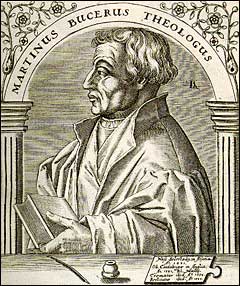
Luminarium: "Martin Bucer" (1491-1551)

http://www.luminarium.org/encyclopedia/bucer.htm


Portrait of Martin Bucer

Martin Bucer (1491-1551)

MARTIN BUCER (or Butzer), German Protestant reformer, was born in 1491 at Schlettstadt in Alsace. In 1506 he entered the Dominican order, and was sent to study at Heidelberg. There he became acquainted with the works of Erasmus and Luther, and was present at a disputation of the latter with some of the Romanist doctors. He became a convert to the reformed opinions, abandoned his order by papal dispensation in 1521, and soon afterwards married a nun. In 1522 he was pastor at Landstuhl in the palatinate, and travelled hither and thither propagating the reformed doctrine.

After his excommunication in 1523 he made his headquarters at Strassburg, where he succeeded Matthew Zell.
Henry VIII of England asked his advice in connexion with the divorce from Catherine of Aragon. On the question of the sacrament of the Lord's Supper, Bucer's opinions were decidedly Zwinglian, but he was anxious to maintain church unity with the Lutheran party, and constantly endeavoured, especially after Zwingli's death, to formulate a statement of belief that would unite Lutheran, south German and Swiss reformers. Hence the charge of ambiguity and obscurity which has been laid against him. In 1548 he was sent for to Augsburg to sign the agreement, called the Interim, between the Catholics and Protestants.

His stout opposition to this project exposed him to many difficulties, and he was glad to accept
Cranmer's invitation to make his home in England. On his arrival in 1549 he was appointed regius professor of divinity at Cambridge. Edward VI and the Protector Somerset showed him much favour and he was consulted as to the revision of the Book of Common Prayer. But on the 27th of February 1551 he died, and was buried in the university church, with great state. In 1557, by Mary's commissioners, his body was dug up and burnt, and his tomb demolished; it was subsequently reconstructed by order of Elizabeth.

Bucer is said to have written ninety-six treatises, among them a translation and exposition of the Psalms and a work De regno Christi. His name is familiar in English literature from the use made of his doctrines by
Milton in his divorce treatises.

Tuesday, June 28, 2011

"The Disputation Had at Oxford, the 16th Day of April, 1554, Between Mr. Hugh Latimer, Answerer, and Mr. Smith and Others, Opposers"

The Disputation Had at Oxford, the 16th Day of April, 1554, Between Mr. Hugh Latimer, Answerer, and Mr. Smith and Others, Opposers.

The disputation began on Wednesday, the 18th of April, at 8 o’clock. It was in the same manner as before, but mostly in English. Mr. Latimer, the answerer, alleged that his Latin was out of use, and unfit for that place. Mr. Smith of Oriel College replied, Dr. Cartwright, Mr. Harpsfield and various others bit at him, and gave him bitter taunts. He didn’t escape hissings and scornful laughing any more than those who went before him. He was very faint and desired that he not stay long. He did not drink for fear of vomiting. The disputation ended before 11 o’clock.

Mr. Latimer was not made to read what he said he had painfully written, but it was exhibited up, and the prolocutor read part of it, and then proceeded to the disputation.

Weston’s preface to the disputation

“Men and brethren, we are come together this day, by the help of God, to vanquish the strength of the arguments and dispersed opinions of adversaries against the truth of the real presence of the Lord’s body in the sacrament. And therefore you, father, if you have any thing to answer, I do admonish that you answer in short and few words.”

Latimer: “I pray you, good master Prolocutor, do not exact that of me which is not in me. I have not these twenty years much used the Latin tongue.”

Weston: “Take your ease, father.”

Latimer: “I thank you sir, I am well. Let me here protest my faith, for I am not able to dispute; and afterwards do your pleasure with me.”

The Protest of Mr. Latimer

The conclusions that I must answer are these:

1. The first is, that in the sacrament of the altar, by the virtue of God’s word pronounced by the priest, there is really and naturally the very body of Christ present, as it was conceived of the virgin Mary, under the kinds of bread and wine. And, in like manner, his blood [in the cup].

2. The second is, that after the consecration there remains no substance of bread and wine, or any other substance but the substance of God and man.

3. The third is, that in the mass there is the lively sacrifice of the church, which is propitiatory for the living and the dead.

To these I answer:

1. Concerning the first conclusion, I think it is set forth with certain new terms, lately found, that are obscure, and do not agree with the speech of the scripture. Nevertheless, however I understand it, thus do I answer, although not without the peril of my life. I say: there is no other presence of Christ required than a spiritual presence; and this presence is sufficient for a Christian man, as the presence by which we both abide in Christ, and Christ in us, to obtain eternal life, if we persevere in his true gospel. And the same presence may be called a real presence, because to the faithful believer there is the real, or spiritual body of Christ. I say this again, so that some sycophant or scorner supposes me, with the Anabaptist, to make nothing else of the sacrament but a bare and naked sign. As for what is pretended by many, I, for my part, take it for an invention of the Popes, and therefore I think it should be utterly rejected from among God’s children, that seek their Savior in faith and are taught among the fleshly Roman Catholics, that will be again under the yoke of antichrist.

2. Concerning the second conclusion, I say boldly that it has no support or ground from God’s holy word; but is a thing invented and found out by man, and therefore to be reputed and known as false; and, I would almost say is the mother and nurse of all other errors. It would be good for you my masters and lords, the transubstantiators, to take better heed to your doctrine, so that you do not conspire with the Nestorians. For the Nestorians deny that Christ had a natural body: and I cannot see how the Roman Catholics can avoid it, for they would contain the natural body which Christ had (sin excepted) against all truth, into a wafer cake.

3. The third conclusion, as I understand it, seems subtly to sow sedition against the offering which Christ himself offered for us in his own person, for all, never again to occur, according to the scriptures written in God’s book. In that book read the forceful and brief words of St. Paul in Hebrews 9 and 10, where he says that Christ himself made a perfect sacrifice for our sins, never again to be performed; and then ascended into heaven, and there sits a merciful intercessor between God’s justice and our sins; and there shall wait until these transubstantiators and all his other foes are made his footstool. This offering he freely made of himself, as it is written in John 10, he did not need any man to do it for him. I say nothing of the amazing presumptions of men, that dare attempt this thing without any manifest calling, especially that which intrudes to the overthrow and make fruitless (if not wholly, then partially) the cross of Christ. Therefore, a man can worthily say to my lords and master offerers, ‘By what authority do you do this? And who gave you this authority? When and where?’ St. John says, ‘A man cannot take any thing except it be given him from above,’ much less then may any man presume to usurp any honor before he is called to do it.

For more at this Calvinistic blogsite, see:
http://livingtext.wordpress.com/2011/06/14/hugh-latimer-disputation


Friday, December 3, 2010

26 November 1559: Bishop John Jewel Preaches at St. Paul’s, London


26 November 1559: Bishop John Jewel Preaches at St. Paul’s, London

A few discursive and unscientific thoughts about Jewel's sermon.

Luther is dead, 1546. Calvin is about to publish his magnum opus, The Institutes of Christian Religion. Cranmer and others have perished in the flames. Elizabeth is on the throne. Spaniards, France and Rome want England. Danger is everywhere in 1559.

Bishop John Jewel preaches at St. Paul’s on 26 November 1559.

A few observations on Anglicanism drawn from Horton Davies’ Worship and Theology in the Church of England: From Cranmer to Baxter and Fox, 1545-1690, Five Volumes (Grand Rapids, MI: Eerdmans Publishing Company, 1996).

Romanists had seven sacraments. Blue-suede-shoe and lime-green gabardine types, like the APA, Walter Grunsdorf and other Romewardizing Anglicans, have seven. Holy Orders was a Roman sacrament, but Ordination was not a sacrament, but a ceremony for the authorizing of Anglican ministry. Confirmation was important, but was never a sacrament; the same went for marriage. For Penance there was no equivalent at all, unless one points to the Declaration of the Remission of Sins by a minister in Christ’s name. Continental Reformers had the equivalent services, including confirmation. It was termed differently, but there is a service of recognition for becoming adult communicant in the Reformed and Presbyterian traditions, as well as Lutheran. Lutherans like Anglicans retained the service. There was no paedo-communion as theonomists like Ray Sutton have introduced. The Articles taught two sacraments.


The two major Gospel sacraments were retained—Baptism, as the sacrament of initiation to the visible Church and Holy Communion, the sacrament of spiritual nourishment.

According to Horton:

The Anglican objections to the Roman Mass were comprehensively and tersely listed by John Jewel in his notable "Challenge Sermon," preached at St. Paul's Cross November 26, 1559 and again on March 31, 1560, which had been repeated at Court exactly a fortnight earlier.

Jewel criticised these points: using Latin and not the vernacular, Communion in one kind, the teaching in the Canon on sacrifice, the adoration of the Sacrament, and private celebration.[i]

It is worth noting by way of practice: no elevation, no kissing of tables, no parading around, etc.

Jewel followed Cranmer on the Lord’s Supper. Three distinctions were made between Rome and early English Reformed theology: (1) There was a difference between the sign and the thing signified. (2) Christ is in heaven, not bodily on earth. Ubiquitarianism or Eutychianism was insurmountable for Cranmer, Jewel, as well as Continental, Swiss reformers. (3) The body of Christ was “eaten by faith only and none otherwise.” (Jewels’ Works, 1, 449 as cited by Davies, op.cit., 121.

Archbishop Grindal wryly observed:

Christ did eat the sacrament with the apostles: ergo, the sacrament is not Christ.” (The Remains of Edmund Grindal, D.D., ed. William Nicholson, p.43, cited by Davies, 121)

At one place, Hooker--he appears to be indifferent. This scribe has not been highly impressed with Hooker by comparison with Luther or Calvin. "Who cares about transubstantiation or consubstantiation?" asks Hooker.

“…why do we vainly trouble ourselves with so fierce contentions, whether by consubstantiation or else by transubstantiation the sacrament be first possessed with Christ or no? –a thing which no way can either further nor hinders us however it stand, because our participation with Christ in this sacrament dependeth on the co-operation of His omnipotent power which maketh it His body and blood to us, whether with change or without alteration of the elements such as they imagine, we need to not greatly to care of inquire.”[ii]

What are we to make of this? How does this comport with the Thirty-nine Articles?

At another point, it was said of Hooker: “…he too moved in the tracks laid down by Thomas Cranmer.”[iii] “The real presence is to be sought, according to Hooker, not in things but in person, not in consecrated elements but in consecrated persons receiving grace through faith.”[iv]

Back to Jewel and the sermon at St. Pauls on 26 November 1559. The sense of Jewel appears to follow Cranmer straight back to Calvin and Bucer rather than Zwingli. One must read Wallace's Calvin: The Word and Sacrament, which sounds very Cranmerian.

Beyond Jewel and a few years later, a scurrilous attack was given by a Rev. Bridges in a Sermon at St. Paul’s Cathedral in 1571. Lutherans would be affronted by this. Rev Bridges affirms that the Catholics had:

"…turned Chryst out of his owne likenesse, and made him looke lyke a rounde cake, nothyng lyke to Iesus Christe, no more than an apple is lyke an oyster, nor so mutche, for there appereth neyther armes nor handes, feete nor legges, back nor belly, heade nor body of Chryst: but all is visoured and disguysed under the fourme of a wafer, as lyghte as a feather, as thinne as a paper, as whyte as a kerchiefe, as round as a trenchour, as flat as a pancake, as smal as a shilling, as tender as the Priestes lemman that made it, as muche taste as a stycke, and as deade as a dore nayle to looke upon. O blessed God, dare they `thus disfigure our Lord and Saviour Iesus Christ?"[v]

Lutheran brethren will confessionally affirm that Anglicans did not get it correct, e.g. the "Black Rubric." Hooker’s view of indifference (?) will be unsatisfying to them. I think Calvin had a higher sacramental view than is current among Presbyterians. Baptists and enthusiasts are excluded. We know where the Papists are. Ridley was comfortable with Ratramnus's views, to wit, that in the 9th century he spoke without official rebuke.

Kissing tables, monstrances with the little glass holes in the boxes to “see an impanated Jesus” as bread worshippers, Holy Roods, choking incense, Marian invocations and all were affronts, except for the blue-suede-shoe types. We are reminded of Archbishop Grindal's question, to wit, "If Jesus instituted the Lord’s Supper and celebrated it the last night before His death, did He eat Himself?"

________________________________________
[i] Horton Davies’ Worship and Theology in the Church of England: From Cranmer to Baxter and Fox, 1545-1690, Five Volumes (Grand Rapids, MI: Eerdmans Publishing Company, 1996), 122.
[ii] Richard Hooker, Ecclesiastical Polity, ed. by Keble, V, lxvii, 12, 359. Davies’, op.cit., footnote 79, 33. Hooker is some of the most wearying reading one can do.
[iii] Horton Davies’ Worship and Theology in the Church of England: From Cranmer to Baxter and Fox, 1545-1690, Five Volumes (Grand Rapids, MI: Eerdmans Publishing Company, 1996), 122.
[iv] Richard Hooker, Ecclesiastical Polity, ed. by Keble, V, lxvii, 12, 359. Davies’, op.cit., footnote 170, 122.
[v] Horton Davies’ Worship and Theology in the Church of England: From Cranmer to Baxter and Fox, 1545-1690, Five Volumes (Grand Rapids, MI: Eerdmans Publishing Company, 1996), 33.

Wednesday, November 17, 2010

Cranmer Quotes: Bible, Faith, Justification, Christ, Lord's Supper, Pope


www.churchsociety.org/crossway/documents/Cway_033_Cranmer.pdf

Article reprinted from Cross†Way Issue Summer 1989 No. 33 (C)opyright Church Society; material may be used for non-profit purposes provided that the source is acknowledged and the text is not altered.

CRANMER SPEAKS TODAY
On this quincentenary of Cranmer’s birth it is good to be reminded of how relevant are many of the things which Cranmer said and wrote to the present times. Here are some extracts from his works and two pieces of poetry which his death inspired.

The Sufficiency of Holy Scripture

Whatsoever the church teacheth you out of the Canonical books of the Bible, believe that; but if
they teach you anything beside (I mean, which is not agreeable with the same) believe neither that nor them...cleave ye fast to the sound and certain doctrine of God’s infallible word, written in the Canonical books of the New and Old Testament. (Comfutation of Unwritten Verities)
Lively Faith
As he that readeth Cesar’s Commentaries, believing the same to be true, hath thereby a knowledge of Cesar’s life and notable acts, because he believeth the history of Cesar, yet it is not properly said that he believeth in Cesar, of whom he looketh for no help nor benefit; even so he that believeth that all that is spoken of God in the Bible is true, and yet liveth so ungodly that he cannot look to enjoy the promises and benefits of God, although it may be said that such a man hath faith and belief in the words of God, yet it is not properly said that he believeth in God, or hath such faith and trust in God whereby he may surely look for grace, mercy and everlasting life at God’s hand. (Homily of The True, Lively and Christian Faith)
Scripture – The Food of the Soul

Let us reverently hear and read Holy Scripture, which is the Food of the soul. Let us diligently
search for the well of life in the books of the New and Old Testament, and not run to the stinking puddles of men’s traditions, devised by men’s imaginations, for our justification and salvation. (Homily on Scripture).

The Lord’s Supper

The true eating and drinking of the said body and blood of Christ is, with a constant and lively faith to believe, that Christ gave his body, and shed his blood upon the cross for us, and that he doth so join and incorporate himself to us, that he is our head, and we his members, and flesh of his flesh, and bone of his bones, having him dwelling in us, and we in him. And herein standeth the whole effect and strength of this sacrament. And this faith God worketh inwardly in our hearts by his holy Spirit, and confirmeth the same outwardly to our ears by hearing of his word, and to our other senses by eating and drinking of the sacramental bread and wine in his holy supper. For figuratively he is in the bread and wine, and spiritually he is in them that worthily eat and drink the bread and wine; but really, carnally, and corporally, he is only in heaven, from whence he shall come to judge the quick and dead.

Christ’s Sacrifice

Christ never gave this honour to any creature, that he should make a sacrifice of him, nor did not ordain the sacrament of his holy supper, to the intent that either the priest or the people should sacrifice Christ again, or that the priests should make a sacrifice of him for the people: but his holy supper was ordained for this purpose, that every man, eating and drinking thereof, should remember that Christ died for him, and so should exercise his faith, and comfort himself by the remembrance of Christ’s benefits, and so give unto Christ most hearty thanks, and give himself also clearly unto him.

Worthy Reception of the Sacraments

As in baptism those that come feignedly, and those that come unfeignedly, both be washed with the sacramental water, but both be not washed with the Holy Ghost, and clothed with Christ: so in the Lord’s supper both eat and drink the sacramental bread and wine, but both eat not Christ himself, and be fed with his flesh and blood, but those only which worthily receive the sacrament. (The True and Catholick Doctrine of the Lord’s Supper)

Justification

Justification is not the office of man, but of God: for man cannot justify himself by his own good works, neither in part, nor in whole ... So the true understanding of this doctrine, we be justified freely by faith without works, or that we be justified by faith in Christ only, is not, that this our own act to believe in Christ, or this our own faith in Christ, which is within us, doth justify us ... but the true understanding and meaning thereof is, that although we hear God’s word and believe it; although we have faith, hope, charity ... we must renounce the merit of all our said virtues....and good deeds which we either have done, shall do, or can do ... and therefore we must trust only in God’s mercy, and in that sacrifice which our High Priest and Saviour Christ Jesus, the Son of God, once offered for us upon the cross... (Homily of Salvation)

The Mass

But what availeth it to take away beads, pardons, pilgrimages, and such other like popery, so long as the two chief roots remain unpulled up? whereof, so long as they remain, will spring up again all former impediments of the Lord’s harvest, and corruption of his flock. The rest is but branches and leaves, the cutting away whereof is but like topping and lopping of a tree, or cutting down of weeds, leaving the body standing and the roots in the ground; but the very body of the tree, or rather the roots of the weeds, is the popish doctrine of transubstantiation, of the real presence of Christ’s body and blood in the sacrament of the altar (as they call it), and of the sacrifice and oblation of Christ made by the priest, for the salvation of the quick and the dead. Which roots if they be suffered to grow in the Lord’s vineyard, they will overspread all the ground again with the old errors and superstitions. (The True and Catholick Doctrine of the Lord’s Supper)

The Pope

Alas! what hath the pope to do in England? whose jurisdiction is so far different from the
jurisdiction of this realm, that it is impossible to be true to the one and true to the other...I will never give my consent to the receiving of him into this Church of England. (Examination before Brokes)

The Martyrdom

‘Make short! make short!’ and so they lit the wood.
Then Cranmer lifted his left hand to heaven,
And thrust his right into the bitter flame;
And crying, in his deep voice, more than once,
‘This hand offended - this unworthy hand!’
So held it till it all was burn’d, before
The flame had reach’d his body; I stood near –
Mark’d him - he never uttered moan of pain:
He never stirr’d or writhed, but, like a statue,
Unmoving in the greatness of the flame,
Gave up the ghost; and so past martyr-like.
Tennyson

Sonnet on Cranmer

Outstretching flame-ward his upbraided hand
(O God of mercy, may no earthly seat
Of judgement such presumptuous doom repeat!)
Amid the shuddering throng doth Cranmer stand;
Firm as the stake to which with iron band
His frame is tied; firm from the naked feet
To the bare head, the victory complete;
The shrouded body, to the soul’s command,
Answering with more than Indian fortitude,
Through all her nerves with finer sense endued,
Till death departs in blissful aspiration:
Then ‘mid the ghastly ruin of the fire,
Behold the unalterable heart entire,
Emblem of faith untouched, miraculous attestation!

Wordsworth

Sunday, November 7, 2010

Nicholas Ridley, "England's Calvin" on the Lord's Supper


Panofré, Charlotte Anne. "From Latimer's Fellow-martyr to the 'English Calvin': Nicholas Ridley's Reputation and the Circulation of A brief declaration of the Lordes Supper, 1555-1570." Reformation & Renaissance Review: Journal of the Society for Reformation Studies 10.2 (2008): 175-193. Academic Search Premier. EBSCO. Web. 7 Nov. 2010.

A most commendable article. In summary,

Nicholas Ridley, the Edwardian Bishop of London, was executed in October, 1555, during Mary Tudor's reign. An active publicist, he composed in prison a treatise that promoted the Reformed view of Holy Communion. If Latimer was the "Apostle to England," a preacher, Ridley was significantly more erudite, "moderate" and "sharp" of mind. Ridley's work was published in Emden (1555) and in Strasbourg (1556). In 1556, A brief declaracion found its way to Geneva where a community of English exiles had it translated into Latin (Conrad Badius then issued a version in French). Not only did the translation acquire a polemical edge, but certain allusions, scattered in the preface and in the margins of the text, turned Ridley's treatise into a `Calvinist' manifesto with a trans-national readership. This came at a time when Calvin was defending his views against the Lutheran polemicist, Joachim Westphal. Ex-patriate English Reformers driven from their homes and families during the Marian period, Edmund Grindal (Frankfurt) and Whittingham (Geneva), both had access to Ridley's work. The former would be Elizabeth's second Protestant and Reformed Archbishop of Canterbury. The latter would become the influential Professor of Divinity, Cambridge, who would lock horns with Cardinal Bellarmine. Whittingham made Ridley's work known to Jean Calvin. Whittingham would also accuse Westphal of "impanation," a view close to transubstantiation. Meanwhile, Jean Crespin made use of Badius's version in his martyrologies and reprinted Ridley's treatise in his 1570 edition. Whereas in England, Ridley's works began to be perceived as controversial after Mary's death. Crespin and Beza (Icones, 1580) put Ridley in the Reformation pantheon, kept his treatise alive and heralded him as the 'English Calvin' in French Reformed circles. Also, Beza likens Latimer and Ridley, in their martyrdoms, to Polycarp and Igatius. This is not something that John Henry Newman would like hearing, but these are the facts.

Thursday, January 14, 2010

Becon's Prayer: Humble Supplication for Restoring the Word of God to the Church of England, pp.223-227


Becon's Prayer: Humble Supplication for Restoring the Word of God to the Church of England, pp.223-227. Becon was Cranmer's Chaplain (1512-1567). He's in earnest against Popedom. This could and should be adapted for revivalism, Finneyism, liberalism as well as that Tractarian disease. Becon prays, but works in his theology....praying his theology.

http://books.google.com/books?id=MkIYAAAAYAAJ&pg=PA223&dq=thomas+becon&output=text#PA223
--------------------

O Most High, dear, gentle, loving, and merciful Father, Maker, Ruler, Conserver, and Disposer of all things both in heaven and in earth; without whose will, ordinance, and commandment nothing is done that is done; in whose hands all the coasts of the earth, and the hearts of princes and of all others are ruled, ordered, and bent as thy godly wisdom doth appoint; from whom also, as from a most righteous judge, cometh prosperity and adversity, health and sickness, wealth and scarceness, peace and trouble, blessings and plagues, the gift of thy holy word and the taking away of the same, the sending of faithful workmen into thy harvest and the displacing of them again, the appointment of godly magistrates and setting up hypocrites and tyrants for the punishment of the disobedient, ungodly, and stiffnecked people: we feel, we feel, yea, we Englishmen feel, O Father of mercies and God of all consolation, so great a dung-hill of sin within us, such vileness, such corruptness, such unthankfulness, and such disobedience against thee and thy blessed will, that, except thou hadst given us a commandment to pray, and also joined unto the Prayer, same a faithful and loving promise that thou wilt hear us whensoever we call on thee in the name of Jesus Christ, thy dearly-beloved Son, our Lord and our alone.

Our Saviour, we never durst so much as once to lift up our eyes unto thee, and to approach unto the gracious and merciful throne of thy divine Majesty, for a redress of those evils wherewith at this present (alas for sorrow!) we are miserably yet worthily plagued, punished, and tormented.

But, 0 heavenly Father, and our most benign and gentle Lord, thou, graciously considering both our vileness and weakness of conscience, hast notwithstanding given us a commandment by thy servant David, not to fear, but frankly to flee unto thee, as unto a most strong, mighty, and invincible bulwark, by fervent prayer in all our troubles; and hast also promised, " not for any works of righteousness that we have done," but for thine exceeding great and unspeakable mercy's sake, to hear us and to satisfy our requests, saying: " Call on me in the day of thy trouble; and I will deliver thee; and thou shalt honour me." Here have we poor wretches, unto our great comfort, both a commandment of thee to pray, and also a promise that thou wilt hear us.

And thy most dear and only-begotten Son commandeth us not only to ask, to seek, and to knock, but he also promiseth, that whosoever will ask, the same shall receive; whosoever will seek, the same shall find; and to him that knocketh it shall be opened; yea, his promise is that, whatsoever we ask of thee in his name, thou wilt give it us. And, being encouraged, and as it were under-propped with this thy gracious commandment to pray and loving promise to be heard, are bold at this present, in the name of Christ, to come unto the merciful throne of thy godly Majesty, and before the same to pour out the sorrowful griefs of our most sorrowful hearts, most humbly beseeching thee for thy mercies' sake, for thy promises' sake, for thy name's sake, yea, for thy dear Christ's sake, that thou, turning away thine eyes from our sins, wilt behold thine holy Anointed, whom thou hast made our Mediator and Advocate, for whose sake thou hast openly declared, even from the heavens, that thou art well pleased with man, and for his dignity and worthiness graciously hear the lamentable petitions and humble requests of our bruised hearts and troubled consciences.

Ah, most dear Fathe! great are our miseries; but greater are our sins: grievous are our troubles; but more grievous are the wickednesses which we, most wretched sinners, have committed against thy fatherly goodness : intolerable are the plagues that be laid upon us; but those through our unthankfulness and wicked living (we freely confess) have we most worthily deserved, which have so oft deserved the torments of hell-fire; alas, wretches that we are! and yet are we compelled even of necessit (for vain is the help that cometh from man, yea, " cursed be he that putteth his trust in man, and maketh flesh his arm") to flee for succour unto thee, whom we have so oft and so grievously offended ; whose righteousness notwithstanding in punishing sinners when we behold, we begin to despair and to cast away all hope ; but when we behold thy mercy, set forth in the precious blood of thy most dear Son Christ Jesu our Lord, we take a good heart unto us, and, setting before our eyes thy most loving, sweet, and fatherly promises in hearing us for Christ's sake, we are encouraged to believe that, although our sins be never so great and grievous, never so abominable and intolerable, and we were never so wicked and filthy sinners, yet for thy mercy's sake, for thy promise sake, for thy name's sake, yea, for thy dear Christ's sake, thou wilt mercifully hear us and grant us our earnest requests, yea, and that so much the more because the matter is not only ours but thine also ; again, seeing we come not unto thee to desire long life, gold, and riches with the wicked worldlings, nor yet to crave at thy hand wealth and pleasure, bishoprics and benefices, deaneries, prebends, and such other worldly promotions, with the swinish and beastly epicures, " whose God their belly is ;" but our humble supplication, our earnest request, our hearty desire is only that thou wilt consider thine own glory, the hallowing of thy blessed name, the advancement of thy glorious kingdom, the accomplishment of thy heavenly will, the honour of thy only-begotten Son, the setting forth of his holy gospel, the pureness of the Christian religion, the sincere preaching of thy lively word, the true administration of thy wholesome sacraments, and the salvation of such as thy dearly-beloved Son hath bought from the tyranny of Satan with the price of his most precious and dear heart-blood.

These things, these things, O heavenly Father, do we poor wretches crave and beg at thy merciful hand. These things, these things, even with sorrowful groanings and lamentable tears, do we miserable captives desire thee to consider, and not so to suffer thine adversaries to triumph as though there were no God at all, no Christ, no gospel, no faith, no true religion, but whatsoever pleaseth the hypocrites to command thy people to believe.

Thou callest thyself a "jealous God:" why then dost thou suffer thy people, thy congregation, thy flock, thine heritage, to be thus seduced and led away from thee unto all kind of spiritual fornication and abominable whoredom by that antichrist of common- Rome, that great Baal, that stout Nemroth, that false prophet, that beast, that whore of Babylon, that son of perdition, and by his abominable adherents, cardinals, archbishops, bishops, suffragans, archdeacons, deans, provosts, prebendaries, commissaries, parsons, vicars, purgatory-rakers, priests, monks, friars, canons, nuns, anchors, anchoresses, pardoners, proctors, scribes, officials, sumners, lawyers, massmongers, canonists, papists, antichrists, mammonists, epicures, libertines, with all the rabble of beastly hypocrites that have received the beast's mark, which do nothing else than seek how they may establish their antichristian kingdom by suppressing thy holy word and leading the people into all kind of blindness, errors, and lies?

Thou callest thyself a Lord, and thou sayest that thou wilt give thy glory to none other, nor thy praise unto graven images: how cometh it then to pass that thou sufferest thy glory so to decay in the realm of England, so many to steal away thy praise and honour, by saying their idolatrous and devilish masses, by ministering a sort of heathenish and Jewish ceremonies, by praying unto dead saints, by blotting out of the temples thy holy law, there written according to thy commandment for the edifying of thy people, and by setting np in the stead thereof idols and mawmets, clean contrary to thy blessed word?

Thou callest thyself a lion and "a consuming fire," and threatenest utter destructioon unto thine adversaries: why sufferest thou then these antichrists thus to rise, roar, and rage against the testament of thy most dear Son, to beat down thy truth, to call thy holy law heresy, to banish the preaching of the gospel and the true use of the sacrament, and to seek the destruction of so many as unfeignedly love thee and thy blessed word?

Thou promisest that so many as hate Sion, that is to say, thy faithful congregation, shall be confounded and brought to nought: how cometh it then to pass that the wicked now flourish like the green olive-tree, living in all wealth, pomp, and pleasure; and thy people, whom thou hast sealed with thy holy Spirit unto everlasting life, are most miserably entreated, some banished, some in prison, some cruelly murdered, but all in most sorrowful miseries and in miserable sorrows?

Thou promisest that thou wilt deliver thy flock from the hand of the wicked shepherds, and that thou thyself wilt feed them in most pleasant and sweet pastures : ah, good God! how cometh it then to pass that, whereas before thy sheep were fed with the comfortable meat of thy glorious gospel by the ministry of the godly-learned preachers, the faithful shepherds are driven away, and a rabble of ravening wolves are brast into the sheep-fold, which spare not the flock, but cruelly murder, not only their bodies by imprisoning, hanging, heading, and burning them, but their souls also, by teaching them wicked and pestilent doctrine?

Thy most dear Son both promised and prophesied that " every plant" which thou, the heavenly Father, hast "not planted, shall be plucked up by the roots;" but we see it otherwise come to pass in the realm of England. For such plants as the devil and his chaplains had planted were, through the diligence and godly zeal of thy servants, king Henry the eighth and king Edward the sixth, most blessedly King Henry plucked up, and thy holy ordinances again planted, unto the great joy and unspeakable comfort of all the faithful. But now, through the tyranny and blind zeal of the certain [sic, PV], are thy blessed statutes plucked up by the roots, and set in again are the damnable decrees and crooked constitutions of antichrist, unto the exceeding great grief, sorrow, and pensiveness of all faithful Christians. Ah, Lord God! seem these things matters of small importance before the eyes of thy divine Majesty ? Can these outrageous things be done in earth, and thou wink at them in heaven ? Art not thou he that keepeth Israel ? But " he neither sleepeth nor slumbereth," saith the psalmograph, " that keepeth Israel." Arise, therefore, O Lord: why sleepest thou ? Is thy ear so stopped that thou canst no more hear ? and is thy hand so shortened that it can no more help ? O Lord, arise for thy mercies' sake, and help us. Haste thee to deliver us for thy name sake; for great are our troubles, and intolerable are our miseries. Ah, Lord! vouchsafe once again to look down from heaven, and consider the lamentable state of the realm of England, and of the godly inhabitants thereof, which desire nothing so greatly as to see thy true honour perfectly set forth, thy holy word truly preached, the Christian religion highly advanced, and thy holy name sanctified, praised, magnified, and commended for ever.

Ah, Lord God! heretofore in the time of thy blessing thou gavest to the realm of King Henry England a man to reign over it, under whom the church was purged of many enormities and great abuses, and the true religion began to have good success. And when it was thy godly pleasure to call him from this vale of misery unto thy heavenly kingdom, thou gavest unto us his son to be our king, a prince, although young in years and tender in age, yet ancient in the knowledge of thee, of thy Son Christ, and of thy holy word, and, as another Josias, altogether bent utterly to weed out all false religion, superstition, hypocrisy, papistry, &c., and after a most perfect manner to set up thy holy religion and to advance the hearty favourers of the same, unto the great and wonderful example of all Christian princes. But (alas for sorrow!) this most goodly and godly imp, this most Christian king, this noble young Josias was, for our unthankfulness and wicked living, taken away from us before the time, unto our great sorrow and unspeakable heart's disease: whose death was the beginning, and is now still the continuance of all our sorrows, griefs, and miseries. For in the stead of that virtuous prince thou hast set to rule over us a woman, whom nature hath formed to be in subjection unto man, and whom thou by thine holy apostle commandest to keep silence, and not to speak in the congregation. Ah, Lord! to take away the empire from a man, and to give it unto a woman, seemeth to be an evident token of thine anger toward us Englishmen. For by the prophet thou, being displeased with thy people, threatenest to set women to rule over them, as people unworthy to isai. Hi. have lawful, natural, and meet governors to reign over them. And verily, though wefind that women sometime bare rule among thy people, yet do we read that such as ruled and were queens were for the most part wicked, ungodly, superstitious, and given to idolatry and to all filthy abominations; as we may see in the histories of queen Jezabel, queen Athalia, queen Herodias, and such-like. Ah, Lord God we dare not take upon us to judge any creature, for unto thee alone are the secrets of all hearts known; but of this are we sure, that since she ruled (whether of her own disposition, or of the provocation of a certain wild boar, successor to Ananias, that white-daubed wall, we know not), thy vineyard is utterly rooted up and laid waste, thy true religion is banished, and popish superstition hath prevailed, yea, and that under the colour of the catholic church and the old ancient faith, when notwithstanding darkness is not more contrary to light, nor cold unto heat, than their proceedings are contrary to the truth of thy holy word, if the practice and doctrine of the true catholic church (we speak of the patriarchs and prophets, of Christ and his apostles, and of so many godly people as lived from Adam unto the time that antichrist the bishop of Rome set up his kingdom, and " advanced himself above all that is called God") might be the judge, and go for payment. For besides the giving of the kingdom unto the rule of a woman, O Lord, we most humbly beseech thee to consider what outrageous floods of most grievous enormities have brast in and overflowed the realm of England, unto the utter subversion of the same, except thy merciful goodness doth shortly help.

Ah, Lord God heretofore, under the rule of that most Christian king Edward the sixth, we were taught according to thy word to flee with our prayers unto thee alone in all our troubles and necessities, as a Lord plentifully rich for so many as call on thee. But now the antichristian preachers teach that we must also pray to creatures that are dead, that they may pray for us; or else we pray unto thee in vain, and our prayers shall never be heard.

Heretofore we were taught that Christ, God and man, is our alone Mediator, Advocate, and Intercessor. But now the priests of Baal teach that Mary, James, Peter, John, Paul, Andrew, and we know not who, are also our mediators, advocates, and intercessors, and that we must call upon them in our troubles and adversities, whensoever we will have to do with thee, namely if we will have our matter go forward.

Heretofore we were taught that the precious blood of our Saviour Christ is the alone and sufficient purgatory for the sins of all them that repent and believe. But now the papists teach that there is a purging-place after this life, where the souls of the faithful shall be miserably tormented with fiery flames, till either they themselves have made satisfaction for all their sins by suffering due punishment, or else other in this world have made amends for them by praying, by singing of trentals, by going on pilgrimage, by dealing money, by buying the pope's pardons for their redemption, and such-like; when the holy scripture contrariwise teacheth that the faithful, so soon as they depart from this life, go straightways unto glory, the unfaithful unto everlasting pain and damnation; as we may see in the history of the rich glutton and of the poor man Lazarus.

Heretofore we were taught that Christ, thy Son and our alone Saviour, made upon the altar of the cross, when he suffered and died for us, so sufficient, perfect, absolute, and consummate oblation and sacrifice for the sins of the people, that by that one and alone sacrifice grace, favour, mercy, forgiveness of sins, and everlasting life is for ever and ever plentifully obtained of thee for so many as repent and believe. But now-a-days those Baalite massmongers are not ashamed to reprove that sweetsmelling sacrifice of Christ, and to say that it is not so perfect but that they also must offer Christ up again daily in their masses for the sins of the people, and that their oblation is a propitiatory sacrifice, and of no less virtue, strength, efficacy, might, and power, than the passion and death of Christ, than the sacrifice which Christ himself offered on the altar of the cross. Our missal sacrifice, say the massing papists, is propitiatory, satisfactory, expiatory, and necessary ad talutem, both for the o antichrists. quick and for the dead. The people sin daily: therefore must we offer sacrifice for the sins of the people daily in our masses. What other thing is this, O heavenly Father, than to defy the death of thy Son, to despise his most healthful sacrifice, to set at nought his wholesome oblation, to tread under foot the blood of the everlasting testament, and utterly to deface both the kingdom and priesthood of Christ, and to erect and set up a new kingdom and priesthood of their own, a new sacrifice and a strange oblation, invented of the devil, brought in by antichrist, confirmed by such as have received the beast's mark, and frequented, used, and sought of all that have their portion in that "lake that burneth with fire and brimstone," except they repent and amend ? Is not Christ an everlasting Priest ? Doth not his priesthood continue from generation to generation ? Hath he not with one oblation made perfect for ever them that are sanctified? Are we not made holy "by the offering up of the body of Jesu, done once for all?" Did not Christ, after he had offered one sacrifice for sins, sit him down for ever on the right hand of God, and from henceforth tarrieth till his foes be made his footstool ? Is not " Jesus Christ yesterday, and to-day, and the same continueth for ever?" What have we then to do with the sacrificing massmongers, or with their missal sacrifice? 0 heavenly Father, suffer us not to be "carried about with divers and strange learning."

Moreover, heretofore we were taught to beat down the idolatrous and heathenish or the holy altars, which antichrist of Rome, intending to set up a new priesthood and a strange sacrifice for sin, commanded to be built up, as though calves, goats, sheep, and such other brute beasts should be offered again, after the priesthood of Aaron, for the sins of the people, and to set in their stead in some convenient place a seemly table, and, Christ, after the examples of Christ, to receive together at it the holy mysteries of Christ's body and blood, in remembrance that Christ's body was broken and his blood shed for our sins. But now the sacrificing sorcerers shame not, both in their private talk or the holy
and in their open sermons, spitefully to call the Lord's table an oyster-board; arid therefore have they taken out of the temples those seemly tables which we, following the examples of thy dearly-beloved Son and of the primitive church, used at the ministration of the holy communion, and they have brought in again their bloody and butcherly altars, and upon those they sacrifice and offer daily, say they, that is, they kill, slay, and murder thy dear Son Christ for the sins of the people. For, as thy holy apostle saith : " Where no shedding of blood is there is no remission" and forgiveness of sins. If through their massing sins be forgiven, then must the sacrifice that there is offered bo slain, and the blood thereof shed. If the massmongers therefore offer Christ up in their masses a sacrifice unto God for the sins of the people, so followeth it that they murder, kill, and slay Christ, yea, and shed his blood at their masses ; and so by this means we must needs confess, that bloody altars are more meet for such bloody butchers than honest and pure tables. But we are taught in the holy scriptures that " Christ, once raised from death, dieth no more. Death hath no more power over him. For as touching that he died, he died concerning sin once ; and as touching that he liveth, he liveth unto" thee, " God" his Father. If Christ therefore dieth no more, then do the papists sacrifice him no more. If they
sacrifice him no more, then are they but jangling jugglers ; and their masses serve for Masses, why none other purpose but to keep the people in blindness, to deface the passion and death of Christ, and to maintain their idle and draffsacked bellies in all pomp and honour with the labour of other men's hands and with the sweat of poor men's brows; so far is it off that they with their abominable massing and stinking sacrificing put away the sins either of the quick or of the dead, as they make the unlearned and simple people to believe.

Ah, Lord God and heavenly Father! if thou were not a God of long-suffering and of great patience, how couldest thou abide these intolerable injuries and too much detestable blasphemies, which the wicked
papists commit against thee and thy Son Christ in their idolatrous masses at their heathenish altars ?

Heretofore we were taught to receive the mysteries of the Lord's body and blood The faithful together, according to the ordinance of Christ. But now no communion is had. For receive the Kicrameni to- the popish and uncharitable massinongers, utterly abusing the Lord's supper, eateth the priest and drinketh up all alone at his idolatrous altar.

Heretofore we were taught to receive the sacrament of the body and blood of Christ aught to under both kinds, according unto Christ's institution, which saith: " Drink of thif, sacrament all ye." And as the holy apostle saith: " So oft as ye shall eat of this bread and kinds. drink of this cup, ye shall remember the Lord's death till he come." But now the i cor. xi. ' Romish sorcerers, contrary to the ordinance and commandment of thy Son, the Master johmiv. of truth, yea, the self truth, and contrary to the practice and usage of the primitive church, like thieves, robbers, and murderers, cruelly take away from thy people the mystical cup of Christ's blood, for the maintenance of their devilish decree, and minister after their sort the sacrament of thanksgiving to thy Christians only under one kind, yea, and that without the preaching of the Lord's death, repentance, faith, amendment of life, &c. And so make they it an idle and dumb ceremony, altogether unprofitable and without fruit, which, being rightly ministered, is to the faithful a sacrament of great joy and comfort.

The Lord's Heretofore we were taught that the Lord's supper, or breaking of the bread, as the apostles term it, is a memorial of the body-breaking and blood-shedding of our death'.' Saviour Christ; and that, as we outwardly feed of the bread and wine, so we inwardly through faith feed of the blessed body and precious blood of Jesus Christ our Lord, The cruelty unto the great and unspeakable comfort both of soul and body. But now the disciples of antichrist, knowing that the whole glory of their kingdom lieth in the false opinion and abuse of this sacrament, in all their sermons and private talk labour, swink, sweat, and seek all means possible, with tooth and nail, with hand and foot, with tongue and pen, with fire and fagot, with sword and halter, to persuade the people that, after they have whispered a few Latin words with one breath over the bread and wine, and have blessed, crossed, conjured, and handled them after their ghostly manner, there remaineth no more bread and wine; although we both see, feel,
and taste very bread and very wine, yea, and although the holy scripture after the words of consecration called the sacrament bread and wine: but, say they, the bread, through the virtue of the words which we holy anointed rehearse, is turned into the natural substance of Christ's body, and the wine is changed into the natural blood of Christ, only the accidents of bread and wine remaining; when notwithstanding the holy scriptures teach us in divers places that thy Christ is ascended into heaven, and " sitteth on thy right hand, and there shall remain, concerning his humanity, till he 'come to judge the quick and the dead.' And after these Capernaites have laboured to persuade the people, that the sacramental bread is the very true, natural, corporal, substantial, real, and sensible body of Christ, even the self-same that was born of Mary the virgin, lived upon the earth, was hanged upon the cross, and died for us; then exhort they the people with all reverence and humility to knowledge and believe it to be their Lord God, their Maker and Redeemer, their Saviour and Defender, and so to fall down before it, to honour and worship it, to praise and call upon it, to flee unto it for succour, and to look for all good things of it, as of the very true and everlasting God.

By these means, O heavenly Father, they bring away thy people, through their vain, fleshly, and sophistical reasons, from the honouring of the alone true, immortal, invisible, and everlasting God unto the worshipping of a piece of bread, yea, of a very idol; whereas thou alone oughtest to have all the honour and glory. " O Lord, arise, and let thine enemies be scattered: let them also that hate thec flee before thee: like as the smoke vanisheth, so drive thou them away; and like as wax melteth at the fire, so let the ungodly" papists " perish" and be confounded; that thy people be no longer seduced and led from the way of truth by their subtile and carnal imaginations, but that they, being truly taught, may "know thee to be the alone true God, and whom thou hast sent, Jesus Christ."

Heretofore we had in the temples, when we came together to pray and to give thanks unto thee, all our prayers and thanksgiving in the tongue that we understood, whereby we received great comfort, and were much edified. But now the papists (which wish thy people to be more rude than asses, more blind than beetles, more ignorant than dastards, that they might make them their riding fools and laughingstocks), contrary to the usage and practice of the primitive church, yea, contrary to to thy commandment given by thine apostle, which willeth all tilings in the congregation to be uttered in such a speech as all might understand and be edified, or else silence to be kept, have brought the matter to this point, that, all English service driven out of the churches, they have stablished their popish Latin service, which the most part of thy people understand nothing at all. And yet so cruel and malignant tyranny. The papists, that they enforce, and with violence compel thy people to come unto their Romish, superstitious, blasphemous, and idolatrous Latin service, to hear it, to reverence and honour it with their presence, and to call it God's service, when they understand not whether Baal's priests, that there bleat and mumble, do bless or curse, praise or blaspheme. Most certain is this, that thy people are altogether without edifying, spend their time in vain, and return home again as unlearned and ignorant as they came thither.

Heretofore we had read in our temples every Sunday, and at divers other times, Homilies in a godly and learned homily or sermon, and certain chapters out of the holy bible in chapters the English tongue, that all the people might understand what was done or said; which gave them occasion to forsake vice and to embrace virtue, to live in thy fear, and diligently to call upon thy blessed name. But now both those godly homilies and comfortable chapters have thine enemies the papists banished out of the temples, unto the great discomfort of all such as unfeignedly love thee and thy blessed word; and, in the stead of them, they have set up blasphemous collations, singing, ringing, Popish piping, censing, holy-water-casting, holy-bread-dealing, palms and candles-bearing, cross-kneeling, bread-worshipping, ashes-dodding, fire and tapers-hallowing, with an infinite number of such-like heathen ceremonies, that the people, being occupied with such childish trifles, lousy traditions, and beggarly ceremonies, might forget the wholesome food of their souls, which is thy holy and blessed word.

Heretofore upon the Sundays, and certain other days in the week, we had the litany many in rehearsed among us in our English tongue, every one of us kneeling devoutly and heartily calling on thee for mercy and grace.

0 heavenly Father, this was set forth in the time of thy servant king Henry the eighth, and continued among us until the death of that most godly and virtuous prince king Edward the sixth, and a little after, unto the singular joy and great comfort of all godly and christian-hearted people. But now the subtile and fleshly papists have so bewitched the queen's eyes, that, whatsoever her father and her brother most godly brought to pass for the advancement of thy glory and for the edifying of thy people, that is utterly subverted and taken for heresy, yea, and spitefully preached against in open sermons; so that this godly and most wholesome litany is not only taken away from us, but in the stead thereof we are compelled to go on procession, following an idol, with singing Ora pro nobis, Salve festa dies, or some other blasphemous Bong, unto the great sorrow and inward heart-breaking of all thy faithful.

Heretofore thy sacraments were so ministered unto us, that we received great comfort by them. But now they are so ministered of these swinish spiritual sorcerers, that they are become dumb and idle ceremonies, altogether without edifying or profit. For besides that they are ministered in an unknown tongue, how be they defiled with men's traditions and beggarly ceremonies! Unto the sacrament of baptism they put j heathenish rites and wicked conjurations. For Baal's priest, before the child can be baptized, bewitcheth the water, shutteth the church-door, conjureth the devil out of the poor young infant, bespueth the child with his vile spittle and stinking slavering, putteth salt in the child's mouth, smeareth it with greasy and unsavoury oil, &c. And without these apish toys they make the people believe that the baptism is nothing worth. Ah, good Lord! is this any other thing than a plain laughing to scorn of thy dear Son's institution? Do these papists, by adding their beggarly ceremonies, any other thing than set thy Son Christ to school, and avance their own fleshly imaginations above the wisdom of the Lord Christ ?

The sacrament also of thy dear Son's body and blood, how have the adversaries profaned and defiled! Thy Son both before and after the ministration of the sacrament preached unto his disciples: the papists preach nothing at all. Thy Son spake the words of the institution openly in that tongue that all the disciples undertacrament stood: the papists utter all things in a strange language, yea, and that so softly that they scarce hear themselves. Thy Son ministered the sacraments without putting on of any disguised apparel: the papists deck themselves like hickscorner in gameplayers' garments. Thy Son ministered the sacrament sitting at the table with his disciples : the papists stand at the altar, and give the bread and wine to the people kneeling. Thy Son gave the sacramental bread to the disciples in their hands, saying: "Take, eat:" the papists thrust the bread into the people's mouths, as though they had not so much wit as to feed themselves. Thy Son ministered the sacrament of his body and blood under both kinds to his disciples: the papists do minister it to the lay people only under one kind, and like thieves steal the other away from them, and reserve it to themselves alone. Thy Son brake the sacramental bread : the papists use no breaking of the bread, as Christ and his apostles and all the primitive church did, for to declare the mystery of Christ's body-breaking on the altar of the cross for our redemption; but they put into the people's mouths a little light white wafer-cake, speaking to them a few words in Latin which they understand not. Thy Son did appoint the sacramental bread to be broken and eaten: the papists keep it whole, and hang it up in the pix, yea, and carry it about for a pageant in their idolatrous, popish, pompous processions.

Thy Son instituted the sacrament to be a memorial of his body-breaking and Bread and blood-shedding. The papists teach that the bread and wine is turned into the natural body and blood of Christ, God and man, even the self-same body that was born of Mary the the virgin, flesh, blood, and bone, so that there remaineth neither bread nor wine; although the holy scripture affirmeth plainly that there is both bread and wine remaining ; the doctors of the Christian primitive church testify the same in their writings; the Greek church, even from the apostles' time unto this day, have so received and believed, utterly denying the popish article of transubstantiation; reason also, and all the senses of man testify that there remain both bread and wine after the words of consecration, as they use to term them; yea, and experience teacheth that, if the sacramental bread he long reserved, it will corrupt, putrify, mould, stink, and breed full of worms, and the wine likewise will change the colour and wax sour.

O heavenly Father! such corruption cannot chance to thy dear Son's body and blood, which is uncorruptible and immortal, sitteth on thy right hand, and reigneth with thee in glory for ever and ever.

This antichristian doctrine, O blessed Lord, was not known in thy holy church, until pope Nicholas, pope Innocent, pope Urban, friar Thomas, and such other ministers of Satan, partly with their tyranny, and partly with their sophistry (as their apish adherents do now again in these our days) brought it in, and compelled the Christians with fire and sword to believe this their monstrous opinion for the maintenance of their belly-kingdom, although it be never so much contrary to the articles of our faith, and to the doctrine of the holy scripture, and of all the ancient writers.

Thy Son at his supper willed the sacramental bread and wine to be eaten and dninken for a remembrance of that one and alone sacrifice which he offered on the altar of the cross for the sins of the people. The papists in their idolatrous and blasphemy make of the sacrament a propitiatory, expiatory, and satisfactory sacrifice for the sins of the people, necessary ad lalutem; affirming that their act in the mass is of equal price, dignity, virtue, might, efficacy, and power before the eyes of thy divine Majesty with the most healthful and sweet-smelling sacrifice that thy Son offered on the altar of the cross, when he gave himself unto the death for the sins of the people. Thy Son ordained the sacrament to be a sign and token of love, when the godly come together to eat all of one bread, and to drink all of one cup. The papists make it a sacrament of dissension, discord, and debate. For if any will not agree to their fleshly, wicked, and devilish opinion, confessing their error of transubstantiation, and affirming that the bread and wine is the very natural body and blood of Christ, God and man, and therefore ought to be kneeled unto,

............and on and on. Mlore to follow