Reformed Churchmen

We are Confessional Calvinists and a Prayer Book Church-people. In 2012, we remembered the 350th anniversary of the 1662 Book of Common Prayer; also, we remembered the 450th anniversary of John Jewel's sober, scholarly, and Reformed "An Apology of the Church of England." In 2013, we remembered the publication of the "Heidelberg Catechism" and the influence of Reformed theologians in England, including Heinrich Bullinger's Decades. For 2014: Tyndale's NT translation. For 2015, John Roger, Rowland Taylor and Bishop John Hooper's martyrdom, burned at the stakes. Books of the month. December 2014: Alan Jacob's "Book of Common Prayer" at: http://www.amazon.com/Book-Common-Prayer-Biography-Religious/dp/0691154813/ref=sr_1_1?ie=UTF8&qid=1417814005&sr=8-1&keywords=jacobs+book+of+common+prayer. January 2015: A.F. Pollard's "Thomas Cranmer and the English Reformation: 1489-1556" at: http://www.amazon.com/Thomas-Cranmer-English-Reformation-1489-1556/dp/1592448658/ref=sr_1_1?ie=UTF8&qid=1420055574&sr=8-1&keywords=A.F.+Pollard+Cranmer. February 2015: Jaspar Ridley's "Thomas Cranmer" at: http://www.amazon.com/Thomas-Cranmer-Jasper-Ridley/dp/0198212879/ref=sr_1_1?ie=UTF8&qid=1422892154&sr=8-1&keywords=jasper+ridley+cranmer&pebp=1422892151110&peasin=198212879

Showing posts with label Anglicanism. Show all posts

Wednesday, February 22, 2012

Andi Naselli: Converting to Evangelicalism, Eastern Orthodoxy, Romanism, and Anglicanism

http://andynaselli.com/converting?utm_source=feedburner&utm_medium=feed&utm_campaign=Feed%3A+nasellitheology+%28Andy+Naselli%29


Converting to Evangelicalism, Eastern Orthodoxy, Catholicism, and Anglicanism

This book releases on March 6:

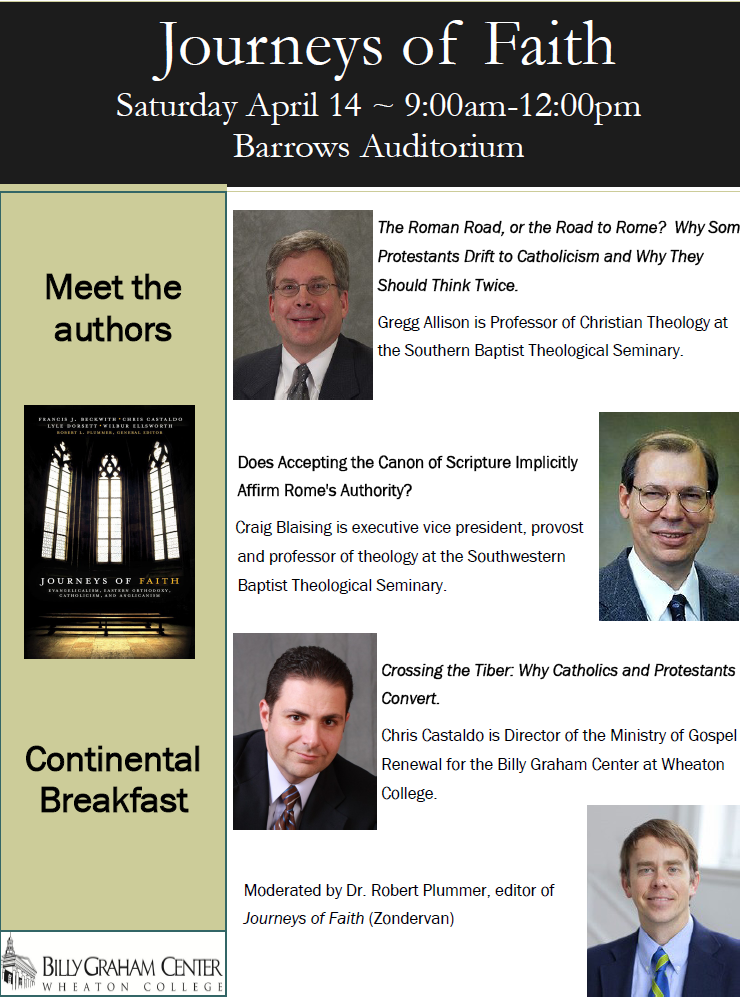
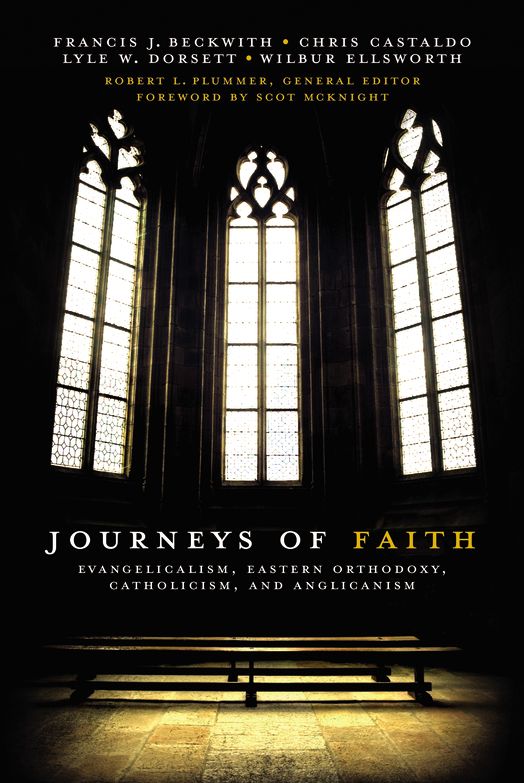
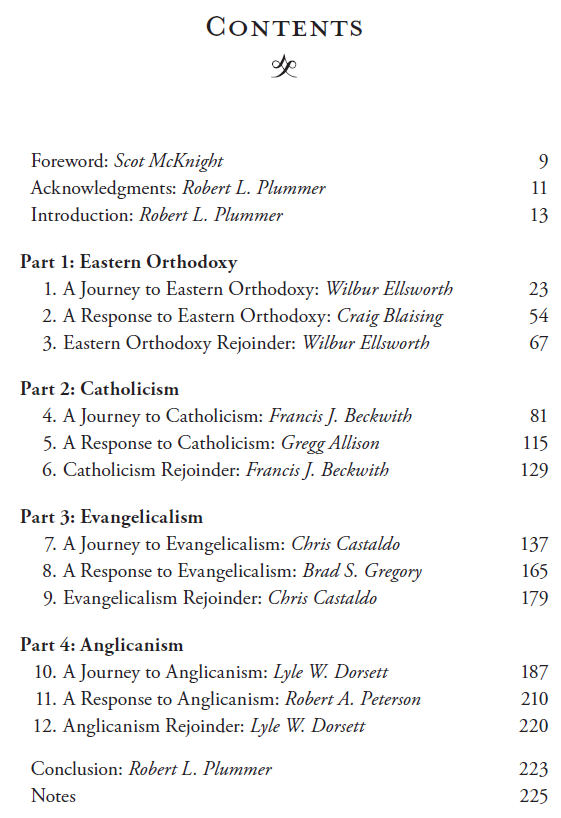
Robert L. Plummer, ed. Journeys of Faith: Evangelicalism, Eastern Orthodoxy, Catholicism, and Anglicanism. Grand Rapids: Zondervan, 2012.


Here’s an interview about the book that Rob posted on his blog.

The book is a fascinating read. It’s helpful to hear directly from the “converts.”

Scot McKnight mentions in the foreword, “If you are worried about numbers, they are still on the side of Evangelicals: more convert to Evangelicalism than away from it into Catholic, Orthodox, and Anglican churches” (p. 10).

Rob, a NT professor at Southern Seminary, concludes the book by sharing a troubling question that his wife asked him: “What if someone reads your book and converts to Catholicism?” (p. 223).

Could my book encourage some readers to embrace a theological tradition that, if given the opportunity, I would personally discourage them from pursuing? The question continued to trouble me. I discussed the matter with a colleague, who noted that Evangelicals are going to either help set the terms of this discussion or simply react to others.
  • Personally, I’d rather help make sure all sides have a fair hearing.
  • Moreover, going back at least to the Reformation, Christians have a long history of publishing academic disputes of this sort. This genre of writing should be understood as in no way implying a contributor’s approval of anyone’s view except those explicitly expressed by him.
  • Indeed, most contributors to this book see themselves as disagreeing on fundamentally irreconcilable issues.
  • Is the pope the rightful head of the Christian church?
  • Is justification a forensic declaration?
  • Is it appropriate, or even commendable, to use icons in Christian worship?
  • Is special grace communicated to participants in the Lord’s Supper, and if so, in what way?
People often find that for which they search. Yet what would I like for readers to take with them from this book? I can think of several things:
  1. I hope readers are able to recognize with greater sympathy the complex motivations which influence conversions to other Christian traditions.
  2. I want readers who are struggling with the desire to leave their tradition to feel both more understood and, in many cases, more hesitant.
  3. I hope that all Christians would find in this volume a model of peaceable ecumenical dialogue. (pp. 223–24, formatting added)

1662 Book of Common Prayer: J.C. Ryle

Bishop John Charles Ryle, Liverpool, UK
(1816-1900)
I go on to say that Evangelical Religion does not undervalue the English Prayer-book. It is not true to say that we do. We honour that excellent book as a matchless form of public worship, and one most admirably adapted to the wants of human nature. We use it with pleasure in our public ministrations, and should grieve to see the day when its use is forbidden.

But we do not presume to say there can be no acceptable worship of God without the Prayer-book. It does not possess the same authority as the Bible. We steadily refuse to give to the Prayer-book the honour which is only due to the Holy Scriptures, or to regard it as forming, together with the Bible, the rule of faith for the Church of England. We deny that it contains one single truth of religion, besides, over and above what is contained in God’s Word. And we hold that to say the Bible and Prayer-book together are “the Church’s Creed,” is foolish and absurd.

Knots Untied, p. 14

Thirty-nine Articles: James Packer and Treading Grain

James I. Packer, D.Phil, Oxford
1926-present
Treading Grain offers the following post at:  http://treadinggrain.com/2012/j-i-packer-the-creeds-and-the-articles-together/

I am enjoying quite a bit the reading I’m doing as preparation for our spring/summer sermon series on the 39 Articles. Peter Moore dropped off his copy of +John Rodgers’ new book on the Articles. It’s next on my reading list having finished J.I. Packer’s nice little treatise: The Thirty-Nine Articles: Their Place and Use Today.

In his essay, Packer writes of the dual role the Creeds and Articles play in the development of a coherent, robust and authentic Anglicanism.

The Apostles’ and Nicene Creeds challenge every generation of the world church: do you still stand with us on the Trinity? on the Incarnation? on the second coming of our Lord, and the Christian hope? If not, why not? Are not our positions scriptural? Go to the Bible and see. And if you find they are, will you not labour to teach and stress and defend these things in your day, as we did in ours? And the Articles, supplementing the Creeds, ask each generation of Anglicans further questions. Do you stand where we stand with regard to the sufficiency and supremacy of Scripture? the gravity of sin? justification by faith alone in and through Christ alone? the nature of the sacraments as seals of the gospel promise, means of grace because they are means to faith? loyalty to the gospel in word and sacrament as the sole decisive mark of the church? the dangerous, anti-evangelical tendency of Roman doctrines and practices? If these things are not at the centre of your faith and testimony, why not? Test these contentions by Scripture: is it not the case that where we are positive, the Bible was positive before us? And if we were right then to treat these points as evangelical essentials, ought not you to be seeking ways and means of proclaiming and vindicating them now?

If there is any substance in what we have been saying, it is clear that we many not just casually cast off the Articles because they are old. Until they are decisively refuted from Scripture (which has not been done yet), we have no warrant for rejecting them, or for relaxing the requirement of clerical subscription.

Tuesday, February 21, 2012

Common Prayer, Uncommon Beauty


The magnificent Book of Common Prayer has been going strong for 350 years.
Last year, this column and the world celebrated the 400th anniversary of the King James Bible. This year brings the 350th birthday of another magnificent monument of early modern English—the 1662 Book of Common Prayer (BCP). All who savor the riches of our common linguistic heritage should rejoice in its commemoration. For the BCP's combination of spiritual wisdom and literary beauty gives it a following far beyond the ecclesiastical frontiers of Anglicanism, Episcopalianism, and the Church of England that originally commissioned it.

The BCP was the creation of Thomas Cranmer, a Tudor statesman blessed with a genius for the writing of prose bordering on poetry. A court favorite of King Henry VIII, who made him Archbishop of Canterbury, Cranmer compiled the various prayers, collects, and orders of worship that eventually emerged as the 1662 prayer book. However, before it could be published in its final form its principal author was burned at the stake for his Reformist sympathies during a period of Catholic repression.

Although these power struggles have long since been forgotten, Cranmer's majestic command of the English language lives on. In the words of his leading biographer, Diarmaid MacCulloch: "Millions who have never heard of Cranmer or of the muddled heroism of his death have echoes of his words in their minds."

These echoes of Cranmer's gift for language ring down the centuries because he had a perfect ear for cadences that are both beautiful and eternal. He wanted "a mere ploughboy" to be able to remember the BCP's most powerful phrases. He did not hesitate to borrow from the finest spiritual writers of his time such as Miles Coverdale, an early translator of the Psalms, and Archbishop Reynolds, who authored the prayer of General Thanksgiving. Yet the most sparkling gems of the BCP were Cranmer's own compositions such as:
We have erred and strayed from thy ways like lost sheep. We have followed too much the devices and desires of our own hearts. We have left undone those things which we ought to have done. And we have done those things which we ought not to have done. And there is no health in us. (General Confession)
Or:
Lighten our darkness we beseech thee O Lord; and by thy great mercy defend us from all perils and dangers of this night. (Collect for Evening Prayer)
In my own love of the rhythms and resonance of such prayers I am conscious that I may be one of a dwindling band of English old fogeys. My familiarity with Cranmer's language dates back to the 1950s, when hardly any form of liturgy other than the BCP was used in Britain's schools and churches—as had been the case for the previous 300 years. But in the last half-century, evangelicals and modernists have elbowed out the BCP, replacing it with liturgical practices whose flexibility is all too often equaled by its banality.

American worshippers of various denominations may find the arguments for and against the BCP to be an esoteric British debate between the cult of quaintness and the pressures of political correctness. Yet excellence is excellence whatever the current fashion, and Cranmer's words, like Shakespeare's, have survived because they are "not of an age, but for all time.

For more, see:
http://spectator.org/archives/2012/02/20/common-prayer-uncommon-beauty

Friday, February 17, 2012

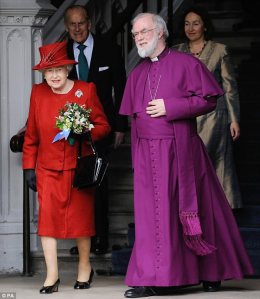
The Queen's Speech at Lambeth Palace

http://fcasa.wordpress.com/2012/02/17/the-queens-speech-at-lambeth-palace/

The Queen’s speech at Lambeth Palace

http://archbishop-cranmer.blogspot.com/2012/02/queens-speech-at-lambeth-palace.html

In an ecumenical gathering of faith leaders at Lambeth Palace, the religious leaders of the nation showed their affection and support for the Queen in her Jubilee year. She, in turn, made one short speech in which she encapsulated perfectly the essential religio-political raison d’ĂȘtre of the Established Church: Your Grace, Ladies and Gentlemen,

Prince Philip and I are delighted to be with you today to pay tribute to the particular mission of Christianity and the general value of faith in this country.

This gathering is a reminder of how much we owe the nine major religious traditions represented here. They are sources of a rich cultural heritage and have given rise to beautiful sacred objects and holy texts, as we have seen today.

Yet these traditions are also contemporary families of faith. Our religions provide critical guidance for the way we live our lives, and for the way in which we treat each other. Many of the values and ideas we take for granted in this and other countries originate in the ancient wisdom of our traditions. Even the concept of a Jubilee is rooted in the Bible.

Here at Lambeth Palace we should remind ourselves of the significant position of the Church of England in our nation’s life. The concept of our established Church is occasionally misunderstood and, I believe, commonly under-appreciated. Its role is not to defend Anglicanism to the exclusion of other religions. Instead, the Church has a duty to protect the free practice of all faiths in this country.

It certainly provides an identity and spiritual dimension for its own many adherents. But also, gently and assuredly, the Church of England has created an environment for other faith communities and indeed people of no faith to live freely. Woven into the fabric of this country, the Church has helped to build a better society – more and more in active co-operation for the common good with those of other faiths.

This occasion is thus an opportunity to reflect on the importance of faith in creating and sustaining communities all over the United Kingdom. Faith plays a key role in the identity of many millions of people, providing not only a system of belief but also a sense of belonging. It can act as a spur for social action. Indeed, religious groups have a proud track record of helping those in the greatest need, including the sick, the elderly, the lonely and the disadvantaged. They remind us of the responsibilities we have beyond ourselves.

Your Grace, the presence of your fellow distinguished religious leaders and the objects on display demonstrate how each of these traditions has contributed distinctively to the history and development of the United Kingdom. Prince Philip and I wish to send our good wishes, through you, to each of your communities, in the hope that – with the assurance of the protection of our established Church – you will continue to flourish and display strength and vision in your relations with each other and the rest of society. The secular-humanist atheists are incapable of grasping these essential truths, but a few politicians might take note. God Save the Queen.
------------------------

http://archbishop-cranmer.blogspot.com/2012/02/queens-speech-at-lambeth-palace.html

There are numerous commentators "for/against" the religious establishment of the Church of England.

Tuesday, December 20, 2011

WCF 31.2: Importance of Synods and Councils

Chapter 31.2: Of Synods and Councils

2: It belongs to synods and councils, ministerially to determine controversies of faith, and cases of conscience; to set down rules and directions for the better ordering of the public worship of God, and government of his Church; to receive complaints in cases of maladministration, and authoritatively to determine the same; which decrees and determinations, if consonant to the Word of God, are to be received with reverence and submission; not only for their agreement with the Word, but also for the power whereby they are made, as being an ordinance of God appointed thereunto in His Word.

Sunday, November 27, 2011

Anglicanism: Lee Gatiss's Take

http://acl.asn.au/reformation-to-revival/

From Reformation to Revival

Posted on November 28, 2011
Filed under
History, Resources


Lee Gatiss has been speaking in Cambridge at the ‘Saturday School of Theology’ on the theme ‘From Reformation to Revival’.

The audio of the first two sessions is now available, with the third to come. Below are the descriptions of each session: 

The 16th Century Reformers

It’s almost 500 years since Martin Luther started the Reformation and changed the course of history. But what did this beer-drinking, outspoken ex-monk really stand for? How did he have such an impact?

Many will also know the name of the French Reformer, John Calvin, but associate him with “chauvinism” or predestination or a little boy with a toy tiger called Hobbes. But what really was the pious heartbeat of Calvin’s life and ministry? And what was it that has made him one of the greatest names in church history?

The 17th Century Puritans

The Puritans saw themselves as pilgrims, warriors, and servants of Christ in an age of great conflict. From them we get our word “puritanical” but were they as bad as that makes them sound? They also gave us several Cambridge colleges, mountains of great books, spread the gospel to far away lands, and chopped off the head of a bad king. So they were anything but dull! What was it that made people either love them or hate them? And what can we learn from them to reinvigorate our lives as Christians today?

The 18th Century Evangelicals (coming soon)

The church was cold and lifeless, infected with worldliness and a lack of vigor. Love for Christ and the Bible was at a low ebb. That is until John Wesley and George Whitefield set the world on fire and revived the nation’s spiritual life with passionate and powerful gospel preaching! Or did they? What can we learn from these heroes of the faith who sought to win the world for Christ? Was all as rosy as it seemed within the Evangelical movement? Or did revival rivalries almost tear it apart from within? Discover the glory, and the dark side, of the great awakenings.

Hear the talks at this link.

Sunday, November 20, 2011

UK Theolgian Dr. Turnbull Says God Still Has Plan for CofE

http://www.virtueonline.org/portal/modules/news/article.php?storyid=15207

UK Seminary Theologian Says God still has a Plan for CofE despite Theological Liberalism, Cultural Obstacles

An Interview with the Rev. Dr. Richard Turnbull principal (president) and Dean of Wycliffe Hall, Oxford

By David W. Virtue
www.virtueonline.org
November 16, 2011

He was the youngest at 44 in 2005 to lead a prominent British theological institution. Now at 51, the Rev. Dr. Richard Turnbull who holds a First Class honors degree in theology and a doctorate in Church History from Durham University has weathered the early storms that go with a new principal (president) and Dean of Wycliffe Hall, Oxford. He is naturally proud that his institution is a recognized college of the University of Oxford although his institution came under close scrutiny a few years ago. In fact Richard comments that the University has been strongly supportive of Wycliffe, its role within the University and its scholarly contribution to the Faculty of Theology. As principal, Turnbull gives leadership to the college as well as teaching and representing the college externally. He teaches courses on Anglicanism, Anglican and Evangelical Identity and the Reformation. He is currently undertaking research projects in Evangelical spirituality and the future of Evangelicalism.

He is the author of Anglican and Evangelical? and Shaftesbury, the great reformer - a great biography of Wilberforce's effective successor who served in Parliament for 60 years. Books on the history of the Evangelical Revival and Evangelical Spirituality will be published in 2012.He was a member of the committee that drafted the document A Covenant for the Church of England. Richard has also served on the Archbishops' Council and chaired review committees for the Church of England.

He was in Philadelphia recently lecturing at the John Jay Institute, an Anglican-based Fellows Program for post-graduate persons aspiring to public office in society and the church.

VOL met with Dr. Turnbull at the Bala Cynwyd based organization and sat down to talk with him about the state of the Church of England, women bishops, as well as theological education in the UK and if the Church of England will be a viable institution 25 years from now.

VOL: What is the state of your theological college and theological education in general in England?

TURNBULL: We have about 100 students. We are among the largest theological colleges in England. About two-thirds are training for the Anglican ministry, another quarter studying apologetics and the rest are doing post-graduate work. Candidates for ministry are evangelicals going into the ministry and they are coming from mainly conservative churches.

While the overall numbers for ordination are down slightly, a fair number are in their 20s which says to me that God still has a plan for England and the Church of England.

Another college like us is Oak Hill in London, though we would probably have a wider range of students. Ridley ,Trinity, Bristol, St John's Nottingham, Durham are much less conservative (some would use the description liberal evangelical - meaning less clarity on the doctrine of scripture and the substitutionary atonement), though all these have some good people. Ripon College Cuddesdon and Westcott House, Cambridge, Queens, Birmingham are more liberal and not evangelical. The Anglo-Catholic colleges are small and very weak. St. Stephens House has less than 20 and The College of the Resurrection Mirfield, is also very liberal and struggling.

ANGLO-CATHOLICISM

VOL: Does Anglo-Catholicism have a future in the Church of England?

TURNBULL: Anglo Catholicism is in long term serious decline in the Church of England. Anglo-Catholics are more conservative in some areas and more liberal in other areas. So for example, most Anglo-Catholics would affirm the same principles of revelation as evangelicals but on issues such as homosexuality there would be much divided opinion in the Catholic constituency.Affirming Catholicism is liberal in theology and doctrine. A majority, are catholic minded Anglicans but there is a great deal of antipathy between Anglo Catholics and Affirming Catholics. Dr. Rowan Williams is an Affirming Catholic, but to be honest he is also a thoughtful and engaging scholar. We at Wycliffe try to co-operate with the Anglo-Catholic constituency as much as possible but friends in the US need to understand that whilst evangelicals in the Church of England are relatively strong, the Catholic constituency is really very weak, with few ordinands.

VOL: What are some of the pressures you face?

TURNBULL: There are lots of pressures on seminaries particularly those that are clear cut in their theology with intrusion from secular authorities. I was advised that I could not hire a Christian as my personal executive assistant. I was told that anybody could type or answer the phone. I thanked the advisors and refused to accept their authority in this matter. I utterly and totally repudiate the notion that you have to accept pressure from the state and pressure from the church over teaching good old fashioned evangelical doctrine. I want to teach people to love Jesus and proclaim the message of the cross and resist the pressure to conform. Jesus was not a conformist.

I am committed to teaching traditional doctrine of the OT & NT and history with lots of training for the practical (pastoral) ministry. A lot of institutions have titles for their professors that do not reflect either sound doctrine or pastoral concerns, a lot of approaches have to do with self esteem and self realization. I don't understand what all that navel gazing has to do with one's ability and need to teach the historic faith. Of course, that is not to say we do not need character formation, that is essential, but it is a matter of being clearly focused on the essentials.

ROWAN WILLIAMS

VOL: It has been widely reported that Dr. Rowan Williams, the Archbishop of Canterbury is going to resign though Lambeth Palace has said nothing either way. What is your take?

TURNBULL: I am not sure about the veracity that he will resign. The idea that Rowan Williams will return to an academic post at some point is not news. All that is at some point in the future. To my knowledge there has been no decision. He may do that and that would not be a surprise. Speculation about his successor is wide of the mark. Most candidates are 2-3 years older than Rowan therefore unlikely to succeed him including John Sentamu Archbishop of York and Richard Charters Bishop of London.

VOL: In your opinion does the former Bishop of Rochester, Dr. Michael Nazir Ali have a chance?

TURNBULL: It would be great if Michael could succeed Rowan. He is very controversial in the minds of some. In point of view of orthodox biblical faith Anglicans would find no better representative than Nazir Ali. He has the confidence of the Global South but within the UK he is probably not a realistic prospect. I should add that Michael serves as a senior fellow at Wycliffe Hall and brings great insights into our teaching.

WOMEN BISHOPS

VOL: Are women bishops inevitable in the Church of England? Can the momentum really be stopped?

TURNBULL: The issue of women bishops is causing much anxiety in the evangelical community in England and although there are various views the majority of evangelicals believe that there should be some legally provided protection for those who, in conscience, find the appointment of women bishops not to be in accordance with the scriptures. What is happening is that all 44 dioceses are voting individually on proposed legislation and it looks likely that it will be passed in most dioceses. In fact we now know that all but two dioceses have passed the legislation but around 12 dioceses also passed resolutions seeking more formal protection for those who have reservations.

VOL: What happens next?

TURNBULL: It will then come back to Synod in July 2012 where it will require two-thirds majority of bishops, clergy and laity voting separately. The vote will be close in the House of Laity, maybe then the archbishop will seek a compromise to offer protection in order to ensure its passage. You need 33% to block it, but they will wobble when they see the other houses go for it. There is a real prospect, but no certainty, that the Measure will in fact fail to gain the necessary votes in the House of Laity.

For the remaining Anglo-Catholics in the Church of England it is a real disaster and will lead to more defections to Rome after the vote.

VOL: What will be the impact on Evangelicals?

TURNBULL: The problem for the evangelical wing is that we are not that keen on bishops anyway and will carry on doing our own thing.

The Church of England will have women bishops and some of the existing bench of bishops can't wait to be the first to make such an appointment. That will create problems if women are appointed for the sake of it and for those parishes and clergy who cannot in conscience accept it. My genuine hope is that there will be some legally provided provision to enable both sides of the debate to coexist.

VOL: Will church attendance suddenly rocket if there are Women Bishops?

TURNBULL: None whatsoever. Most people are not interested and they do very little evangelism in the name of Jesus and it is therefore a distraction from the real mission of the church.

HOMOSEXUALS AND THE CHURCH OF ENGLAND

VOL: Where is the "gay" agenda going in the Church of England?

TURNBULL: It is only a matter of time before we have an attempted effort to appoint a bishop who is a practicing homosexual. Regrettably some people are already campaigning on the issue and can't wait till the opportunity arises. The problem for most orthodox Christian believers is that such an appointment would be contrary to Scripture.

VOL: Would that split the Church of England?

TURNBULL: It's very complicated in England because local churches have significant independence from their bishop and can safely ignore the bishop so there will not be a clean linear split. That explains why there won't be a split.

VOL: What is the difference between a TEC bishops' authority versus a CofE bishops' authority?

TURNBULL: It is amazing to us that TEC bishops have that power and authority and can determine the employment and future of a local priest. In England a bishop does not necessarily have that same authority at all.

VOL: In TEC a bishop has rights of visitation to a parish and has significant control over the priest and acts really as a key central ecclesiastical authority. A priest is obliged to receive a bishop once every three years.

TURNBULL: The history of the Church of England is that authority is diffused and dispersed and bishops have no power to impose their will on local churches. The local church is not ecclesiastically required to invite a bishop to his/her parish. All financial assessments are voluntary and could/should be drastically reduced. A bishop does not have the power to visit at will or to fire a priest without a disciplinary process, for example involving adultery.

VOL: There are some very real fundamental differences then?

TURNBULL: Yes. The situation in England is different from that in TEC and it is possible for parishes to exist within the Church of England without the same degree of oppression and most evangelicals have no intention of leaving the Church of England - mainly because the foundation documents are clearly Protestant and Reformed. In England most evangelical priests have a low opinion of the theology of bishops and also most of the occupants on the current bench in the House of Lords.

The Lords Spiritual as they are called number 26 in the House of Lords, and they love it for the preferment it offers and they enjoy the status it gives them and they can lead prayers. I welcome the Christian voice in the public square. However, they are rarely united and most wouldn't know how to lead anyone to Christ.

VOL: Former Archbishop George Carey and former Rochester Bishop Dr. Michael Nazir Ali have been quite vocal on the Culture Wars. What is your take on this?

TURNBULL: I admire and welcome both men's contribution to the debate on the clash of culture and the challenge to Christianity that comes from culture. Christianity has always been counter cultural not just submerged underneath the culture, especially in terms of secularization and Islam.

Both men have been very brave speaking out about most things. It is seen as very politically incorrect in the UK to do so. It is very brave of Nazir Ali. He is powerfully speaking up about the challenge of Islam because he has direct experience as well as being the [former] Bishop or Rochester. He was not listened to but he represents a strong standard of English public opinion. Both Christianity and Islam are missionary faiths and it is not surprising there are clashes of culture. We should not be afraid of Christianity being a missionary faith.

THE FUTURE OF THE CHURCH OF ENGLAND

VOL: What do you see as the future of the Church of England?

TURNBULL: The Church of England will be smaller in 10-15 years and my hope is it will be slimmer and fitter. It suffers from an enormous bureaucracy and a financial system that looks like a command economy and that needs to change. I hope we reduce the number of dioceses and reduce bureaucracy and appoint bishops, that is leaders who are spiritual, evangelical and church planters rather than estate agents and managers.

VOL: Should the CofE be disestablished?

TURNBULL: On balance to go down that road of disestablishment would be a distraction from evangelism and mission and church planting. The CofE is not a state church, it is the church in Europe that is least connected to the state and it is a common misunderstanding that the state controls the church or funds the church. It does neither. The establishment can give enormous opportunity for witness and evangelism. My responsibility is to train clergy so that they can make effective use of those opportunities to proclaim Jesus.

VOL: With the growing liberalization and feminization of the Church of England can you easily place graduates?

TURNBULL: Generally that is not a problem. There are occasional issues of mismatch of graduates from evangelical colleges but mostly graduates can find jobs and it is the best interest of the Church of England that they do so.

VOL: How important is C. S. Lewis to the British public?

TURNBULL: He is only a big name in regard his being the author of children's books. Some people would recognize the Christian analogy that is drawn from those books. Very few know him as a Christian apologist. I think he is better known as a Christian apologist in the US

CULTURE WARS

VOL: There have been several reported instances in the British press of English Christians losing their jobs and facing legal action for praying with people, wearing Christian symbols, B& B owners being fined for not allowing homosexual couples to stay in their place and generally standing up for their Christian convictions.

TURNBULL: The use of legal action against Christians has caused enormous anxiety and we have even had situation of people losing their jobs for having a Christian symbol in their vehicle while working for a city council. Legal action on behalf of Christians oppressed in this way has generally failed, which frankly, is quite depressing. I see no end in sight, but there could be a backlash if this continues.

EVANGELISM AND CHURCH PLANTING IN THE UK

VOL: How is evangelism and church planting doing in England?

TURNBULL: England is spiritually desperate and more in need of the message of the gospel than ever before. This is the land of Wesley and Whitfield and we need people raised up with a passionate love of Christ to proclaim his life changing message. God has acted before in England I believe he will do so again. We need to plant churches, declare it in our teaching and allow God to act.

England has a great missionary heritage and is now in need of missionaries returning to England with that same gospel we once took elsewhere, so I welcome all of those who come from the Global South because they have the spiritual experience, suffering and persecution and the clarity of biblical teaching which England so desperately needs.

VOL: The Occupy Wall Street movement has come to England and St. Paul's Cathedral became the focus of their protest resulting in three resignations including the Dean. It has also put the Bishop of London Richard Charters in a very awkward position. If you side with the protestors who believe the moneyed few control the assets of England then the cathedral suffers from lost income (about $23,000) a day. If you side with the cathedral who look like the money changers in the Temple you might incur the wrath of Jesus or at the very least the protestors if you call the Police in to take them away. What is your take?

TURNBULL: I do have sympathy, great sympathy, with St Paul's Cathedral who found themselves in an impossible position. I very much regret the Dean's resignation. The truth is that once the police were sent away and the protesters welcomed, any decision made by the Cathedral authorities was likely to be problematic. I personally do not have much sympathy with the protesters and the church has been made to look foolish. Most of the protesters are 'fair weather' agitators; they put up their (rather expensive) tents and go to sleep in their comfortable suburban homes at night.

Actually we do not wish to adopt the views of the protest groups, I do not think they represent any significant opinion in the UK they are a rather motley collection of Marxists and anarchists. We need the banks, we need wealth creators we need innovation. However, I also believe that it is a legitimate Christian concern to raise questions about the level and structure of remuneration in the banking industry, but the questions need to be asked in context and not linked to some bizarre protest. Equally I would say that the Cathedral is right not to pursue legal action to evict if possible. We should not use unnecessary legal means or force that is not a great witness. My point also though is we should also not 'baptize' protest movements as representing the views of Christ. God created man to work, to create wealth and we should encourage that, as well as asking appropriate questions about philanthropy, boundaries, distribution etc - but you cannot properly discuss the latter without the former.

VOL: I understand there might be a silver lining with an orthodox bishop called to take over the helm of the cathedral. Can you elaborate on that?

TURNBULL: English Cathedrals are another idiosyncrasy. They are independent of Bishops (again, rather vigorously so in some respects) and the Bishop cannot control the cathedral. The senior cleric is the Dean, appointed in consultation with the Bishop, but no exclusively so. Occasionally a Bishop may move to be a Dean, but it is not usual, slightly more often, a Dean moves to become a Bishop. To be Dean of St Paul's is an important and highly responsible job, I pray the right person is appointed.

VOL: Thank you Dr. Turnbull.

END

Descriptive and Prescriptive Anglicanism

http://livingtext.wordpress.com/2011/11/19/descriptive-and-prescriptive-anglicanism/

Descriptive and Prescriptive Anglicanism

by joelmartin

You may be familiar with the two different approaches to grammar known as descriptive and prescriptive grammar. The Concise Oxford Companion to the English Language defines these approaches as follows:
A descriptive grammar is an account of a language that seeks to describe how it is used objectively, accurately, systematically, and comprehensively. A prescriptive grammar is an account of a language that sets out rules (prescriptions) for how it should be used and for what should not be used (proscriptions), based on norms derived from a particular model of grammar. (p 262-63)
A way to illustrate this is that a descriptivist would include “aint” in the dictionary because it is a word that people say, while a prescriptivist would not include it because it is a vulgar word, or a neologism and so should not be included.
I think the same schools of thought can be helpfully applied to the term “Anglicanism” today. Just what does it mean to be Anglican? If we use the descriptivist approach, we come up with an answer so broad as to cease being useful. You can be homosexual, bow to man-made objects, pray to Mary and the saints, be a conservative evangelical, be an Arminian or Calvinist, be charismatic or cessationist, and on and on. Archbishop Orombi attempted a summary a few years ago (here). There really aren’t many boundaries at all, everyone claims a right to the title and most have at least some historical precedent for their position.

If we turn to prescriptivist approach, I think we can fairly establish the parameters by looking at the two foundings of Anglicanism as something unique – the first under Henry VIII and the second under Elizabeth, the Virgin Queen. We could look at the formularies of the Church, the substance of the Book of Common Prayer, the Book of Homilies, the writings of the early Bishops and clergy, and so on. Although there will not be complete unity from this body of literature, I believe that there is enough substance to establish a firm baseline for what “Anglicanism” was intended to be.
Unfortunately, as Nietzsche said, the “world is the will to power” and the trajectories of Anglicanism show this in practice. Folks have paid no heed to the genesis of Anglicanism and have made it into a multifarious mess. As a prescriptivist I cannot agree that their interpretations are valid, ultimately they fail the Scriptural test. But from a descriptivist perspective, they can only be called Anglicans because that is what they call themselves.

Here are some sources that can contribute to a better understanding of what Anglicanism was intended to be:

[1] The Doctrine of the Church of England as to the Effects of Baptism in the Case of Infants, by William Goode.

[2] The Primer: a Book of Private Prayer, edited by Henry Walter.

[3] Eighteen Sermons Preached in Oxford 1640, by Archbishop James Usher.

[4] Documentary Annals of the Reformed Church of England, Volume I and Volume II, by Edward Cardwell.

[5] The Principal Ecclesiastical Judgments Delivered in the Court of Arches 1867 to 1875, by Sir Robert Phillimore.

[6] Certain Sermons or Homilies: Appointed to be Read in Churches in the Time of the Late Queen Elizabeth, by the Church of England.

[7] Writings of the Rev. Dr. Thomas Cranmer

[8] Lives of the Elizabethan bishops of the Anglican Church, by Francis Overend White.

[9] Lawful Church Ornaments: Being an Historical Examination of the Judgment of Stephen Lushington in the case of Westerton v. Liddell, etc, by Thomas Walter Perry

[10] Formularies of faith put forth by authority during the reign of Henry VIII, ed. Charles Lloyd

[11] The Ecclesiastical Law of the Church of England, Sir Robert Phillimore

And of course, Richard Hooker’s Laws of Ecclesiastical Polity, all the works of Latimer, Cranmer, and Jewel.

Friday, November 18, 2011

Hilda, Another Anglican Forbear from Northumbria, UK

Another hat tip to Ohio Anglican at:  http://ohioanglican.blogspot.com/2011/11/hilda-of-whitby.html.  As a Northumbrian, that involves the Veitch-heritage in northern England.  Again, thanks OA.

Hilda of Whitby


Hilda (known in her own century as "Hild") was the grandniece of King Edwin of Northumbria, (see 12 Oct) a kingdom of the Angles. She was born in 614 and baptized in 627 when the king and his household became Christians. In 647 she decided to become a nun, and under the direction of Aidan (see 31 Aug) she established several monasteries. Her last foundation was at Whitby. It was a double house: a community of men and another of women, with the chapel in between, and Hilda as the governor of both; and it was a great center of English learning, one which produced five bishops (during Hilda's lifetime or that of the Abbey?). Here a stable-boy, Caedmon, was moved to compose religious poems in the Anglo-Saxon tongue, most of them metrical paraphrases of narratives from Genesis and the Gospels.

The Celtic peoples of Britain had heard the Gospel well before 300 AD, but in the 400's and 500's a massive invasion of Germanic peoples (Angles, Jutes, and Saxons) forced the native Celts out of what is now England and into Wales, Ireland, and Scotland. The invaders were pagans, and missionaries were sent to them in the north and west by the Celts, and in the south and east by Rome and other churches on the continent of Europe.

Hilda herself greatly preferred the Celtic customs in which she had been reared, but once the decision had been made she used her moderating influence in favor of its peaceful acceptance. Her influence was considerable; kings and commoners alike came to her for advice. She was urgent in promoting the study of the Scriptures and the thorough education of the clergy. She died 17 November 680.


Propers for Hilda of Whitby - Abbess

The Collect.

O God, whose blessed Son became poor that we through his poverty might be rich: deliver us from an inordinate love of this world, that, following the example of thy servant Hilda, we may serve thee with singleness of heart, and attain to the riches of the world to come; through Jesus Christ our Lord, who liveth and reigneth with thee in the unity of the Holy Spirit, one God, now and for ever.


The Epistle - Ephesians 4:1-6
The Holy Gospel - St. Matthew 19:27-29

Reference and Resources:
http://en.wikipedia.org/wiki/Hilda_of_Whitby
http://elvis10.rowan.edu/~kilroy/jek/11/18.html
http://www.newadvent.org/cathen/07350a.htm
http://www.missionstclare.com/english/people/nov18.html

Saturday, July 23, 2011

"The Historical Moorings of Anglicanism" by Robin Jordan

http://anglicansablaze.blogspot.com/2011/07/historical-moorings-of-anglicanism.html

The Historical Moorings of Anglicanism


By Robin G. Jordan

The Protestant, Reformed faith of historic Anglicanism may be summed up in a number of propositions.

--The Scriptures are God’s Word written. They are our supreme and final authority in all matters of faith and practice.

--They contain all that we need to know to be saved.

--Due to sin, our own individual rebellion against God as well as that of humankind, we have become estranged from God, and rightly deserve his just wrath and condemnation.

--Only Christ was free from the human propensity to disobey God and to do evil. Only he was free from the effects of humankind’s rebellion against God.

--We cannot by our own efforts be reconciled to God. We do not even have the will to seek reconciliation with God.

--Our salvation is God’s doing. He provides a way by we may be restored to a right relationship with him. Only God’s influence working in us enables us to have the will to seek reconciliation with God and to take advantage of the way that he has provided to affect that reconciliation. It is by faith in Christ and by faith in him alone that we are reconciled to God.

--Christ offered himself as a sacrifice for the sins of all humankind upon the cross. Christ’s one offering was finished in the cross. There he bore the full consequences of humanity’s rebellion against God and gained God’s forgiveness. Christ’s sacrifice was complete and perfect. We have need of no other sacrifice for the forgiveness of sins.

--Our good deeds are acceptable to God only when they spring from a vital faith in Christ. This faith is not a result of our own efforts but a gift from God.

--Christ instituted two sacraments—baptism and the Lord’s Supper. They are signs and guarantees of God’s favour and goodwill toward us. They answer the purposes for which Christ ordained them.

--Christ instituted the Lord’s Supper to be a commemoration of his sacrifice and to enliven and strengthen our faith in him. Through the Lord’s Supper we participate in the benefits of his sacrifice.

These propositions are the moorings to which historic Anglicanism is tied. They are not its only moorings but they are numbered among its chief moorings—the teachings of the Bible to which it is attached.

When you attend church on Sunday, do you hear these teachings preached from the pulpit and taught in the classroom? Or do you hear a different message taught in their place? If you hear a different message, you are not hearing the New Testament gospel, as the English Reformers understood it.

In the sixteenth century the English Reformers drew up the Thirty-Nine Articles to safeguard the truth of the gospel and to protect the pulpit from heresy and false teaching. The gospel had been lost to the Church of England for centuries. In its place had grown up a false religion which taught that sacraments and good deeds are the way to heaven and which took salvation out of God’s hands and placed it into the hands of a human being—a priest. The English Reformers did not want the gospel to be lost to the English Church again.

Sadly many Anglicans in America have a distorted view of the Reformation. Late Philip Edgcumbe Hughes in his opus magnum, The Theology of the English Reformers explains the true nature of Reformation.

In England, as in other countries, the Reformation of the sixteenth century was in its essence a spiritual movement flowing from the rediscovery of the gospel of divine grace to which the pages of the Holy Scripture bear testimony.

The English Reformers would experience the power of the gospel and it would transform their lives. Having received so precious a gift, they did not want to keep it to themselves but desired to share it with their fellow countrymen and future generations. God was working in them both to will and do his good pleasure. Five centuries later Anglican Christians in Africa, Asia, Australia, the British Isles, Canada, Ireland, South America, and other parts of the world can lift their voices in praise of the God who brought the English Reformers out of darkness into his marvelous light and in turn has done the same thing for them. They too have experienced the dynamic, life-transforming power of the gospel because God caused the English Reformers and those who followed in their footsteps to not only pass on the good news of Jesus Christ to the next generation but also to fulfill Christ’s Great Commission to go into all the world and to proclaim the gospel to the whole creation.

Yet wherever the Holy Spirit is working to bring men and women to the knowledge of salvation, other forces are at work to keep them in darkness, ignorance, and superstition. This includes our own predisposition to rebel against God and to do evil. While the gospel of grace has not been entirely lost, it has disappeared from a number of churches that claim to stand in the Anglican tradition. Elements of the false religion that had displaced the true apostolic faith in the Medieval Church have been reintroduced into these churches along with innovations in doctrine and worship borrowed from a corrupt Church of Rome. Other heretical and false teachings have also been introduced into these churches. This has often been done by men and women who are not trying to deceive the congregations of these churches with teachings that they recognize are heretical and false. It has been done by those who themselves are deceived by such teachings. The “god of this world”, to use the words of the New Testament, along with their own vanity, keeps them from seeing the truth, and encourages them to accept falsehood in place of the truth.

The churches in which Anglicanism has been cast loose from these moorings are drifting toward a maelstrom of destruction. A maelstrom is a great tidal whirlpool that ships caught in its grip cannot escape. They are dragged to the sea bottom or broken on the rocks, and their crew and passengers are drowned.

How can we distinguish those Anglican churches that are adrift? They are churches in which the true gospel is not preached from the pulpit or taught in the classroom. They are churches in which the Protestant, Reformed faith summed up in the foregoing propositions is not found, or if it is found, is greatly diluted or distorted. They are churches that do not accept the authority of the Thirty-Nine Articles, which regard them as historical documents or relics of the past, or where they “have formal authority but are neglected as living formularies.” They are churches in which the Articles are not interpreted in accordance with their plain, natural, and intended sense but in a fanciful, ahistorical manner.

The Articles are compared with a standard of doctrine that does not exist, which is a construction in the mind of the interpreter. The “great historical fact” that “the Articles belonged to an age in which Western Christendom was divided into two great camps, the Roman Catholic and the Protestant, and that the Articles were a declaration that England took her place in the Protestant camp” is ignored. The reference in the Declaration to only “the literal and grammatical sense” of the Articles is held relieve the interpreter “from the necessity of making the known opinions of the framers a comment upon the text.” “This last evasion,” as Professor Gillis Harp points out in his Churchman article, ”Recovering Confessional Anglicanism,” “…effectively detaches” the ‘train' of the Articles from its ‘engine' (i.e., its original historical context and the original Intent of its authors) and essentially allows one to pull Anglicanism anywhere one likes.”

In the United States in which Christians who have been influenced by the culture’s emphasis upon the maintenance of diversity at the expense of truth seek to outdo each other in showing their tolerance of divergent opinions, the view expressed in this article may seem to be intolerant. However, I doubt that the English Reformers would see it that way. They recognized that where the salvation of humankind was involved, there was only one truth, the truth of God’s Word. Men might differ on secondary matters but not on any matter related to salvation.

1 comments:


Jordan said...
Tips for churchgoers: Anytime you hear the words, "Well, the Articles don't really say that," beware! The Articles are easy to understand but many clergy will take a word and make it mean something contrary

Friday, July 15, 2011

Glad to Be Anglican

http://gladtobeanglican.blogspot.com/2008/08/his-cross-and-ours.html

His Cross and Ours
The following is the bulk of my sermon today from Galatians 5:24. The stuff about Bishop Moule will be no surprise for readers of this blog!

One my heroes for the last 30 years has been Bishop Handley Carr Glynn Moule, born in Dorsetshire, in 1841, and died in Cambridge, in May of 1920. The son of an Anglican priest - who, by the way, was of French extraction; his mother was Welsh - he became the dean of Trinity College, Cambridge, the first president of Ridley Hall, Cambridge - which is where I would have liked to have studied if I had done my schooling in England. A friend of mine is currently studying there, and I'm a bit envious of that. Eventually Moule was consecrated the Bishop of Durham, following on the heals of two other great Bishops of Durham, J. B. Lightfoot, and B. F. Westcott, both of whom remain still today, like Moule, giants in New Testament studies. Though raised a Christian, it was not until September the 18th, of 1884, that Moule seems to have gone through a spiritual crisis which was a defining point in his commitment to Christ. The rest of his life as a Christian could be considered as a progressive growth from that particular time. Now, Moule was a poet and author, and has given us some beautiful pieces - sadly, none of his hymns are in the 1940 hymnal. One of his pieces is connected to that moment of commitment to Christ to which I have referred, and it is called the Morning Act of Faith. Let me read it to you:

I believe on the Name of the Son of God.
Therefore I am in Him, having Redemption through His Blood, and Life by His Spirit.
And He is in me, and all fulness is in Him.
To Him I belong, by purchase, conquest, and self-surrender.
To me He belongs, for all my hourly need.
There is no cloud between my Lord and me.
There is no difficulty, inward or outward, which He is not ready to meet in me to-day.
The Lord is my Keeper. Amen.


Now it is that line, where he says, To Him I belong, that I want us to note. Every Christian belongs to Christ.

Why do we belong to him? Bishop Moule tells us, summarising what the Bible says. First, we are his by purchase. Paul says in I Corinthians: 19: What? know ye not that your body is the temple of the Holy Ghost which is in you, which ye have of God, and ye are not your own? 20: For ye are bought with a price.... Peter tells us what that price was in his first epistle: 18: Forasmuch as ye know that ye were not redeemed with corruptible things, as silver and gold, ... 19: But with the precious blood of Christ, as of a lamb without blemish and without spot. We belong to Christ by purchase. And when did He purchase us? When died on the Cross, and shed His blood for our payment.

But Moule also says we belong to Christ by conquest. We don't talk like this much in our day of disdain for empires and our talk of international laws - which don't work, by the way - but it used to be that a conqueror was considered to have right over those he had conquered; right by conquest, we say. Well, Christ has conquered us, has he not? We lived in rebellion against him; we were part of that humanity, under bondage to the devil, that raises its fist to God and cries "We will not have the LORD to reign over us," and seeks to build its own kingdom for its own glory. But Christ came, born of Mary, riding on a donkey, suffering under Pontius Pilate, crucified, dead, and buried, that he might on the third day rise from the dead as Christus Victor - Christ the Victor - as He himself had said, "Be not afraid, I have overcome the world!" How? Through the cross, as we are told in Hebrews 2: 14: Forasmuch then as the children are partakers of flesh and blood, he also himself likewise took part of the same; that through death he might destroy him that had the power of death, that is, the devil; 15: And deliver them who through fear of death were all their lifetime subject to bondage.

And now all authority is given to him in heaven and earth, and the words of God, spoken through King David in the second psalm, are fulfilled in these last days: "Yet have I set my king upon my holy hill of Zion - ask of me and I shall give thee the heathen for thine inheritance and the uttermost parts of the earth for thy possession. Thou shalt break them with a rod of iron; thou shalt dash them in pieces, like a potter's vessel." And then David tells the kings and rulers of this rebellious globe - admit your defeat! Reverence and submit to this new king, the Son of the God of the Universe, lest you be destroyed should he get riled with you, even just a little bit. And when this great King, who is also a Lamb, called us ever so kindly to come to him and turn from living in our rebellion against him, and to bow our knees to him and acknowledge him as king and Lord over our lives, we were conquered - not by His sword, but by His love and grace - that love and grace so wonderfully displayed and powerfully effectual on the Cross of Calvary. We now love our Conqueror, because He first loved us.

We belong to Jesus. We belong to Him because He has bought us, because he has conquered us, and because we have gladly surrendered ourselves to him. This surrendering of ourselves to Him is depicted, here in Galatians 5, by Paul, with the imagery of crucifixion. 24: And they that are Christ's have crucified the flesh with the affections and lusts.

We belong to Christ because we have given ourselves to Him. And this giving of ourselves to him is a kind of dying. We cease to live our life for ourselves and begin to live for him. Hear what Paul says earlier in Galatians, in ch. 2:20: I am crucified with Christ: nevertheless I live; yet not I, but Christ liveth in me. Note this idea of replacement through crucifixion: my life is given up for His. Christians are disciples who follow Christ. Christ went to the cross so that he might remove all that would hinder us from joining with him in his new resurrected life. But in order to share in his new life, we must share in his death. In order to rise with him in the Spirit, we must die with him on the Cross.

Do you remember, in the gospel of Mark, when Peter tried to talk Jesus out of going to Jerusalem and being crucified there? It's in chapter 8. It says that Peter actually rebuked Jesus for having such an idea. Right after that happened, Jesus called all the people around him together and then he said these words: Whosoever will come after me, let him deny himself, and take up his cross, and follow me. 35: For whosoever will save his life shall lose it; but whosoever shall lose his life for my sake and the gospel's, the same shall save it. 36: For what shall it profit a man, if he shall gain the whole world, and lose his own soul? Having just talked about dying in Jerusalem, Jesus now talks about losing one's life. He would lose His life in Jerusalem on the cross. He's talking about losing your life by dying on a cross. He kept using this imagery of the cross in his call to people to follow him at other times. When he met the man who said he had kept all God's commands, Jesus told him, "Sell what you have, take up the cross, and follow Me"(Mark 10:21). And after Peter confessed Jesus to be the Messiah, Jesus said to all his disciples, "If any man will come after me, let him deny himself, and take up his cross daily, and follow me. 24: For whosoever will save his life shall lose it: but whosoever will lose his life for my sake, the same shall save it."

So you see what is happening here. A Christian is someone who follows Jesus; who "comes after Jesus." Where was Jesus going? To the cross. Where does he say we must go if we are going to follow him? To the cross. Why? To die on it, like he did. Becoming a Christian is the equivalent of taking in hand our natural selves, dominated by the desires and affections of our evil hearts, which we inherited from Adam, and which are stirred up by the rebellious world around us. And having taken ourselves in hand, we nail ourselves on a cross to die to our old selves. We determine that we will not be that kind of person any more. We will put away from our lives the things that characterise our fallen condition, such as the things which Paul listed earlier in the Epistle reading. We will stop living for ourselves - give up our life - so that we may follow Jesus - to death - to the end of all we have known in this world up to this point.

Now if we consider the horrible damage that our sins do to us - the sins we naturally love so much - it should sound wonderful that we can die to all that garbage! What a wonderful thing! I can stop being the person I have always been - messing my life up all the time and hurting all the people around me. I can be free from sin - by dying to it. But, at the same time, that sounds rather threatening. Death? Crucify myself? Die? How can I lose myself? The idea of going on, dead to myself, does not sound very inviting. Ah! But the death is not all there is! Remember the principle of replacement. Jesus said, we must lose our life to save it! Just as Jesus' own cross was the way to His own day of resurrection, so our own cross is the way to a new life in Him: He dwells in us and we dwell in Him. Death to living for self is not the end, but the means to an end. It is the way to follow Jesus - through death, past the cross, unto resurrection and newness of life. Taking up our cross - turning from living for ourselves - surrendering ourselves to our King - ceasing to try to own ourselves and beginning to live, owned by someone else - by Christ, is the path to the glory and joy that Jesus already knows in heaven and wants to give to us today. And in place of a life dominated by the works of the flesh, having left that life behind, we now can know a life filled with the fruits of His own Spirit. Instead of a life of hatred, we can have a life of love. Instead of a life of anger, we can have a life of joy. Instead of a life of strife, we can have a life of peace. And we have all these because those who belong to Him are those to whom He gives His Spirit, that right now, we might know the power of the saving and redeeming work of Jesus' Cross in our lives. He died, that we might live - in the power of His Spirit - freely by His grace. And, having taken up our own cross and died on our own cross by self-surrender, we now live a new life, raised with Christ - not for ourselves, but for Him who died and rose again for us, our Loving King and Saviour.

Friends, this life of love and joy and peace is yours - if you will have it. It is free - completely paid for by your Saviour. It is yours every day. As Bishop Moule said: To Him I belong, by purchase, conquest, and self-surrender. "To me He belongs, for all my hourly need." Yes! The path of the cross - of losing your own life - is the path of gaining the life of Christ Himself. He gives himself to you, with all his glory and grace, for everything you need, until the day when he brings you home to himself, perfectly.
Wednesday, July 13, 2011

Aging Church of England will be Dead in 20 Years

http://www.telegraph.co.uk/news/religion/8633540/Ageing-Church-of-England-will-be-dead-in-20-years.html

Ageing Church of England 'will be dead in 20 years'

The Church of England will cease to exist in 20 years as the current generation of elderly worshippers dies, Anglican leaders warned yesterday.

The Church of England will cease to exist in 20 years as the current generation of elderly worshippers dies, Anglican leaders warned yesterday.
In the past 40 years the number of adult churchgoers has halved Photo: ALAMY
The average age of its members is now 61 and by 2020 a “crisis” of “natural wastage” will lead to their numbers falling “through the floor”, the Church’s national assembly was told.
The Church was compared to a company “impeccably” managing itself into failure, during exchanges at the General Synod in York.
The warnings follow an internal report calling for an urgent national recruitment drive to attract more members.
In the past 40 years, the number of adult churchgoers has halved, while the number of children attending regular worship has declined by four fifths.
The Rev Dr Patrick Richmond, a Synod member from Norwich, told the meeting that some projections suggested that the Church would no longer be “functionally extant” in 20 years’ time.
“The perfect storm we can see arriving fast on the horizon is the ageing congregations,” he said. “The average age is 61 now, with many congregations above that.

“These congregations will be led by fewer and fewer stipendiary clergy … 2020 apparently is when our congregations start falling through the floor because of natural wastage, that is people dying.

“Another 10 years on, some extrapolations put the Church of England as no longer functionally extant at all.”

Andreas Whittam Smith, the first Church Estates Commissioner, who leads the Church’s £5.3 billion investment fund, said the demographic “time bomb” for Anglicans should be seen as “a crisis”.

He told the assembly: “One of our problems may be that decline is so slow and imperceptible that we don’t really see it coming clearly enough.

“I have seen large companies perfectly and impeccably manage themselves into failure. Every step along the road has been well done.

“Every account is neatly signed off.”

Then finally they find they have “gone bust”, he said. “I sometimes feel the Church is a bit like that.”

He added: “I wish that all of us would have a sense of real crisis about this.”

Maths lessons are too “capitalist” and should be reformed to promote Christian values, the Rt Rev Paul Butler, Bishop of Southwell and Nottingham, told Synod.

The meeting heard that teachers should not illustrate lessons with examples of “profit and loss”, or encourage children to save in order to buy bikes or toys.

Instead, lessons should focus on the maths involved in giving donations to charity, saving for an overseas project, or even “tithing” – giving 10 per cent of one’s income to the Church, Synod members said.

In his speech to the assembly, Bishop Butler said: “We need to explore different models from a Christian perspective of how we approach all the curriculum, not just RE.”