Reformed Churchmen

We are Confessional Calvinists and a Prayer Book Church-people. In 2012, we remembered the 350th anniversary of the 1662 Book of Common Prayer; also, we remembered the 450th anniversary of John Jewel's sober, scholarly, and Reformed "An Apology of the Church of England." In 2013, we remembered the publication of the "Heidelberg Catechism" and the influence of Reformed theologians in England, including Heinrich Bullinger's Decades. For 2014: Tyndale's NT translation. For 2015, John Roger, Rowland Taylor and Bishop John Hooper's martyrdom, burned at the stakes. Books of the month. December 2014: Alan Jacob's "Book of Common Prayer" at: http://www.amazon.com/Book-Common-Prayer-Biography-Religious/dp/0691154813/ref=sr_1_1?ie=UTF8&qid=1417814005&sr=8-1&keywords=jacobs+book+of+common+prayer. January 2015: A.F. Pollard's "Thomas Cranmer and the English Reformation: 1489-1556" at: http://www.amazon.com/Thomas-Cranmer-English-Reformation-1489-1556/dp/1592448658/ref=sr_1_1?ie=UTF8&qid=1420055574&sr=8-1&keywords=A.F.+Pollard+Cranmer. February 2015: Jaspar Ridley's "Thomas Cranmer" at: http://www.amazon.com/Thomas-Cranmer-Jasper-Ridley/dp/0198212879/ref=sr_1_1?ie=UTF8&qid=1422892154&sr=8-1&keywords=jasper+ridley+cranmer&pebp=1422892151110&peasin=198212879

Showing posts with label Diarmaid MacCulloch. Show all posts

Saturday, March 22, 2014

Kneecapping Tractarians: Mr. (Dr. Prof.) MacCulloch's "Myth of English Reformation"

Diarmaid MacCulloch gets this exactly right, to wit, the Laudian-Arminian-Tractarian revisionistic history writing. What I loathe about TFOs is the willingness to deceive the simple, the pew, those laboring in other areas than history and theology (but who deserve facts, respect, honor and truth...think busy Americans, mothers, fathers, supporting a family and more), the broken, the wounded and injured. They steamroll others. Well, we kneecap those Great Necromancers here. We give to them what they've given to others: and they elbowed, ramrodded, and pushed their way steamrolling others. We're not nice people here, but we're old Marines. TFOs, be advised. We don't tolerate what Prof. MacCulloch calls "radically reinterpreting its history" (see his last sentence below). It goes by other names: lying, deceit, duplicity, hoodwinking and more.  TFOs, eat it and own it as liars. Never miss an opportunity to kneecap a TFO.  Who can abide liars? (Psalm 15)?
.
Here's the Prof at:
http://www.historytoday.com/diarmaid-macculloch/myth-english-reformation


 The Myth of the English Reformation


"The ambiguous nature of the Reformation settlement in England has often taxed historians. Diarmaid MacCulloch casts a critical eye over the evidence for a 16th-century half-way house between Catholic and Protestant.


"The myth of the English Reformation is that it did not happen, or that it happened by accident rather than design, or that it was half-hearted and sought a via media between Catholicism and Protestantism; and the point at issue is the identity of the Church of England. The myth was created in two stages, first in the middle years of the seventeenth century, and then from the third decade of the nineteenth century – in either case, by a, 'High Church' party within the Church: first, the Laudians or Arminians, later the Tractarians or Anglo-Catholics.  [Ed. we call them TFOs = Tracto-friendly operatives like the ACNA, REC, and Nashotah House.] These parties largely consisted of clergy, with the particular motive of emphasising the structural Catholic continuity of the Church over the break of the Reformation, in order to claim that the true representative of the Catholic Church within the borders of England and Wales was not the minority loyal to the Bishop of Rome, but the Church as by law established in 1559 and 1662. The nineteenth century growth of Anglo-Catholicism amounted to nothing less than an ideological revolution in the Church of England, which involved radically reinterpreting its history."


It's called agenda-driven revisionism.  It's called mischaracterization.  It will take a generation of serious scholars to rid the "kinks" and "kooks" out of American Anglicanism...for those of stout heart, honest mind, and vigorous wills. 

Thursday, March 6, 2014

Conversations wtih Mr. (Dr. Prof.) Diarmaid MacCulloch

http://www.abc.net.au/local/stories/2014/03/05/3957179.htm#.UxlIy2VkaXA.twitter

Diarmaid MacCulloch

Diarmaid MacCulloch's recent history of Christianity is an expansive account of the religion's growth, struggles and paradoxes.   
Broadcast date: Wednesday 5 March

Diarmaid's childhood was steeped in the teachings of the Anglican church, in which his father and grandfather were clergymen.


He studied history at Churchill College, Cambridge, and has written several highly-awarded histories on aspects of the Christian story.


Diarmaid resigned his ministry with the Church of England when its views on homosexuality became unreconcilable with his own.


He is Professor of the History of the Church at Oxford University and was knighted for his services to scholarship in 2012.


A History of Christianity: The First Three Thousand Years is published by Penguin.
=======
You can either listen to each Conversations interview by clicking on the audio or you can download each interview as an mp3 by right clicking on the blue heading under the audio.


To subscribe to the Conversations podcast, paste


http://www.abc.net.au/queensland/conversations/conversationspodcast.xml into your podcasting application or visit our podcasting page.


Visit the Conversations archive.

Sunday, September 15, 2013

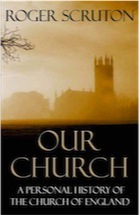
Mr. (Dr. Prof.) Diarmaid MacCulloch Thumps Mr. (Prof.) Scruton: Anglican Revisionism

http://www.theguardian.com/books/2013/jun/19/our-church-roger-scruton-review

Our Church by Roger Scruton – review

What makes the C of E special? This account of Anglicanism is full of cliches and misrepresentations?


Canterbury cathedral
Canterbury cathedral Photograph: Alamy
 
I begin this review with a declaration of interest. Roger Scruton and I are rather alike. When very young, we watched our present queen's coronation on small black-and-white televisions, our first experience of the medium. We are both church organists, both distrust confident religious dogma and clerical pretensions, both love the Church of England in a grumpy fashion, and we have both been known to cultivate a fogeyish image on occasion.
 
Our Church
by Roger Scruton
            
Because of these congruities, I find Scruton's latest book, a paean to Anglicanism, deeply irritating and unsatisfactory. It attempts to disarm criticism by styling itself "a personal history"; but that's no substitute for real history. Instead of history, it provides a catalogue of Victorian cliches and misrepresentations, from "the church of the catacombs" through to an Anglo-Saxon church proudly independent of Rome to a Thomas Cranmer influenced by John Calvin, and beyond. A similar historical farrago of half-truths and wishful thinking helped convert TS Eliot to high church Anglicanism in the 1920s, so there's one brownie point for it, but as an account of the English past, it won't wash.

Over four decades of teaching undergraduates, I have been fortunate rarely to read an essay on church history this bad: it's Sellar and Yeatman without the jokes. This is a common problem with philosophers. I will not weary the reader by cataloguing howlers and solecisms, but would be pleased to furnish a list to Prof Scruton, should he so desire.

A fundamental problem is that he persistently refers to "the Anglican church" throughout his account of its history since 1533, with a further implication that even before that, Anglicanism had always been sitting in the cupboard under the stairs, waiting for the pope to go away. Augustine of Canterbury, sent by Pope Gregory in 597 to establish Roman authority in the old imperial provinces of Britannia, would have been puzzled to learn that his mission had created such a body.

A millennium after Augustine, during the 16th-century reformation, we still couldn't talk about "Anglicanism" – only about the Church of England. Anglicanism really didn't take shape until some determined reconstruction in 1660-62. Previously, it was a "reformed" Protestant church of the European reformation – "reformed", technically, because it wasn't Lutheran – and it looked much to the reformed church in Zurich, a city that doesn't get a mention in Scruton's account, though Geneva does, excessively. The Tudor C of E lacked qualities Scruton admires: tolerance and an embrace of the "middle way". Its bishops ordered images and stained glass to be smashed, a regrettable vandalism that Scruton attributes to some vaguely characterised fanatical thugs called "Puritans". Tudor and Stuart England executed more Roman Catholics than any other Protestant church in Europe, and burned Anabaptists too, besides later dispatching quite a few Scottish Covenanters. The English church was not a "middle way" between the pope and Protestantism, because, as its leaders would brutally have made clear to Scruton, you can't have a middle way between the Antichrist and truth.

There was one big difference, nevertheless, between this reformed church and others in the Netherlands, Scotland, Switzerland, Geneva and Hungary: it kept cathedrals, with virtually all their medieval institutions, especially choirs and organs, and a regular daily round of solemnly performed services to which Archbishop Cranmer's Prayer Book accidentally lent itself. The cathedrals and their continuing life threw a spanner in the works of English reformed Protestantism, directly confronting many of its cherished beliefs. Members of the church who logically enough objected to this anomaly were given that abusive label "Puritans", and in the end, their fury led to the beheading of Charles I in 1649, having already prompted the abolition of cathedrals and their bishops. Killing a king was a step too far, and so the English upper classes meekly acquiesced to bringing back crown and mitre in 1660. This restored church constructed a new myth of itself as a middle way of moderation, which was a facade for a great deal more persecution, until it realised reluctantly that it would never enjoy a monopoly on English Protestantism, and would have to tolerate competitors.

Only then, and only gradually, did the C of E really become the nuanced, slightly apologetic institution that Scruton, with justice, admires. It has evolved into a church of irreconcilable paradox, where, particularly after the 19th-century Oxford movement, people kneel at the altar rail next to each other and believe completely contradictory things about the bread and wine they are receiving. This profound clash renders trivial the present disagreements in the Anglican communion about sexuality. That seems to me one of the most hopeful things about Anglicanism: it is an arena for paradox. No false claims of clerical authority or spurious logical consistency will ever make its understanding of religion into a neat range of solutions. Yet it has a firm grip on the past: it sees that Christianity is a religion of stories, layer on layer, right back to Christ's apostles. On that, Scruton and I would probably agree, even if we drew different conclusions from such propositions. We would both commend its established status, though for different reasons. Mine include the observation that interestingly many English Muslim, Hindu and Jewish leaders approve of the Anglican establishment, though I can quite understand why other English Christians don't. Roman Catholics and Free Church people alike might appreciate the spoof letterhead I was once sent: "The Church of England: Loving Jesus with a Slight Air of Superiority Since 597." That rather embodies Scruton's account of "Anglican" history.

All this may seem like breaking a butterfly on a wheel, and it has to be said that lurking behind Scruton's "597 and All That" there is a delicate essay on belief in the modern world that says sensible things about the nature of sacrifice. Scruton provides a rather moving and perhaps unintentionally revealing memoir of his youthful struggle towards Anglicanism. When he genuinely knows about something, other rewards appear: some enjoyably sensitive pages on the feel of a country church, church architecture generally, and some mostly accurate discussion of church music. The why-oh-why Daily Mailery is mostly postponed to the brief conclusion, and we do not encounter that chimera of rightwing journalism "political correctness" until late on.

But it would be nice if Scruton knew more about the Church of England for which he has such affection. He seems to take seriously the Anglican ordinariate, an expensive damp squib created by Pope Benedict XVI to attract conservative Anglicans, so far with very little success, and his knowledge of the Episcopal church (the Anglican church of the US) seems confined to the sniping from small splinter groups that have left it – the Tea Party at prayer. Above all, the great puzzle of this book is that it hardly mentions the cathedrals, which are the great success story of the modern established church, their congregations growing and their fabrics better cared for than ever before. Perhaps a bit more church-crawling is called for?

• Diarmaid MacCulloch's Silence: A Christian History is published by Allen Lane.

Tuesday, September 3, 2013

1520s: Peek at Cranmer's Education, Library & Early Views of Martin Luther

MacCulloch, Diarmaid. Thomas Cranmer: A Life. New Haven, CT: Yale University Press, 1996.

It is available at:
http://www.amazon.com/Thomas-Cranmer-Life-Diarmaid-MacCulloch/dp/0300074484/ref=sr_1_6?ie=UTF8&qid=1378262768&sr=8-6&keywords=diarmaid+macculloch

In 1503, Mr. Cranmer took the standard Arts program. It took 8 years to complete, a “surprisingly long time.” It’s 1511 when he graduates at age 22. He worked in classical texts. In his 3rd year of the program, he had logic and the 4th philosophy. The emphasis on the classics “was precisely what annoyed Tyndale in 1530, impatient as he was to turn education toward the text of the Bible” (19).

Mr. Cranmer’s “embryonic library” was founded on “medieval texbooks” which he kept “amidst his magnificent later collections” (19).   Mr. MacCulloch's word, "magnificent" begs for elaboration, but we must move on. Some volumes:

• Peter of Spain’s Summulae Logicale, a text on logic
• Peter Tartaret’s commentary on Aristotle’s logic and philosophy
• Other commentaries on Aristotle
• Duns Scotus’ Questiones subtilissme. Mr. Cranmer’s volume was a 1497 edition. Unsurprisingly, it had “copious annotations” with “responses and objections” (20).

By graduation day for the B.A., he is listed with other notables: Thomas Goodrich, Hugh Latimer, John Lambert, Richard Astall and Richard Horne—the latter two becoming chaplains to Mr. Cranmer during his regency at Canterbury.

Of note, John Lambert would be burned at the stake in 1538 for being a “sacramentary,” that is, denying cannibalism (our fair word for it) at Holy Communion. This event would cause Cranmer's “admirers much embarrassment and heart-searching” (21). Indeed. 


The question lingers long: what did Cranmer believe, affirm and/or deny and when?  And here, more narrowly, what about Cambridge and the 1520s?

On the day of Mr. Cranmer’s graduation, another famous person would enter the story: Stephen Gardiner. (Gardiner will be buried as a Bishop inside Winchester Cathedral with a regal service during Mary’s burning times while Cranmer would go to the stake.) Gardiner will also be the man at the fateful meeting at Waltham in 1529, but we get ahead of ourselves.  Gardiner is another man warranting investigation.

In 1515, Mr. Cranmer completes his M.A. He was 26 years old. He studied arithmetic, music, geometry, Faber, Erasmus, and some “good Latin authors” (21). Another volume is in his library: the “mathematical treatise by the humanist polymath Jacques Lefevre d’Etaples" (Faber). Shortly after getting the MA, he was elected as a Fellow to Jesus College, although the exact date is “uncertain” (21).

The interlude with his first marriage occurs, an “abrupt trespass on a conventional career” (21). He was not ordained, but it caused his dis-Fellowship at Jesus. It was a “definite step down in the status-conscious world” (21). There is some obscurity on dates, including whether this was forced marriage or inconvenient pregnancy. But, she and the child died. Had she lived, Mr. Cranmer’s entry to the ministry would have been foreclosed.

“Snobbishly malicious glee” would characterize the imputation of being an “ostler,” or one living in an Inn. But, whatever that means, he returns to Jesus College and is re-admitted as a Fellow.

At this point, his life takes a “decisive turn for the future” (22). His post-graduate work is now theology. This would be about the same time that Luther’s writings “on indulgences were beginning to work themselves out on the international scale” (22).

Undoubtedly, Mr. Cranmer would learn of the conflict. “Cranmer considered `what great controversy was in matters of religion’ and ‘applied his whole study three years into the Scripture. After this he gave his mind to good writers both new and old…This kind of study he used till he was made Doctor of Divinity” in 1526” (22).

If our dates and information are correct, Mr. Cranmer is an MA from 1515 until 1526.  That means eleven years of labors in theology. By 1526, he is 37 years old when made a Doctor of Divinity. Commendable.


As an aside, we wonder what the requirements were for doctoral degrees at Cambridge in 1526?

Some things can be said:

• He did not study canon law. We offer this: Mr. Anthony Deane, another biographer, wrongly asserts that he [Cranmer] was a “canonist.”   Mr. Deane, an Honorary Canon of Worcester, offers no footnotes in his little volume.  We must dismiss this claim; it is unlikely that Mr. Cranmer was a "canonist." The school’s charter forbad “canon studies.”

• Rather, his specialty was biblical and theological studies. The “biblical character of theological study in Jesus was underlined by the provision of the college theological lectureship endowed for a Fellow of the College in 1512 by the civil servant Sir John Rysley” (23). The lectureship was “restricted to the Old and New Testaments” (23) and Mr. Cranmer held that lectureship.

Mr. MacCulloch asserts what other biographers note: “…there is so much that is not known about Cranmer’s nigh-on three decades at Cambridge” (emphasis added, 23). Ergo, efforts at filling the gaps are problematic (just as Mr. MacCulloch proceeds to fill the gap).

Again, we are talking about 1503-1529, but, more notably the 1520s, the days of intense and widening conflict over Lutheranism.

Enter Chancellor/Bishop John Fisher—a man who valued Aquinas, Scotus, “alongside those of modern humanist giants like Lorenzo Valla [who debunked the Papal Constantinian forgeries], Erasmus, and Pico della Mirandola” (23). Mr. Fisher is important because Cranmer will carefully study Mr. Fisher’s tango over Lutheranism. More below.

Mr. MacCulloch briefly suggests--interestingly--that Mr. Stephen Gardiner [faithful Marian Bishop of Winchester] may have had “more reformist” sympathies than Mr. Cranmer during the 1520s at Cambridge:

• In Feb., 1526, Gardiner helped the early English Reformer, Robert Barnes, an Augustinian Prior, craft a sophisticated “abjuration of Lutheran sympathies” (25). This needs further research.

• Further, Gardiner spoke up for another early English Reformer, George Joye, when “Wolsey’s officers” were investigating Lutheranism. So, we clearly infer that Lutheranism was becoming-big-time-problematic. We are getting some good details here from Mr. MacCulloch. We recollect that later Mr. Joye was a Bible translator who would tango with Tyndale on the Continent, but that postdates Mr. Gardiner’s intervention at Cambridge.

• Gardiner forewarned another early English Reformer, George Stafford, of an “impending prosecution” (25). Again, evidence that Lutheranism was roiling the environment in the 1520s.

Mr. MacCulloch notes Mr. Cranmer’s silence as over against Mr. Gardiner.


But we must be cautious about the conclusions.

Mr. MacCulloch does critique--perhaps justifiably so--admirers who conferred “retrospective honorary membership” to Mr. Cranmer for involvement in the White Horse Inn, e.g. Alfred Pollard, William Clebish, and Philip Edgcumbe Hughes (the latter being my revered Church of England professor).  We will continue to weigh this.

 Mr. MacCulloch then does a wonderful, albeit far too brief, service in reviewing Mr. Cranmer’s marginalia or annotations on Mr. Fisher’s attack on Luther in Fisher's Assertionis Lutheranae Confutatio.  This scholarly review is worth the price of the book (as well as his stated friends-list in the bibliography).

We are on track to get Mr. Fisher’s volume and review it, Deo volente. Mr. Cranmer’s edition of Mr. Fisher’s was dated 1523; this edition was published in Antwerp.  No doubt it was published in Latin and no doubt for review by Continental Romanists.  Mr. Fisher was an international scholar.
So, what did Cranmer know, believe, affirm and/or deny and when? 

Clearly, Mr. Cranmer is studying Lutheranism. 1523 is the very earliest date for Cranmer's work on Mr. Fisher's volume; also, notably, although we digress, Mr. Tudor is pleased with Fisher's anti-Lutheran polemics (until his fall from Henry's good graces and you know what that means).

Some notes from Mr. MacCulloch on the marginalia by Mr. Cranmer on Mr. Fisher writing about Luther (did you get that sequence?):

• Cranmer uses “black ink” and “red ink,” indicating two different periods of time


• Cranmer critiques Fisher for an interpolation to Chrysostom’s text “suggesting that St. James the Great received his bishopric of Jerusalem from St. Peter” (26). Fisher gratuitously inserted the comment and Cranmer calls him on it, if only privately.

• The “red ink” offers “consistent criticisms of Fisher.” Mr. MacCulloch is not clear here. The suggestion is that the red ink is a later date.

• The “black ink” offers “gentle criticisms” of Fisher

• But, Cranmer offers “furious and horrified condemnations of Luther’s arguments”

• Mr. MacCulloch notes that it’s not so much Fisher’s arguments but Luther himself “which provokes Cranmer’s greatest emotion” (27)

• Cranmer says “Luther wantonly attacks and raves against the Pontiff” and “this malice grows worse” (27). We would add that Mr. Cranmer may be a bit late to the ballgame. Mr. Luther has been in the fight since 1517, had been banned, condemned by Emperor and Pope, and was battling for his very life.  Mr. Cranmer is Mr. Luther's junior by six years. But, it is here that the intersection between Mr. Cranmer and Mr. Luther must be explored.

• Cranmer says “…he [Luther] accuses a whole council of madness; it is he who is insane.” “He calls a most holy counsel impious; oh, the arrogance of a most wicked man” (27).

• Mr. MacCulloch throws these two gems out: “…a clutch of Cranmerian cheers from the sidelines as Fisher scores points against this hapless German opponent” so “here is Cranmer the papalist” (27). Clearly, we need much more from Mr. MacCulloch here for a full review of the marginalia; or, we need it from other scholars. Perhaps it is out there?

• These annotations are no later than 1532 and, by definition of the date in Cranmer's own volume, are no earlier than 1523.

• These are not “the emotional jottings of a youth” but from a “man who is at least thirty-four years old and more probably in his late thirties” (27). This is a weighty point by Mr. MacCulloch. We might add that this could have been done during his doctoral studies leading up to 1526?

• A summary of the black ink: these comments are reserved for Luther’s comments about Councils.

• On Councils, Mr. MacCulloch offers this note that “From then on, Cranmer’s sympathy for Luther is gone” and he has “provoked Cranmer to a fever pitch” (29). That is quite a summary: a “fever pitch.”

• Fisher entirely “side-steps the possibility of a clash between Popes and Councils”

• Cranmer was, at a minimum, a “Concilarist” a commitment that would later inform his 1552-letters to Wittenberg, Zurich and Geneva, rather than Rome, in an effort to put together a Council “for a defense against Trent” (29)

Mr. MacCulloch also points us to the classic imbroglio between Erasmus and Luther. Erasmus shot across Luther’s bow with De Libero Arbitrio.  Cranmer’s edition is 1524 and was published in Antwerp. Mr. Luther, on our view, entirely demolished Eramus with his must-read Bondage of the Will, 1525. Mr. Cranmer has copious notes as summaries and believes that “Luther’s argument about the will is dangerous because they touch on secret matters” (29). We would add Mr. Cranmer, if fairly characterized by Mr. MacCulloch, is seriously behind the power-curve on this question. But, he will mature as The Thirty-nine Articles show. It also suggests some lack of exegetical saavy.

Mr. Cranmer offers this:

“…we go on swiftly to better things…or if we are entangled in sins, let us strive with all our might and have recourse to the remedy of penance…and what evil is in us, let us impute to ourselves, and what is good, let us ascribe wholly to divine benevolence, to which we owe our entire being, and for the rest, whatever befalls us in this life, whether joyful or sad, let us believe it to be sent by him for our salvation.”

Mr. MacCulloch calls it “reverent agnosticism” (29).  We call it weak.  Mr. Luther "ruled that school" on this issue.

In the closing section of this chapter, Mr. MacCulloch offers an important note that Cranmer went to Spain on a minor diplomatic mission. Date: Summer, 1527. While school was recessed?  We don't know.  He points to some diplomatic correspondence. On this view, Cranmer may have had a brief audience with Mr. (Henry VIII) Tudor upon his return from Spain; this, Mr. MacCulloch tells us, “completely re-dates the relationship between the two men” (37). In other words, Mr. Cranmer may not have been entirely unknown to Mr. Tudor. (By the way, Mr. Cranmer had a rough ride by sea from Spain back to England—thirteen days at sea.)

But largely, upon return from Spain to England, Mr. Cranmer returned to Cambridge until 1529.   And the story of Lutheranism is far from over.  And Mr. Tyndale is busily at work too.

Mr. MacCulloch closes this chapter with: “Within two years of the Spanish mission, he would leave the university for good…and at the age forty, he committed himself to a new, spectacular, and infinitely more dangerous life” (37).  Indeed, Mr. Cranmer's quiet academic life would turn into a life of servitude--er, service--to Mr. Tudor.

Tuesday, August 27, 2013

Diarmaid MacCulloch's "The Boy King: Edward VI and the Protestant Reformation"

MacCulloch, Diarmaid. The Boy King: Edward VI and the Protestant Reformation, 1st Ed. Berkeley, CA: University of California Press, 2002.

Available at:
http://www.amazon.com/Boy-King-Edward-Protestant-Reformation/dp/0520234022/ref=sr_1_7?s=books&ie=UTF8&qid=1374790262&sr=1-7&keywords=diarmaid+macculloch

There are 273-pages including the (often funny) illustrations, acknowledgements, abbreviations, bibliography and index. The illustrations alone merit a purchase of this handy little volume.

The outline is simple:

1. Dramatis Personae
2. King Josiah: Purifying the Realm
3. King Solomon: Building the Temple
4. The Afterlife of the Edwardian Reformation

Before posting our notes and interpolated musings, we must say that Mr. MacCulloch writes vividly and dramatically. And, he is an academic elite when it comes to Cranmer.

Now for the notes.

Edward VI ascended the throne on Jan 28, 1547, the day of his father’s death. The boy-king was fathered by a "middle-aged man" who died in "middle-age," aged 56 and six months shy of 57. Edward never saw his father’s reign or manner of rule.

Henry had become increasingly capricious, “dangerous, egotistical” with large views of his own ability (1). He had broken England’s millennium-long association with Rome. 100s of monasteries, friaries, and nunneries were turned “into empty shells” to be “torn down” and “sold off by speculative builders” (1).

Meanwhile, we are reminded, the context was a “background of a Europe-wide movement of Reform” that “convulsed the whole Western Latin Church.”

Mr. MacCulloch does some house-keeping on terms, just as he did in his Thomas Cranmer: A Life.  As a matter of "historical accuracy," he prefers, likes and will use the term “Evangelical.” He notes that “from the mid-1550s, English people used the term `Protestantism’” (1). The term had arisen from the Continental Diet (Assembly) held at Speyers in 1529. The Holy Roman Empire or Holy Germanic Empire convened and Protestant princes presented a protest—called Protestatio.  The term “Protestant” or its cognates gained currency akin to perestroika and glasnost in the mid-1980s. Yet, the term “Protestant” remained a term for “the doings of foreigners” (2). But, it was well-worn and used.

Mr. MacCulloch offers an interesting insight. The “Protestants” were invited to Henry VIII’s funeral at Windsor in 1547. Should they please.

This--the "Protestants"--referred to a German religious alliance called the Schmalkaldic League.

At Edward VI’s coronation, the Germanic "Protestant" Princes were given “an honoured place in the coronation procession of the new king in London” (2). They were simply called “The Protestants.”


Also, again, take note of Mr. MacCulloch's title The Boy King: Edward VI and the Protestant Reformation.  That term "Protestant Reformation," at this point, will cause the Tractarians to break out in involuntary sweats, hyper-ventilating and perspicuous hives.  As an aside, we do like Mr. Packer's term for them, the "Roman Trojan Horse."

But, what does Mr. Cranmer think of it, our oblique mystery man?

We are reminded of what Mr. Clebisch noted: Mr. (Bp.) Stephen Gardiner conducted Henry's funeral obsequies according to the "ancient custom," not Mr. Canterbury. Also, of note, Mr. Cranmer preached at Edward's coronation on February 20, 1547. A long tension between Gardiner and Cranmer, but we move on.

But, moving on, Mr. MacCulloch observes that the term of preference must be “evangelical” or one of its widely used cognates. The sense was this.  The term meant “faithful to the spirit of Christ’s Gospel, the good news of the evangelium.” (2).  The “Evangelicals” offered a “restatement of the Christian faith” (2). As an aside to Mr. MacCulloch's historical point on the term, many Confessional Lutherans to this day also claim this title as a matter of historical privilege; we would add that the Tractarians and other “Anglican drunks tottering on the cliff’s edge” (to use Mr. Canterbury Welby's very recent term for Anglicans), the Greeks, and the Romanists would, will and do eschew the historical sense of the term, “Evangelical.”  And, of course, it does not refer to the American yahoos of our times.  These were Prayer Book men and Reformers. But, Mr. MacCulloch points us back to the “Continent-wide struggle” and the historic use of the term (3). Mr. MacCullock adopts the term in both volumes, Thomas Cranmer and The Boy King.

Yet Henry prided himself on steering some middle course. In a “Swansong” and keynote address to Parliament in 1545, he declaimed against two parties: (1) those who were “too stiff in their old mumpsimus” and (2) those “too busy and curious in their new sumpsimus” (3). Allegedly, he got so worked up and was so earnest that he “dissolved into tears” (3). But what middle course?

Apparently, Henry and Mr. Canterbury were “not entirely in agreement about where that middle way might be found.” Of course, Henry was in command and Mr. Canterbury was always ever-pliable.  However, the Edwardian reforms would indicate Mr. Canterbury’s directions and his "middle course."

Henry apparently was offering a “theological jackdaw’s nest” according to Mr. MacCulloch. What a term, "theological jackdaw's nest."  It's memorable. Jackdaws are crows that fly in formation or packs. They will steal and store things they don't need.  As a result, the term gains the sense of covetous chap, stealing and storing its thieving achievements, without a sense of any need for what was stolen. Some theological contours are offered by Mr. MacCulloch on this "nest of crows:"

• During Henry’s last decade, he toned down purgatory, the “thought and devotional practice of northern Europe” (4).  We are unconvinced by the claim, especially since Henry endowed French shrines for masses to be said for himself and his family for years after his death.  But, we'll take Mr. MacCulloch's point under advisement.

• The King’s Book of 1543 was the “last official doctrinal statement.”  In it, the term "purgatory" was downgraded and its use was “forbidden.” That’s new to us.  And it's odd. We would add, were Mr. Canterbury’s views on "justification by faith alone" influencing this? Mr. MacCulloch will allude briefly to Mr. Canterbury's view as per below.

• Henry was “crystallizing” an “anticlericalism” (5), although this was by no means a novel thing for English kings. Think Avignon Papacy or the Conciliarist Councils of the 15th century. Or, think of Emperor Charles V holding the Pope hostage in Castile d' San Angelo, Rome. Or, Pope Clement VII's "double crossing Henry" on the "Great Matter."

• Mr. MacCulloch suggests that Henry was downgrading the “traditional church’s seven sacraments” that emphasized the “clerical mystique: confirmation, unction, and ordination” (5). We would add that we want documentary evidence for this claim.

• There was some iconoclastic destruction of “shrines and images” (5). Mr. MacCulloch points to Henry’s "self-congratulatory note" in his own hand in "his own Psalter."

• Yet, Henry never accepted Mr. Canterbury’s instruction on "justification by faith alone." Henry “passionately believed,” we are told, that this doctrine would undercut the motive to good deeds. After all, Henry believed he was the “guardian of the kingdom’s morality.” We would add, never mind the divorces or “non-marriages” as he would call them (with Cranmer obliging on three of them: Catherine of Aragon, Ann Boleyn, and Ann of Cleves).

• Henry maintained “clerical celibacy” vis a vis the Six Articles. Poor Mr. Canterbury would ship his wife back to Germany, the ever-pliable one.


 Mr. MacCulloch has a classic line to summarize Henry’s jackdaw’s nest: “To describe the religious mixture as theologically ambiguous is to indulge in courtier-like understatement” (6). Excellently put.

We include the wonderful illustration/picture in the volume. It is by Girolamo de Treviso. It was commissioned by Henry VIII and hung at Hampton for nearly a decade before and up to his death on January 28, 1547. It’s entitled, “The Four Evangelists Stoning the Pope.” A slam dunk by Henry whatever else he was.


Such a nest of conflicts would become the “see-saw in the fortunes of evangelicals and traditionalists around him,” never quite knowing what to make of it all (6), “lurching back and forth.” One might think old Harry was playing both sides against his middle (er, his reportedly 76-inch waistline).

Mr. MacCullough observes that Henry had “evangelicals” around him; apparently, this was unproblematic or perhaps they were just pliable and quiet?  The “people closest to the old king in his everyday life and in his private apartments—even his doctors—were mostly evangelical in sympathy” (7).   Again, odd. Confusing.

Henry had given up burning “evangelical heretics” from 1543-1546, we are told, but what else was Mr. Cranmer doing during this time?  Mr. MacCulloch hints that perhaps, again, perhaps Henry tired of “the manouevers [sic] of leading traditionalists” as heresy-hunters. Think More, Fisher and others. Henry extended his protection to Mr. Canterbury in the “so called ‘Prebendaries Plot’” seen by Henry as an “unwarranted assault on a faithful servant” (7).

But conflicting evidence is at hand. In the summer of 1546, several “evangelical sacramentaries” went to the stake of flames. They denied the cannibalism-view of the Holy Supper (cannibalism is our term, not Mr. MacCulloch’s…it is what they claim it is, eating flesh and drinking blood, so let them “name it, claim it, own it and rename it for what it is”). Where’s Mr. Canterbury again during these burnings? In summer of 1546?

Yet, Henry left in place the political machinery for a reformation. He left “evangelical politicians in an unassailable position to take over at his death” (7). Edward Seymour and his associates on the Privy Council were ready for Seymour’s status as “Lord Protector.” Edward VI would inherit the “closely knit group of his father’s advisors” (8). They were given power “in the last weeks before his [Edward’s] accession,” an “arrangement by Henry.” Again, odd. Again, confusing.

 The Lord Protector surrounded himself by “like-minded politicians”—John Dudley, William Parr, Thomas Cranmer himself, and William Paget—“heading an evangelical establishment” (8). But, why?

Other Henrician incongruities are observed.

Bishop Ridley and old Thomas Goodrich are brought aboard. Further, Henry had Edward trained as a lad by two “evangelicals,” Sir John Cheke and Richard Cox. Cheke would later go to the stake under Mary while Mr. Cox would flee to the Continent (and have his dog fight with Mr. John Knox at Franfort), but we digress. Mr. Cox would also become an Elizabethan Bishop. Mr. MacCulloch observes that these men had an agenda that would have been “hard to hide from Henry VIII” (8). These men were “determined to join the religious revolution in the rest of Europe” (8). Quite a “high claim” by Mr. MacCulloch, a man ensconced in academic primary and secondary sources at length and in depth. If one is to quarrel with Mr. MacCullouch, we would advise thorough preparation with extremely humble questions.

Mr. MacCulloch then speaks of the Edwardian “revolution with a cast list.” The title of the chapter itself is “Dramatis Personae” and that’s where he’s going. It's a high drama.

Or, we are “spectators at a drama: a drama of six years’ span” (9). Some call it a “tragedy” full of “destruction, attacks on beauty, refined spirituality” and a “senseless waste of resources.”

Whatever the view, Mr. MacCulloch vividly calls it the “epic contest between polar opposites,” one that lacked the “nuances of Elizabeth’s time” (9).

He calls the Edwardian days a “dynamic assault on the past.” Were these six years that dramatic? The general narrative is that this is where Mr. Canterbury tipped his hand.

The story, he tells us, will be written, revised, rewritten, with revisions of the rewritings, all to suit varied agendas, tastes and desires. That is why one must do their own homework.


We certainly do not want to take the word of some "Anglican drunk" (again, borrowing from Mr. Canterbury Welby's recent turn of phrase).  Or, to use Mr. (Rev. Dr. Prof.) Alister McGrath's recent claim (as in today) that Anglican leaders have left a "vacuum" for our times.  What's that, "vacuum cleaners" sucking up the Reformation dirt and filth?  Who does one listen to?  We have to do our own reading.

We return to a governing question: “Where was Mr. Canterbury, what did he affirm or deny, and when did he do such or the other?” Our mystery man is mysterious.

Where is this all going in this high drama of epic proportions?

Also, for an overview of the direction of things, Mr. MacCulloch gives us a (funny and entertaining) engraving from Mr. Foxe’s Acts and Monuments entitled “Allegory of the Reign of Edward.”  See the picture below. Mr. Foxe envisions a “Reformed house of God” with an “ordered hierarchy of a royal court,” “stripped of Popery,” with a “bonfire consuming images.” A picture with Papal and Non-Papal Roman Anglicans (our term for 1.0, 2.0ers) fleeing the English coast “to take such abroad, clutching to whatever paraphernalia of errors they can salvage--`Ship over your trinkets and be packing ye papists” (10). A few other comments in the picture: “The Temple well purged.” The “Ship of the Romish Church.” Mr. Clebisch will call it a “revolution” in the making and something that may have exceeded Mr. Canterbury's vision for a Reformed Church of England. Indeed. A Civil War in England followed by the exports of English Puritanism to America.


Saturday, September 29, 2012

ABC Thomas Cranmer's Ambitious Legacy

http://www.historytoday.com/diarmaid-macculloch/cranmers-ambiguous-legacy


Cranmer's Ambiguous Legacy

Diarmaid MacCulloch reflects on the 'after-life' of Henry VIII's archbishop, burnt at the stake as a Protestant martyr under Mary.

 
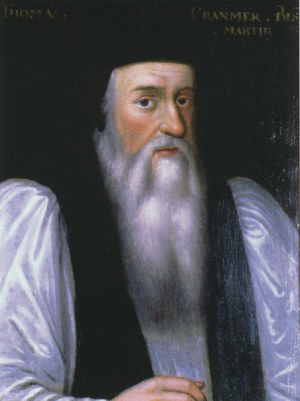
Portrait of Cranmer after Henry VIII's death by an unknown artistPortrait of Cranmer after Henry VIII's death by an unknown artistArchbishop Thomas Cranmer died at the stake in 1556, a martyr for the English Reformation; but did he die a martyr for the Church of England or for Anglicanism? If we examine Cranmer's career after he parted company in the early 1530s with the Catholicism of his first forty years, we find a man of international perspective, who sought to move England into the path of the wider European Reformation: in particular towards the Reformations to be found in the churches of south Germany and Switzerland. After Cranmer's death, most of these churches would be labelled 'Calvinist' or 'Reformed'. He would not have recognised these descriptions, but if he had lived, it is very likely that he would have done his best to take the English church in the same direction.
What would the Church of England have looked like if instead of Queen Mary's triumph in 1553, Queen Jane's quite reasonable hereditary claim to the throne had succeeded in establishing her regime? The Lady Mary would have to have been effectively neutralised, and one fears that neutralising her for good would have involved the block, in a return to Henrician savagery. The Lady Elizabeth could have been married off to Lord Robert Dudley, a good catch for a royal bastard, and a good chance for them both of a happy love-match.

Archbishop Cranmer, living to his allotted three-score years and ten or beyond, could produce a third version of his two earlier Prayer Books of 1549 and 1552, in the light of friendly criticism from continental reformers whom he respected, like Peter Martyr, Johann Heinrich Bullinger and Calvin. He would be succeeded as archbishop by Nicholas Ridley or Robert Holgate, with energetic younger reformers like Edmund Grindal ready to make their mark and pick up good ideas from the best reformed churches of Europe. The Scots immigrant John Knox, mellowed by an increasingly successful career in the Church of England, would be appointed Bishop of Newcastle, benevolently taking no notice of the advanced congregations in his diocese who received communion sitting; this was a practice in any case increasingly common throughout Jane's Church, despite Cranmer's grumbles. Cranmer's cherished reform of the old popish canon law would be achieved; the primer and catechism published at the very end of Edward's reign in 1553 would become the standards; the Forty-two Articles would have been unmodified by Elizabethan hesitations about relegating the significance of the sacrament of Holy Communion to that merely of a symbolic repetition.

Out in the parishes, metrical psalms in the style of Geneva would quickly have spread: these were the best secret weapon of the English Reformation, making its public worship and private devotional practice genuinely popular throughout increasing areas of the kingdom. This congregational music would also take over in the cathedrals, now devoid of choirs or polyphony, and with their organs (where they survived) used mainly for entertainment in the Dutch fashion. The conservative nobility would continue the sullen public compliance with religious change which they had shown under Edward VI, their private celebration of ceremonial worship tolerated as eccentricity, like the Lady Elizabeth's patronage of choral music in her own chapel.

The traditionalist higher clergy would gradually die off in senior church offices and the universities, with no possibility of like-minded replacement: since the universities produced no major haemorrhage of exiles in the 1560s, the Jesuits and other religious orders would find it difficult to recruit potential clergy to train for their attempt to treat Jane's England as a mission field. England would have become the most powerful political player in the Reformed camp, with Cranmer a cordial if geographically distant partner with John Calvin. It is powerfully symbolic that it was Cranmer's son-in-law Thomas Norton who translated Calvin's Institutes into English, and Cranmer's veteran printer Reyner Wolfe who published it. With a Cranmer-Calvin axis, the profile of Reformed religion across the whole Continent would have been changed, and with the help and encouragement of Bishop Knox, the Reformation in Scotland might have followed a close path to the Reformed Church of England.

That is the history that never happened. Instead, in 1558 Queen Elizabeth had to cope with the consequences of Mary's steadily more successful effort to integrate a traditionalist comeback with the Counter- Reformation's new dynamism. At home, Elizabeth wanted to conciliate conservatives; abroad, she wanted to conciliate suspicious Catholic Spain and France, and also to win friends among the Lutheran princes of Germany and Scandinavia, who were increasingly hostile to the Calvinist and other Reformed Churches to their south. At the same time, however, she was identified with the Protestant cause by her birth, she had a team of advisers who were senior administrators from Northumberland's regime, and she faced a triumphalist Protestant grouping already creating a mythology of glorious resistance to evil in the deaths of so many martyrs. Of these martyrs, Cranmer's name headed the list. Elizabeth herself shows signs of having preferred his discredited first Prayer Book of 1549 to his second of 1552, but virtually no-one at the time agreed with her: to reintroduce 1549 was not practical politics.

Elizabeth's solution to her dilemmas was remarkable: quite deliberately, she established what proved to he a snapshot, frozen in time, of the Church as it had been in September 1552, ignoring the progress made in further changing the Church of England after that date. This meant that the 1559 Prayer Book was the 1552 rite, devoid of the last-minute 'black rubric' denying that kneeling at communion represented adoration of the eucharistic elements of bread and wine (an addition probably demanded by Cranmer himself to preserve the custom of kneeling after John Knox's criticism). No government sympathy was offered to attempts in 1559 and 1571 to revive the arch- bishop's 1553 scheme of wholesale replacement for canon law. The 1553 catechism and primer were set aside, the primer in favour of a modified version of that issued in 1551 – itself a reworking of Henry VIII's 1545 primer.

One of the most striking features of Elizabeth's 1559 Settlement was that it began the Church of England's long march away from Cranmer's eucharistic theology, if only in small details. Cranmer wanted to ensure that people did not think that there was any physical or corporal presence of Christ in the elements of bread and wine, and he carefully recast his 1552 communion service to make this clear. Christ was only present to those communicants who had faith in him, and faith could not be earned by any human being; it was a predestined gift of God to those to whom he chose to give it. The clarity of Cranmer's sacramental intentions was undermined by restoring to the communion service the 1549 formulae of administering bread and wine to communicants which he had replaced in 1552, now simply shackled to the later formulae: was the communicant receiving the body and blood of Christ, or taking the elements in remembrance that Christ had died for human salvation? This, the omission of the 'black rubric', and a baffling instruction that the permissible ornaments and vestments of the Church were those in use in the year before the 1549 Prayer Book was authorised, were the only modifications of significance to the 1552 book in 1559.

Similarly, the most material alterations made by the 1565 Convocation to the Forty-two Articles of 1553 concerned eucharistic doctrine. Lutherans believed in a real presence in the eucharist. Although advocates of such views were virtually non-existent among English higher clergy, there were foreign diplomatic considerations. Most significantly, the Article statement 'of the wicked which do not eat the body of Christ', was omitted in 1563 to spare foreign Lutheran sensibilities, and it was only restored in 1571 when Lutherans no longer mattered. The 1553 argument that Christ's body could not be on earth because he was locally present in heaven was also left out for ever. It was true that the replacement wording still emphasised spiritual presence: 'the body of Christ is given, taken and eaten in the supper only after an heavenly and spiritual manner; and the mean whereby the body of Christ is received and eaten in the supper is faith'. However, Edmund Guest, the architect of this phrase and one of the bishops on Elizabeth's bench farthest from the Reformed ethos, gave it a spin which would not have appealed greatly to Cranmer: it 'did not exclude the presence of Christ's body from the sacrament, but only the grossness and sensibleness in the receiving thereof.

One should not exaggerate the extent of the drift at this early stage. Edwardian establishment evangelicals who survived the Marian holocaust, either through exile or some form of discreet invisibility at home, resumed their careers. To men like Bishop Edmund Grindal, who had been a major help to John Foxe in compiling his collections on the Marian persecutions, Cranmer, Latimer and Ridley were shining examples whose work needed to be upheld and extended. Even more radical evangelicals who had clashed with Cranmer under Edward Vl could forget their differences in view of what had happened under Mary: John Knox was generous in his comments on the three Oxford prisoners' 'lenity, sincere doctrine, pure life, godly conversation, and discreet counsel' and he called the martyred Cranmer 'the mild man of God'.

Yet the plain fact was that the Supreme Governor would not allow the Edwardian Reformation to proceed on its path, at least if it meant bringing structural change to her Church. Famously, she ruined Archbishop Grindal's ministry because of his refusal to suppress the 'prophesyings' – gatherings of clergy for the improvement of their preaching, and much more useful and less dramatic occasions than their name implied. The generation of Parker and Sandys found themselves defending this fossilised version of the Edwardian Church in the face of criticism from those who had been their companions in misfortune under Mary – increasingly also from a new generation who had no such personal links to restrain their expression of anger at the bewildering immobilism of the Church establishment.

In the face of this unexpected turn of events, the Oxford martyrs became as much the property of those who deplored the Elizabethan Church's half-reformed polity, as of Cranmer's remaining colleagues. A tussle, indeed, took place for the honour of being the heirs of Cranmer, Latimer and Ridley between groups within the Church which from the late 1560s can be distinguished as Puritan and conformist. Both sides claimed the myth-making of Foxe's Book of Martyrs for their own, and chose what they wanted from the myth. For conformists, Cranmer's legacy was his Prayer Book, so that he was the symbol of their defence of the liturgy against Puritans, just as he had been in the disputes among the Marian exiles about how far they could depart from the 1552 Book. For Puritans, this was a distortion of the Cranmer legacy, tragically cut off before it could be completed.


Notoriously, for John Field and Thomas Wilcox, the authors of the Admonition to the Parliament in 1572, the Prayer Book was 'an unperfect book, culled and picked out of that popish dunghill, the mass-hook full of all abominations'. Even John Foxe, in his 1571 introduction to the published text of Cranmer's canon law revision, felt compelled to point out the one serious flaw in this document prepared by his hero, that it ordered the exclusive use of the Prayer Book. The way to avoid the seeming contradiction of attacking Cranmer's Prayer Book while regarding him as an example to all good Protestants was the quite reasonable supposition that his work had been interrupted: the tradition that in time he would have 'drawn up a book of prayer a hundred times more perfect than this that we now have'.

The separatists who resisted a state- sanctioned Church encompassing both godly and ungodly alike who emerged on the fringe of the Puritan movement were much more equivocal towards Cranmer than mainstream Puritans, but they were by no means totally hostile; they too could use the Oxford martyrs as sticks with which to beat the Elizabethan hierarchy. Robert Browne, a Cambridge Puritan who had taken the rare step beyond the official Church into separatism, sneered about Elizabeth's bishops that 'neither Cranmer nor Latimer, nor Hooper, nor Ridley were so meet for the prison houses, as these are for their bishoprics'. He regarded the Marian persecution as God's way of. trying to save Edwardian establishment evangelicals from repeating the follies of the old Church; however, the Elizabethan hierarchy had not learned from Cranmer's and Ridley's mistakes, and 'these have got again that false popish government'. John Greenwood, a separatist who bitterly detested the Prayer Book which Cranmer had created, coupled his rather condescending view of the Oxford trio's 'ignorance' in borrowing a liturgy from Antichrist with the affirmation that 'I reverence those good men as much as I may by the word of God ... In that they knew, they shewed themselves faithful unto the death; therefore they [were] gatherers with Christ and not with antichrists ... God did pardon Cranmer for making that vile book, and his being metropolitan', he affirmed confidently. Only among the real radicals, those who were conscious heirs of the anabaptist martyrs whom Cranmer had helped to burn in Edward VI's reign, was there a consistent tradition that scorned the Oxford martyrs even amid the Marian troubles.

Another less positive view of Cranmer emerged from the 1.580s in a different quarter, among members of the established Church who wished to lay greater stress on its sacramental life. Most early significant figures (like many Puritan leaders), were Cambridge dons, notably Lancelot Andrewes, the Master of Pembroke: later the movement would widen, until under the patronage of the two first Stuart monarchs it gained an edgy self-confidence and a leading role in the Church. It is difficult to find a satisfactory general label for the grouping, except for the vague and variable description 'High Church'. At first without much public group identity, by the second decade of the seventeenth century these sacramentalists were being given. the nickname 'Arminians', by comparison with the movement in the Netherlands pioneered by the maverick Calvinist theologian Jacobus Arminius. The common factor was a revolt against the orthodoxy established by the great figures of the Reformation, of whom Calvin was the most obvious reference-point. However the English 'Arminians' predated Arminius' emergence as a disruptive force, and they had other priorities: a predisposition to emphasise continuity rather than discontinuity in the English Church through the Reformation struggles, and a willingness to appreciate afresh the devotional traditions of the medieval West. Above all, the sacramentalists wished to restore the notion of real presence in the eucharist to what they regarded as its rightful key place in Christian doctrine.

For saccamentalists or Arminians, Cranmer's 1552 Prayer Book as lightly revised in 1559 was not promising territory; nor did they enjoy contemplating the work of the Edwardian Church over which the Archbishop had presided. For most of them, there was no question of open criticism, Arminians made much of heir loyalty to the established Church, and they were fond of citing the homilies to prove controversial points which were often far from the intentions of the homilies' original compilers. Rather, their disapproval manifested itself in a discreet lack of comment about the virtues of the Edwardian Church, and also an increasing interest in the 1549 Prayer Bonk, for the very reason that Cranmer had revised it, because of the possibilities that it offered of reinstating a more extrovert Catholic practice and devotion than was possible with the 1559 rite. Lancelot Andrewes, once he had become a bishop, set an example in his private chapel by rear- ranging the order. of material in the 1559 communion service and multiplying the accompanying ceremonial to suit his theological predilections, an interesting action for a bishop who always emphasised uniformity and obedience to the Church in his public statements. When in 1.637 the sacramentalists had the chance to create an entire new liturgy for the kingdom of Scotland (alas, a liturgy which was not appreciated by the recipients), it was to 1549 and not to 1559 that they looked for a model.

Matters were made worse when the Arminians' growing ascendancy in the early Stuart Church and their frequently aggressive promotion of their remoulding of its life and practice met with opposition from the older Church establishment. One of the best examples of how Cranmer could now be used to embarrass the Arminians comes from the bitter dispute between William Laud and Bishop John Williams of Lincoln over the correct positioning of the communion table, and the symbolism or lack of it which the positioning might imply. In his 1637 justification of the general practice of the Elizabethan Church, Holy Table: name and thing, Williams naturally drew .heavily on the 1559 Book of Common Prayer, and on the Homilies. He also appealed directly to Cranmer's arguments as presented in the Defence and the Answer, since Cranmer's was 'the most learned in this theme of our late divines'. The 'theme' was eucharistic sacrifice, and Cranmer's usefulness to Williams was to restrict the idea of sacrifice, oblation or offering in the communion to the 'sacrifice of laud and thanksgiving', so that the holy table could not be regarded as a place of sacrifice, an altar.

Cranmer indeed became powerfully symbolic for all Laud's enemies. William Dowsing has entered history- books (to a limited extent) as the man who turned iconoclasm into, if not a fine art, then at least a careful bureaucratic duty. He was an East Anglian Puritan who, in the Civil War, gained a commission from Parliament to wreck churches; he was also an admirer of Thomas Cranmer and the Oxford martyrs. He possessed both Cranmer's Defence and his Answer: his surviving copy of the Answer, bought in 1637 at the height of the confrontation with Laud and now far from home in St Andrews, is filled with his customary lavish marginal annotations. Having read Cranmer's book, Dowsing drew particular attention to what he called 'Cranmer's prayer', an acrid rebuke to the Catholic Bishop Stephen Gardiner. The passage culminated with the ringing call: 'I pray God, that we have not rather been figures of bishops, hearing the name and title of pastors and bishops before men, than that we have in deed diligently fed the little flock of Christ with the sweet and wholesome pasture of his true and lively word'. Dowsing summed this passage up as Cranmer's 'desire he may answer his call of bishop'. Here was an archbishop after his own heart. a sad contrast to the contemporary occupant of the office in 1637.

After the 1641 national crisis, attitudes to the Marian prelate-martyrs became more divided. William Prynne, for instance, can be found re- evaluating the deaths of Cranmer and Ridley, whom (like Dowsing) he had previously seen as symbolic allies in his campaigns against Laudian prelacy. Most hostile of all was John Milton, in his bitter attacks on the whole notion of episcopacy during the Interregnum. Cranmer and Ridley became 'halting and time-serving prelates' who were only brought to a better understanding of truth by the persecution which they endured, although it must be said that Milton's opinion of the tyranny of Genevan church government was no higher! Conversely, moderate defenders of the pre-war established Church redoubled their praise of bishops who could be seen as redeeming episcopacy from Laud's follies. However, perhaps the most impressive Interregnum verdict on the martyred archbishop's memory was spoken more quietly, throughout the parishes of England. That verdict was neither one of Laudian embarrassment nm of anti-episcopal antagonism. It was the unobtrusive continuing use of the Book of Common Prayer at a time when it was illegal and officially replaced by the Westminster Assembly's Directory of Public Worship. The Prayer Book itself had attracted little open hostility during the course of the Civil War, while bishops were abolished and church furnishings and ornaments were destroyed by the likes of Dowsing. In the years after the war, through all the turbulence of Commonwealth and Protectorate, its use continued in very many churches, adapted to local needs in the way sought by Elizabethan Puritans. After a century of use, it had become part of an English popular culture.

Given this testimony to the Prayer Book's place in the fabric of English Protestantism, the nature of Charles II's Restoration Settlement of 1660-62 with its startling triumph of militant Anglicanism becomes more comprehensible; Cranmer played his part in that victory. Whether he would have been happy with the aftermath of the triumph is less certain. Perhaps he would have understood the need to modify his liturgy after a century of use; after all, he had only been given four years in which to experiment with its practice in Edward VIs reign. However, the author of the Defence and the Answer might have looked askance at the delicate subversion of his sacramental outlook by the 1662 revisers.

Likewise, he is unlikely to have been happy that Anglicanism's new,, more narrowly-drawn, identity in 1662 which excluded many Protestants who would have found a home in. the pre-Laudian Church; almost single-handed, the triumphalist Anglicanism of the Restoration created that phenomenon which is so distinctive in English religion – large-scale Protestant nonconformity. At the moment in the eighteenth century when that 'Old Dissent' seemed to be fading, a new outburst of energy within the established Church burst its banks and formed a family of 'Methodist churches. Particularly in the Wesleyan Connexion which lay at the heart of the Methodist phenomenon, this rebellion remained true to the spirit of Cranmer's Prayer Book, and was sustained by the spirituality of the English Reformation. When archivist at English Methodism's oldest surviving theological college, Wesley College, Bristol, I had in my custody two quarto copies of the Book of Common Prayer used in the college's original chapel from its opening in Manchester: they were worn frail with regular use in leading the community's communal worship.

Later, attitudes to Cranmer among historians and biographers remained divided. On the one hand there was a tradition of praise, led by John Strype and Gilbert Burnet; on the other, a tradition of blame, which stemmed naturally from Catholic sources, hut which found some unexpected adherents during the nineteenth century. Most bizarre was the virulent stance taken by William Cobbett, whose view of the Reformation as an act of deliberate plunder inflicted on the helpless poor needed a villain, provided by Thomas Cranmer. Besides this, however, came a revival of coldness towards Cranmerian religion among the heirs of Laud and the Arminian tradition: the Tractarians and churchmen of the Oxford Movement, whose ideas were absorbed into the wider Anglican movement known as Anglo-Catholicism. They were embarrassed that the Church of England had been permanently shaped by the reign of Edward VI; the responsibility for that shaping was in the hands of the one man who remained at the centre of religious policy throughout Edward's reign, Thomas Cranmer.

There was at least one escape-route for Tractarians and Anglo-Catholics from the worst consequences of the reign of Edward VI. As the Arrninians and Laudians had done two centuries before, they could see Cranmer's first Prayer Rook (quite mistakenly) as a welcome refuge from the theological implications of his second. Towards the end of the nineteenth century, reorderings of the eucharistic rite in the mould of 1549 became common in Anglo-Catholic parishes and convents, particularly in dioceses which had been created by the world-wide spread of Anglicanism in the wake of the successive British empires. Yet the 1549 Prayer Book's compiler remained Ioved more for his prose than for his theology. There are not any statues to him in the beautiful churches built in the Anglo-Catholic tradition.

Today Anglicanism makes much of its position as a 'middle way' (via media) between Roman Catholicism and Protestantism. Standing as he did in the developing Reformed tradition of Europe in the 1550s, Cranmer's conception of a 'middle way' in religion was different. The middle ground which he sought was the same as Bucer's: an agreement between Wittenberg and Zurich which would provide a united vision of Christian doctrine against the counterfeit being refurbished at the Council of Trent. For him, Catholicism was to be found in the scatterered churches of the Reformation, and. it was his aim to show forth their unity to prove their Catholicity.


Perhaps the most widespread use of Cranmer's original texts in pure form remains Anglican evensong, where twentieth-century forms have failed to win admirers away from the majestic rhythms of his prose. One of the glories of the Anglican tradition is the choral performance of this even- song in the setting of great churches such as cathedrals: again a situation replete with irony. Cranmer had little affection for cathedrals, and no discernible love of complex choral music. He would have deplored the long-term survival of the Anglican cathedral tradition which Elizabeth I's obstinate traditionalism made possible. At a. deeper level, he would have been appalled at the spirituality which may be represented in the love of evensong. This is the exploration of religion by those who have decided to remain on the fringe of the Church, genuinely concerned to pursue their dialogue with God, yet not prepared to demonstrate the degree of commitment demanded by the eucharist. The encounter with the Anglican offices, however infrequent, can provide a place where they can show that they still wish to look beyond the surface of events and say that there is more to human life and creation than the obvious, the every- day. That home has been bequeathed them by Archbishop Cranmer.

Cranmer could hardly complain about adaptability to different times, since the consistent evangelical drive apparent in his career from 1532 was coupled with a remarkable penchant for temporary adaptations to circumstances, and adaptations of alien means to evangelical ends. No-one has made a very satisfactory defence of his conduct in taking the archbishopric (which involved simultaneously swearing an oath of loyalty to the pope and rejecting papal authority). Neither is his part in the annulment of Henry VIII's Aragon and Boleyn marriages inspiring. Yet to sneer at these three events and others as proving his craven wish to advance or present himself is a had misjudgement. The thread running through them all is his fierce determination to promote the evangelical reform of the Church. He cut legal corners. Equally, he captured the Devil's best tunes for the Lord's service. He cannibalised the writings of a Roman cardinal, Quiñones, for his liturgical reforms, and the prose of another contemporary cardinal, the theologian Cajetan, for his homilies, without the slightest respect for the theology which underlay their work. He redirected some of the riches of the Church's liturgical heritage for his Prayer Book, and only gradually discovered that this was a risky thing to do. In all this, one could compare another great metropolitan of the Church Universal who in the 1540s failed where Cranmer succeeded, and whom Cranmer clearly regarded as following the same policy: Hermann von Wied, Archbishop of Cologne. With archbishops like these, Calvin need never have turned Calvinism into a Presbyterian system, and. Andrew Melville need not have waged his long war against bishops in the Church of Scotland.

The widest aftermath of Cranmer's life and work is to be found in the realms of language and cultural identity. It was the happiest of accidents that this ecclesiastical functionary, propelled into high office by the accidents of politics, had a natural feel for English prose. His genius was limited to prose, and we can be grateful that, ever-practical, Cranmer knew that he could not write poetry. Cranmer's prose, however, has done much to guide the direction of the English language. He was a connoisseur of English who was not ashamed to borrow what he liked from other people's efforts, so what we think of as Cranmer's Prayer Book English is in fact a patchwork of his adaptations of other writers like Miles Coverdale, George Joye and Richard Taverner. If he were writing liturgy today, he would face crippling lawsuits for breach of copyright. However, his motive was not sinister; it was an expression of his natural modesty and practicality, and his alterations of existing texts were almost invariably improvements. And it came at a crucial time, for Cranmer was doing his work at a time when English, like all Western European languages, faced a double challenge: the effect of the universities' enthusiasm for humanist Latin, and the standardisation and centralisation caused by printing. Every Western European language has certain key texts of literature from this era and for English-speakers one of that handful of texts is the Book of Common Prayer. Millions who have never heard of Cranmer or of the muddled heroism of his death have echoes of his words in their minds.

The Prayer Book inevitably had a key role in deciding what was good English: it was one of the most frequently-printed and often most heard texts in the language. Whatever its content, it would have become decisive. For this reason, Cranmer deserves the gratitude not merely of the Church of England, but of all English speakers throughout the world. Through his connoisseurship, he created a prose which was self-consciously formal and highly-crafted, intended for repeated use until. it was polished as smooth as a pebble on the beach. Yet he spared the users of the Prayer Book the worst pomposities of humanism and the sprawling sentence constructions which are only too common in the English prose writers of the sixteenth century. He stands prominently amid a select band of Tudor writers from Tyndale to Shakespeare who set English on its future course.

In an ecumenical age, which honours honest doubt and hesitancy as a lesser evil than clear-eyed ideological certainty, Cranmer may win admirers and sympathisers and take his due place in Anglican history. He would not have known what Anglicanism meant, and would probably not have approved if the meaning had been explained to him, but without his contribution, the unending dialogue of Protestantism and Catholicism which forms Anglican identity would not have been possible. Beyond the concerns of Christianity, for all those who criticise his politics, or find his theology alien, Cranmer's language remains as the most enduring monument to Henry Vlll's and Edward VI's most faithful servant. Twentieth-century scholarship has reminded us just how fundamental is the structure of language to the way in which we construct our lives and our culture. Cranmer's language lies at the heart of our own English-speaking culture, which has now become so central to the destiny of the world.