Reformed Churchmen

We are Confessional Calvinists and a Prayer Book Church-people. In 2012, we remembered the 350th anniversary of the 1662 Book of Common Prayer; also, we remembered the 450th anniversary of John Jewel's sober, scholarly, and Reformed "An Apology of the Church of England." In 2013, we remembered the publication of the "Heidelberg Catechism" and the influence of Reformed theologians in England, including Heinrich Bullinger's Decades. For 2014: Tyndale's NT translation. For 2015, John Roger, Rowland Taylor and Bishop John Hooper's martyrdom, burned at the stakes. Books of the month. December 2014: Alan Jacob's "Book of Common Prayer" at: http://www.amazon.com/Book-Common-Prayer-Biography-Religious/dp/0691154813/ref=sr_1_1?ie=UTF8&qid=1417814005&sr=8-1&keywords=jacobs+book+of+common+prayer. January 2015: A.F. Pollard's "Thomas Cranmer and the English Reformation: 1489-1556" at: http://www.amazon.com/Thomas-Cranmer-English-Reformation-1489-1556/dp/1592448658/ref=sr_1_1?ie=UTF8&qid=1420055574&sr=8-1&keywords=A.F.+Pollard+Cranmer. February 2015: Jaspar Ridley's "Thomas Cranmer" at: http://www.amazon.com/Thomas-Cranmer-Jasper-Ridley/dp/0198212879/ref=sr_1_1?ie=UTF8&qid=1422892154&sr=8-1&keywords=jasper+ridley+cranmer&pebp=1422892151110&peasin=198212879

Showing posts with label Archbishop Thomas Cranmer. Show all posts

Friday, March 21, 2014

21 Mar 1556: Cranmer's Final Speech Before a Murderous Burning


21 March 1556.  Mr. (Canterbury) Cranmer’s final words on the day of his murder. https://www.youtube.com/watch?v=vWultNKI76o


Archbishop Cranmer, an eponym or namesake, posts the following:


On this day, 458 years ago, Archbishop Cranmer was martyred

His Grace has ever struggled with conflicting personal, political and theological loyalties. The careful balance of his prose reflects an anguished attempt to hold together a church and nation in crisis. As that prose is incrementally discarded by the church and forgotten by the nation, the same crisis re-emerges as people's political beliefs and theological loyalties are stretched to breaking point.

On this day, a year ago, Justin Welby was enthroned as the 105th Archbishop of Canterbury. The service of inauguration included:


The Collect for Thomas Cranmer
Father of all mercies,
who through the work of your servant Thomas Cranmer
renewed the worship of your Church and through his death
revealed your strength in human weakness:
by your grace strengthen us to worship you in spirit and in
truth and so to come to the joys of your everlasting kingdom:
through Jesus Christ our Mediator and Advocate,
who is alive and reigns with you,
in the unity of the Holy Spirit,
one God now and for ever.
Amen


In his inaugural sermon – prefaced Commemoration of Thomas Cranmer, Feast of St Benedict – Archbishop Justin said:


The more the Church is authentically heeding Jesus’ call, leaving its securities, speaking and acting clearly and taking risks, the more the Church suffers. Thomas Cranmer faced death with Christ-given courage, leaving a legacy of worship, of holding to the truth of the gospel, on which we still draw.


On which we still draw?

As His Grace said at the time, this didn't sound like an archbishop who would obligingly bow to the gods of this age or meekly roll over when Parliament asserts its immutable creed of uniformity: "Transformation, renewal and reconciliation precede the confident declaration of the Good News of Jesus Christ. You may not agree with every word Archbishop Justin utters or every pragmatic decision he takes in the service of the Church, but don’t ever judge the man’s heart or motives. For he has declared himself to be, like St Benedict, a man of prayer and contemplation; possessing the courage, like Archbishop Cranmer, to take risks in defence of the Truth."

In commemoration of His Grace's martyrdom on this day 458 years ago, his final words are broadcast to the nation once again in the above video. And here, in defence of the Truth and in honour of His Grace's memory, is an excerpt from the sermon preached by Dr Rowan Williams seven years ago at the Church of St Mary the Virgin, Oxford:


Cranmer lived in the middle of controversies where striking for a kill was the aim of most debaters. Now of course we must beware of misunderstanding or modernising. He was not by any stretch of the imagination a man who had no care for the truth, a man who thought that any and every expression of Christian doctrine was equally valid; he could be fierce and lucidly uncompromising when up against an opponent like Bishop Gardiner. Yet even as a controversialist he shows signs of this penitent scrupulosity in language: yes, this is the truth, this is what obedience to the Word demands - but , when we have clarified what we must on no account say, we still have to come with patience and painstaking slowness to crafting what we do say. Our task is not to lay down some overwhelmingly simple formula but to suggest and guide, to build up the structure that will lead us from this angle and that towards the one luminous reality. 'Full, perfect and sufficient' - each word to the superficial ear capable of being replaced by either of the others, yet each with its own resonance, its own direction into the mystery, and, as we gradually realise, not one of them in fact dispensable.

...And in his last days, this was Cranmer's curse. If there was no easy certainty enough to kill for, was there certainty enough to die for? That habit of mind which had always circled and hovered, tested words and set them to work against each other in fruitful tension, sought to embody in words the reality of penitence and self-scrutiny, condemned him, especially in the midst of isolation, confusion, threats and seductions of spirit, to a long agony, whose end came only in this church minutes before his last hurrying, stumbling walk through the rain to the stake. It is extraordinary to think of him drafting two contradictory versions of his final public confession, still not knowing what words should sum up his struggles. But at the last, it is as if he emerges from the cloud of words heaped up in balance and argument and counterpoint, knowing almost nothing except that he cannot bring himself to lie, in the face of death and judgement. What he has to say is that he has 'written many things untrue' and that he cannot face God without admitting this. He cannot find a formula that will conceal his heart from God, and he knows that his heart is, as it has long been, given to the God whom the Reformation had let him see, the God of free grace, never bound by the works or words of men and women. Just because he faces a God who can never be captured in one set of words, a God who is transcendently holy in a way that exacts from human language the most scrupulous scepticism and the most painstaking elaboration possible, he cannot pretend that words alone will save him. 'If we deny him, he also will deny us'. He must repent and show his repentance with life as well as lips; 'forasmuch as my hand offended in writing contrary to my heart, therefore my hand shall first be punished'.

...So Cranmer draws the terrible and proper conclusion from a lifetime of skill and balance, of 'rightly dividing the word of truth': what appears bit by bit in our words about God as they are prompted and fired by the Word Incarnate is the realisation of the God who is always in excess of what can be said...

...It led Cranmer - as it led so many others in that nightmare age, as it led the martyrs of our own age - Bonhoeffer, Maria Skobtsova, Janani Luwum - to something more than a contemplative silence: to a real death. When we say that the word of God is not bound, we say that death itself can be the living speech of God, as the Word was uttered once and for all in the silence at the end of Good Friday. Cranmer speaks, not only in the controlled passion of those tight balances and repetitions in his Prayer Book, but in that chilling final quarter of an hour. He ran through the downpour to the town ditch and held out his right hand, his writing hand, for a final composition, a final liturgy. And, because the word of God is not bound, it is as if that hand in the flames becomes an icon of the right hand of Majesty stretched out to us for defence and mercy.
Let this blessed day be a day to remember all of our brothers and sisters around the world who are being persecuted, tortured and murdered for their faith in defence of the Truth. May they be strengthened by His grace.

Monday, April 29, 2013

Dr. Ashley Null: (MP3) "Thomas Cranmer & the English Reformation"

http://sharpens.blogspot.com/2007/10/jacob-smith-thomas-cranmer-english.html#.UX3AoUhawhY.blogger

DR. ASHLEY NULL: "Thomas Cranmer & the English Reformation"

MP3 Available Here

DR. ASHLEY NULL, author of Thomas Cranmer's Doctrine of Repentance — Renewing the Power to Love , &; REV. JACOB SMITH of Calvary/Saint George's Parish in New York City, will address the theme: "THOMAS CRANMER & THE ENGLISH REFORMATION" .

Dr. Null, an orthodox, Protestant Anglican and adherent of historic, Reformational Theology, is canon theologian for the Episcopal Diocese of Western Kansas, visiting fellow at Cambridge, visiting research fellow at Humboldt-Universitat in Berlin, and recent recipient of a Guggenheim Fellowship. He received his MDiv from Yale Divinity School and a PhD from Cambridge. As one of the world's foremost experts on Thomas Cranmer, Dr. Null is a well-known speaker and writer. He also has a long history as a chaplain to elite athletes, most recently serving as the resident Protestant Chaplain in the Olympic Village during the Athens 2004 Games.

Tuesday, October 23, 2012

Anglican Watch: Gerald Bray on "Reformed Anglicans"

http://www.ligonier.org/learn/articles/anglican-way/

The Anglican Way

 
The English Reformation produced the Book of Common Prayer and the Thirty-nine Articles of Religion as its foundational documents. Both represent the more Reformed (as opposed to Lutheran) phase of the English reformation, though they are closer to patristic and medieval traditions than most Reformed documents are.

Archbishop Cranmer believed that he had to reform the worship, doctrine, and discipline of the church. The Prayer Book represents reformed worship, and the Articles contain reformed doctrine. Yet Cranmer’s reformed discipline failed to gain parliamentary approval, and that failure was a factor that led to the rise of puritanism.

The first Book of Common Prayer appeared in 1549. It contained services for daily worship, both morning and evening, and forms for the administration of baptism and the Lord’s Supper, along with other ceremonies that were used less often. The services were full of biblical phrases and imagery, and English people absorbed a considerable knowledge of Scripture from the Prayer Book, which was often repeated and easily memorized. The most important service was the one for the Lord’s Supper. Cranmer used traditional medieval English liturgies like the Sarum rite (“Sarum” is Latin for the town of Salisbury, in southern England), a liturgy drawn from Norman, Anglo-Saxon, and Roman traditions in the eleventh century. Cranmer restructured the old liturgies, however, in order to bring out the centrality of justification by faith alone. The communicant’s attention was directed away from the consecration of the bread and wine, which recalled the Roman Catholic doctrine of transubstantiation, and refocused on his spiritual state, in line with Reformed teaching.

In order to reach the widest audience with the least resistance, Cranmer was careful not to break too obviously with tradition, and although the doctrines of the Reformers were clearly stated in the Prayer Book, traditionalist Catholics could still use the new rites. Cranmer had to move on, and in 1552, with some help from Martin Bucer and John Knox, he brought out a much more radically Protestant Prayer Book. What this meant can be seen in the revision of the words used in the administration of Holy Communion. In 1549, the minister said: “The body of our Lord Jesus Christ which was given for thee preserve thy body and soul unto everlasting life.” This did not make it clear whether the bread being given to the recipient was transubstantiated or not. But in 1552 the words were changed to: “Take and eat this in remembrance that Christ died for thee, and feed on him in thy heart by faith, with thanksgiving.” Here what the communicant received was bread, and he was told to reflect on the presence of Christ in his heart.

In 1559, the 1552 Prayer Book was brought back after Queen Mary banned it, with some modifications. In the example given above, both sentences were included, making the words of administration very long. This was a concession to traditionalist sentiment, but it was Protestantism that predominated, and when the Prayer Book was revised again in 1662 this was reinforced.

American readers need to realize that, although the 1662 Prayer Book is the classic Anglican form that is still used in England, it was replaced in the United States (in 1786) by a form that was closer to the 1549 book. As a result, the American Episcopalian liturgical tradition is more “catholic” and “high church” than its English counterpart.

Until the liturgical reforms of the mid-twentieth century, most Anglicans used the 1662 Prayer Book as a matter of course. Its language and its doctrines penetrated deep into the psyches of the English-speaking peoples, and its power to win souls for Christ is widely attested. Charles Simeon, the great evangelical leader of the early nineteenth century, was converted by reading it in preparing himself to receive communion. The warnings against unworthy reception that the Prayer Book contains went straight to his heart. Simeon repented as the Prayer Book urged him to do, and he gave his life to Christ. In Africa and Asia today, the strength of the Anglican churches there is partly due to the translations of the 1662 Prayer Book, which do not sound archaic in the way that the original English version now does. Tragically, it seems that the current spiritual lethargy of Anglicanism in the English-speaking world is connected to the demise of the Prayer Book since the 1960s. However, there is still a faithful remnant that keeps its witness alive, both in the traditional 1662 form and in modern-language adaptations, and there are signs that a spiritual renewal may be developing that will influence the Anglican Communion in the next generation.

The Thirty-nine Articles are usually printed with the 1662 Prayer Book, but they have a different history. There were forty-two of them in 1552, when Archbishop Cranmer gave them to the church. A revision was made in 1559–63 by some of Cranmer’s disciples, and the number was reduced to thirty-nine, though this was not achieved simply by leaving three of the older articles out. They were rearranged, expanded in some places, and abridged in others, though it must be said that Cranmer’s articles on the millennium, originally designed to counter the Anabaptists, were omitted in the 1563 version. The Articles were given official status by King Charles I in 1628; since then they have been the accepted doctrinal standards of the Church of England. Other Anglican churches have received them to a greater or lesser degree, sometimes with revisions, as happened in the United States (1801). But not all Anglican churches recognize them, and it has to be said that most Anglicans today are scarcely aware of their existence. Even the clergy have seldom studied them, and only evangelicals now take them seriously as doctrine.

The Articles are not a comprehensive systematic theology in the way that the Westminster Confession is, but they do address questions of theological controversy in a systematic way. In that sense, they are more advanced than earlier Protestant doctrinal statements. They start with the doctrine of God, go on to list the canon of Scripture, and then get into more controversial subjects. Justification by faith alone is clearly stated, and there is also a clear defense of predestination. The sacraments are numbered as two only, and they are defined as witnesses to the Gospel. Towards the end there are articles defining the powers of the civil magistrate, along with one that sanctions the two books of Homilies, collections of sermons in which the doctrines of the Articles and Prayer Book are more fully expounded. The Homilies are almost unknown today, but they have recently been reprinted, and this may lead to a renewal of interest in them.

The Westminster divines realized that the Articles were products of their time and needed supplementing even in the mid-seventeenth century, and few voices would dissent from that judgment today. What the Articles say is fair enough, but they need to be developed further if their doctrine is going to be appreciated and used in the modern church. Whether this can be done in the current state of the Anglican Communion is doubtful, but the Articles remain a touchstone of Reformed Anglicans, and perhaps their brief and judicious statements will one day gain them greater acceptance within the wider Reformed community.

Saturday, September 29, 2012

ABC Thomas Cranmer's Ambitious Legacy

http://www.historytoday.com/diarmaid-macculloch/cranmers-ambiguous-legacy


Cranmer's Ambiguous Legacy

Diarmaid MacCulloch reflects on the 'after-life' of Henry VIII's archbishop, burnt at the stake as a Protestant martyr under Mary.

 
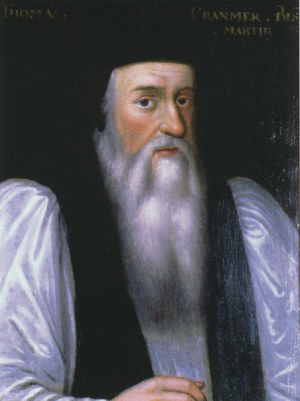
Portrait of Cranmer after Henry VIII's death by an unknown artistPortrait of Cranmer after Henry VIII's death by an unknown artistArchbishop Thomas Cranmer died at the stake in 1556, a martyr for the English Reformation; but did he die a martyr for the Church of England or for Anglicanism? If we examine Cranmer's career after he parted company in the early 1530s with the Catholicism of his first forty years, we find a man of international perspective, who sought to move England into the path of the wider European Reformation: in particular towards the Reformations to be found in the churches of south Germany and Switzerland. After Cranmer's death, most of these churches would be labelled 'Calvinist' or 'Reformed'. He would not have recognised these descriptions, but if he had lived, it is very likely that he would have done his best to take the English church in the same direction.
What would the Church of England have looked like if instead of Queen Mary's triumph in 1553, Queen Jane's quite reasonable hereditary claim to the throne had succeeded in establishing her regime? The Lady Mary would have to have been effectively neutralised, and one fears that neutralising her for good would have involved the block, in a return to Henrician savagery. The Lady Elizabeth could have been married off to Lord Robert Dudley, a good catch for a royal bastard, and a good chance for them both of a happy love-match.

Archbishop Cranmer, living to his allotted three-score years and ten or beyond, could produce a third version of his two earlier Prayer Books of 1549 and 1552, in the light of friendly criticism from continental reformers whom he respected, like Peter Martyr, Johann Heinrich Bullinger and Calvin. He would be succeeded as archbishop by Nicholas Ridley or Robert Holgate, with energetic younger reformers like Edmund Grindal ready to make their mark and pick up good ideas from the best reformed churches of Europe. The Scots immigrant John Knox, mellowed by an increasingly successful career in the Church of England, would be appointed Bishop of Newcastle, benevolently taking no notice of the advanced congregations in his diocese who received communion sitting; this was a practice in any case increasingly common throughout Jane's Church, despite Cranmer's grumbles. Cranmer's cherished reform of the old popish canon law would be achieved; the primer and catechism published at the very end of Edward's reign in 1553 would become the standards; the Forty-two Articles would have been unmodified by Elizabethan hesitations about relegating the significance of the sacrament of Holy Communion to that merely of a symbolic repetition.

Out in the parishes, metrical psalms in the style of Geneva would quickly have spread: these were the best secret weapon of the English Reformation, making its public worship and private devotional practice genuinely popular throughout increasing areas of the kingdom. This congregational music would also take over in the cathedrals, now devoid of choirs or polyphony, and with their organs (where they survived) used mainly for entertainment in the Dutch fashion. The conservative nobility would continue the sullen public compliance with religious change which they had shown under Edward VI, their private celebration of ceremonial worship tolerated as eccentricity, like the Lady Elizabeth's patronage of choral music in her own chapel.

The traditionalist higher clergy would gradually die off in senior church offices and the universities, with no possibility of like-minded replacement: since the universities produced no major haemorrhage of exiles in the 1560s, the Jesuits and other religious orders would find it difficult to recruit potential clergy to train for their attempt to treat Jane's England as a mission field. England would have become the most powerful political player in the Reformed camp, with Cranmer a cordial if geographically distant partner with John Calvin. It is powerfully symbolic that it was Cranmer's son-in-law Thomas Norton who translated Calvin's Institutes into English, and Cranmer's veteran printer Reyner Wolfe who published it. With a Cranmer-Calvin axis, the profile of Reformed religion across the whole Continent would have been changed, and with the help and encouragement of Bishop Knox, the Reformation in Scotland might have followed a close path to the Reformed Church of England.

That is the history that never happened. Instead, in 1558 Queen Elizabeth had to cope with the consequences of Mary's steadily more successful effort to integrate a traditionalist comeback with the Counter- Reformation's new dynamism. At home, Elizabeth wanted to conciliate conservatives; abroad, she wanted to conciliate suspicious Catholic Spain and France, and also to win friends among the Lutheran princes of Germany and Scandinavia, who were increasingly hostile to the Calvinist and other Reformed Churches to their south. At the same time, however, she was identified with the Protestant cause by her birth, she had a team of advisers who were senior administrators from Northumberland's regime, and she faced a triumphalist Protestant grouping already creating a mythology of glorious resistance to evil in the deaths of so many martyrs. Of these martyrs, Cranmer's name headed the list. Elizabeth herself shows signs of having preferred his discredited first Prayer Book of 1549 to his second of 1552, but virtually no-one at the time agreed with her: to reintroduce 1549 was not practical politics.

Elizabeth's solution to her dilemmas was remarkable: quite deliberately, she established what proved to he a snapshot, frozen in time, of the Church as it had been in September 1552, ignoring the progress made in further changing the Church of England after that date. This meant that the 1559 Prayer Book was the 1552 rite, devoid of the last-minute 'black rubric' denying that kneeling at communion represented adoration of the eucharistic elements of bread and wine (an addition probably demanded by Cranmer himself to preserve the custom of kneeling after John Knox's criticism). No government sympathy was offered to attempts in 1559 and 1571 to revive the arch- bishop's 1553 scheme of wholesale replacement for canon law. The 1553 catechism and primer were set aside, the primer in favour of a modified version of that issued in 1551 – itself a reworking of Henry VIII's 1545 primer.

One of the most striking features of Elizabeth's 1559 Settlement was that it began the Church of England's long march away from Cranmer's eucharistic theology, if only in small details. Cranmer wanted to ensure that people did not think that there was any physical or corporal presence of Christ in the elements of bread and wine, and he carefully recast his 1552 communion service to make this clear. Christ was only present to those communicants who had faith in him, and faith could not be earned by any human being; it was a predestined gift of God to those to whom he chose to give it. The clarity of Cranmer's sacramental intentions was undermined by restoring to the communion service the 1549 formulae of administering bread and wine to communicants which he had replaced in 1552, now simply shackled to the later formulae: was the communicant receiving the body and blood of Christ, or taking the elements in remembrance that Christ had died for human salvation? This, the omission of the 'black rubric', and a baffling instruction that the permissible ornaments and vestments of the Church were those in use in the year before the 1549 Prayer Book was authorised, were the only modifications of significance to the 1552 book in 1559.

Similarly, the most material alterations made by the 1565 Convocation to the Forty-two Articles of 1553 concerned eucharistic doctrine. Lutherans believed in a real presence in the eucharist. Although advocates of such views were virtually non-existent among English higher clergy, there were foreign diplomatic considerations. Most significantly, the Article statement 'of the wicked which do not eat the body of Christ', was omitted in 1563 to spare foreign Lutheran sensibilities, and it was only restored in 1571 when Lutherans no longer mattered. The 1553 argument that Christ's body could not be on earth because he was locally present in heaven was also left out for ever. It was true that the replacement wording still emphasised spiritual presence: 'the body of Christ is given, taken and eaten in the supper only after an heavenly and spiritual manner; and the mean whereby the body of Christ is received and eaten in the supper is faith'. However, Edmund Guest, the architect of this phrase and one of the bishops on Elizabeth's bench farthest from the Reformed ethos, gave it a spin which would not have appealed greatly to Cranmer: it 'did not exclude the presence of Christ's body from the sacrament, but only the grossness and sensibleness in the receiving thereof.

One should not exaggerate the extent of the drift at this early stage. Edwardian establishment evangelicals who survived the Marian holocaust, either through exile or some form of discreet invisibility at home, resumed their careers. To men like Bishop Edmund Grindal, who had been a major help to John Foxe in compiling his collections on the Marian persecutions, Cranmer, Latimer and Ridley were shining examples whose work needed to be upheld and extended. Even more radical evangelicals who had clashed with Cranmer under Edward Vl could forget their differences in view of what had happened under Mary: John Knox was generous in his comments on the three Oxford prisoners' 'lenity, sincere doctrine, pure life, godly conversation, and discreet counsel' and he called the martyred Cranmer 'the mild man of God'.

Yet the plain fact was that the Supreme Governor would not allow the Edwardian Reformation to proceed on its path, at least if it meant bringing structural change to her Church. Famously, she ruined Archbishop Grindal's ministry because of his refusal to suppress the 'prophesyings' – gatherings of clergy for the improvement of their preaching, and much more useful and less dramatic occasions than their name implied. The generation of Parker and Sandys found themselves defending this fossilised version of the Edwardian Church in the face of criticism from those who had been their companions in misfortune under Mary – increasingly also from a new generation who had no such personal links to restrain their expression of anger at the bewildering immobilism of the Church establishment.

In the face of this unexpected turn of events, the Oxford martyrs became as much the property of those who deplored the Elizabethan Church's half-reformed polity, as of Cranmer's remaining colleagues. A tussle, indeed, took place for the honour of being the heirs of Cranmer, Latimer and Ridley between groups within the Church which from the late 1560s can be distinguished as Puritan and conformist. Both sides claimed the myth-making of Foxe's Book of Martyrs for their own, and chose what they wanted from the myth. For conformists, Cranmer's legacy was his Prayer Book, so that he was the symbol of their defence of the liturgy against Puritans, just as he had been in the disputes among the Marian exiles about how far they could depart from the 1552 Book. For Puritans, this was a distortion of the Cranmer legacy, tragically cut off before it could be completed.


Notoriously, for John Field and Thomas Wilcox, the authors of the Admonition to the Parliament in 1572, the Prayer Book was 'an unperfect book, culled and picked out of that popish dunghill, the mass-hook full of all abominations'. Even John Foxe, in his 1571 introduction to the published text of Cranmer's canon law revision, felt compelled to point out the one serious flaw in this document prepared by his hero, that it ordered the exclusive use of the Prayer Book. The way to avoid the seeming contradiction of attacking Cranmer's Prayer Book while regarding him as an example to all good Protestants was the quite reasonable supposition that his work had been interrupted: the tradition that in time he would have 'drawn up a book of prayer a hundred times more perfect than this that we now have'.

The separatists who resisted a state- sanctioned Church encompassing both godly and ungodly alike who emerged on the fringe of the Puritan movement were much more equivocal towards Cranmer than mainstream Puritans, but they were by no means totally hostile; they too could use the Oxford martyrs as sticks with which to beat the Elizabethan hierarchy. Robert Browne, a Cambridge Puritan who had taken the rare step beyond the official Church into separatism, sneered about Elizabeth's bishops that 'neither Cranmer nor Latimer, nor Hooper, nor Ridley were so meet for the prison houses, as these are for their bishoprics'. He regarded the Marian persecution as God's way of. trying to save Edwardian establishment evangelicals from repeating the follies of the old Church; however, the Elizabethan hierarchy had not learned from Cranmer's and Ridley's mistakes, and 'these have got again that false popish government'. John Greenwood, a separatist who bitterly detested the Prayer Book which Cranmer had created, coupled his rather condescending view of the Oxford trio's 'ignorance' in borrowing a liturgy from Antichrist with the affirmation that 'I reverence those good men as much as I may by the word of God ... In that they knew, they shewed themselves faithful unto the death; therefore they [were] gatherers with Christ and not with antichrists ... God did pardon Cranmer for making that vile book, and his being metropolitan', he affirmed confidently. Only among the real radicals, those who were conscious heirs of the anabaptist martyrs whom Cranmer had helped to burn in Edward VI's reign, was there a consistent tradition that scorned the Oxford martyrs even amid the Marian troubles.

Another less positive view of Cranmer emerged from the 1.580s in a different quarter, among members of the established Church who wished to lay greater stress on its sacramental life. Most early significant figures (like many Puritan leaders), were Cambridge dons, notably Lancelot Andrewes, the Master of Pembroke: later the movement would widen, until under the patronage of the two first Stuart monarchs it gained an edgy self-confidence and a leading role in the Church. It is difficult to find a satisfactory general label for the grouping, except for the vague and variable description 'High Church'. At first without much public group identity, by the second decade of the seventeenth century these sacramentalists were being given. the nickname 'Arminians', by comparison with the movement in the Netherlands pioneered by the maverick Calvinist theologian Jacobus Arminius. The common factor was a revolt against the orthodoxy established by the great figures of the Reformation, of whom Calvin was the most obvious reference-point. However the English 'Arminians' predated Arminius' emergence as a disruptive force, and they had other priorities: a predisposition to emphasise continuity rather than discontinuity in the English Church through the Reformation struggles, and a willingness to appreciate afresh the devotional traditions of the medieval West. Above all, the sacramentalists wished to restore the notion of real presence in the eucharist to what they regarded as its rightful key place in Christian doctrine.

For saccamentalists or Arminians, Cranmer's 1552 Prayer Book as lightly revised in 1559 was not promising territory; nor did they enjoy contemplating the work of the Edwardian Church over which the Archbishop had presided. For most of them, there was no question of open criticism, Arminians made much of heir loyalty to the established Church, and they were fond of citing the homilies to prove controversial points which were often far from the intentions of the homilies' original compilers. Rather, their disapproval manifested itself in a discreet lack of comment about the virtues of the Edwardian Church, and also an increasing interest in the 1549 Prayer Bonk, for the very reason that Cranmer had revised it, because of the possibilities that it offered of reinstating a more extrovert Catholic practice and devotion than was possible with the 1559 rite. Lancelot Andrewes, once he had become a bishop, set an example in his private chapel by rear- ranging the order. of material in the 1559 communion service and multiplying the accompanying ceremonial to suit his theological predilections, an interesting action for a bishop who always emphasised uniformity and obedience to the Church in his public statements. When in 1.637 the sacramentalists had the chance to create an entire new liturgy for the kingdom of Scotland (alas, a liturgy which was not appreciated by the recipients), it was to 1549 and not to 1559 that they looked for a model.

Matters were made worse when the Arminians' growing ascendancy in the early Stuart Church and their frequently aggressive promotion of their remoulding of its life and practice met with opposition from the older Church establishment. One of the best examples of how Cranmer could now be used to embarrass the Arminians comes from the bitter dispute between William Laud and Bishop John Williams of Lincoln over the correct positioning of the communion table, and the symbolism or lack of it which the positioning might imply. In his 1637 justification of the general practice of the Elizabethan Church, Holy Table: name and thing, Williams naturally drew .heavily on the 1559 Book of Common Prayer, and on the Homilies. He also appealed directly to Cranmer's arguments as presented in the Defence and the Answer, since Cranmer's was 'the most learned in this theme of our late divines'. The 'theme' was eucharistic sacrifice, and Cranmer's usefulness to Williams was to restrict the idea of sacrifice, oblation or offering in the communion to the 'sacrifice of laud and thanksgiving', so that the holy table could not be regarded as a place of sacrifice, an altar.

Cranmer indeed became powerfully symbolic for all Laud's enemies. William Dowsing has entered history- books (to a limited extent) as the man who turned iconoclasm into, if not a fine art, then at least a careful bureaucratic duty. He was an East Anglian Puritan who, in the Civil War, gained a commission from Parliament to wreck churches; he was also an admirer of Thomas Cranmer and the Oxford martyrs. He possessed both Cranmer's Defence and his Answer: his surviving copy of the Answer, bought in 1637 at the height of the confrontation with Laud and now far from home in St Andrews, is filled with his customary lavish marginal annotations. Having read Cranmer's book, Dowsing drew particular attention to what he called 'Cranmer's prayer', an acrid rebuke to the Catholic Bishop Stephen Gardiner. The passage culminated with the ringing call: 'I pray God, that we have not rather been figures of bishops, hearing the name and title of pastors and bishops before men, than that we have in deed diligently fed the little flock of Christ with the sweet and wholesome pasture of his true and lively word'. Dowsing summed this passage up as Cranmer's 'desire he may answer his call of bishop'. Here was an archbishop after his own heart. a sad contrast to the contemporary occupant of the office in 1637.

After the 1641 national crisis, attitudes to the Marian prelate-martyrs became more divided. William Prynne, for instance, can be found re- evaluating the deaths of Cranmer and Ridley, whom (like Dowsing) he had previously seen as symbolic allies in his campaigns against Laudian prelacy. Most hostile of all was John Milton, in his bitter attacks on the whole notion of episcopacy during the Interregnum. Cranmer and Ridley became 'halting and time-serving prelates' who were only brought to a better understanding of truth by the persecution which they endured, although it must be said that Milton's opinion of the tyranny of Genevan church government was no higher! Conversely, moderate defenders of the pre-war established Church redoubled their praise of bishops who could be seen as redeeming episcopacy from Laud's follies. However, perhaps the most impressive Interregnum verdict on the martyred archbishop's memory was spoken more quietly, throughout the parishes of England. That verdict was neither one of Laudian embarrassment nm of anti-episcopal antagonism. It was the unobtrusive continuing use of the Book of Common Prayer at a time when it was illegal and officially replaced by the Westminster Assembly's Directory of Public Worship. The Prayer Book itself had attracted little open hostility during the course of the Civil War, while bishops were abolished and church furnishings and ornaments were destroyed by the likes of Dowsing. In the years after the war, through all the turbulence of Commonwealth and Protectorate, its use continued in very many churches, adapted to local needs in the way sought by Elizabethan Puritans. After a century of use, it had become part of an English popular culture.

Given this testimony to the Prayer Book's place in the fabric of English Protestantism, the nature of Charles II's Restoration Settlement of 1660-62 with its startling triumph of militant Anglicanism becomes more comprehensible; Cranmer played his part in that victory. Whether he would have been happy with the aftermath of the triumph is less certain. Perhaps he would have understood the need to modify his liturgy after a century of use; after all, he had only been given four years in which to experiment with its practice in Edward VIs reign. However, the author of the Defence and the Answer might have looked askance at the delicate subversion of his sacramental outlook by the 1662 revisers.

Likewise, he is unlikely to have been happy that Anglicanism's new,, more narrowly-drawn, identity in 1662 which excluded many Protestants who would have found a home in. the pre-Laudian Church; almost single-handed, the triumphalist Anglicanism of the Restoration created that phenomenon which is so distinctive in English religion – large-scale Protestant nonconformity. At the moment in the eighteenth century when that 'Old Dissent' seemed to be fading, a new outburst of energy within the established Church burst its banks and formed a family of 'Methodist churches. Particularly in the Wesleyan Connexion which lay at the heart of the Methodist phenomenon, this rebellion remained true to the spirit of Cranmer's Prayer Book, and was sustained by the spirituality of the English Reformation. When archivist at English Methodism's oldest surviving theological college, Wesley College, Bristol, I had in my custody two quarto copies of the Book of Common Prayer used in the college's original chapel from its opening in Manchester: they were worn frail with regular use in leading the community's communal worship.

Later, attitudes to Cranmer among historians and biographers remained divided. On the one hand there was a tradition of praise, led by John Strype and Gilbert Burnet; on the other, a tradition of blame, which stemmed naturally from Catholic sources, hut which found some unexpected adherents during the nineteenth century. Most bizarre was the virulent stance taken by William Cobbett, whose view of the Reformation as an act of deliberate plunder inflicted on the helpless poor needed a villain, provided by Thomas Cranmer. Besides this, however, came a revival of coldness towards Cranmerian religion among the heirs of Laud and the Arminian tradition: the Tractarians and churchmen of the Oxford Movement, whose ideas were absorbed into the wider Anglican movement known as Anglo-Catholicism. They were embarrassed that the Church of England had been permanently shaped by the reign of Edward VI; the responsibility for that shaping was in the hands of the one man who remained at the centre of religious policy throughout Edward's reign, Thomas Cranmer.

There was at least one escape-route for Tractarians and Anglo-Catholics from the worst consequences of the reign of Edward VI. As the Arrninians and Laudians had done two centuries before, they could see Cranmer's first Prayer Rook (quite mistakenly) as a welcome refuge from the theological implications of his second. Towards the end of the nineteenth century, reorderings of the eucharistic rite in the mould of 1549 became common in Anglo-Catholic parishes and convents, particularly in dioceses which had been created by the world-wide spread of Anglicanism in the wake of the successive British empires. Yet the 1549 Prayer Book's compiler remained Ioved more for his prose than for his theology. There are not any statues to him in the beautiful churches built in the Anglo-Catholic tradition.

Today Anglicanism makes much of its position as a 'middle way' (via media) between Roman Catholicism and Protestantism. Standing as he did in the developing Reformed tradition of Europe in the 1550s, Cranmer's conception of a 'middle way' in religion was different. The middle ground which he sought was the same as Bucer's: an agreement between Wittenberg and Zurich which would provide a united vision of Christian doctrine against the counterfeit being refurbished at the Council of Trent. For him, Catholicism was to be found in the scatterered churches of the Reformation, and. it was his aim to show forth their unity to prove their Catholicity.


Perhaps the most widespread use of Cranmer's original texts in pure form remains Anglican evensong, where twentieth-century forms have failed to win admirers away from the majestic rhythms of his prose. One of the glories of the Anglican tradition is the choral performance of this even- song in the setting of great churches such as cathedrals: again a situation replete with irony. Cranmer had little affection for cathedrals, and no discernible love of complex choral music. He would have deplored the long-term survival of the Anglican cathedral tradition which Elizabeth I's obstinate traditionalism made possible. At a. deeper level, he would have been appalled at the spirituality which may be represented in the love of evensong. This is the exploration of religion by those who have decided to remain on the fringe of the Church, genuinely concerned to pursue their dialogue with God, yet not prepared to demonstrate the degree of commitment demanded by the eucharist. The encounter with the Anglican offices, however infrequent, can provide a place where they can show that they still wish to look beyond the surface of events and say that there is more to human life and creation than the obvious, the every- day. That home has been bequeathed them by Archbishop Cranmer.

Cranmer could hardly complain about adaptability to different times, since the consistent evangelical drive apparent in his career from 1532 was coupled with a remarkable penchant for temporary adaptations to circumstances, and adaptations of alien means to evangelical ends. No-one has made a very satisfactory defence of his conduct in taking the archbishopric (which involved simultaneously swearing an oath of loyalty to the pope and rejecting papal authority). Neither is his part in the annulment of Henry VIII's Aragon and Boleyn marriages inspiring. Yet to sneer at these three events and others as proving his craven wish to advance or present himself is a had misjudgement. The thread running through them all is his fierce determination to promote the evangelical reform of the Church. He cut legal corners. Equally, he captured the Devil's best tunes for the Lord's service. He cannibalised the writings of a Roman cardinal, Quiñones, for his liturgical reforms, and the prose of another contemporary cardinal, the theologian Cajetan, for his homilies, without the slightest respect for the theology which underlay their work. He redirected some of the riches of the Church's liturgical heritage for his Prayer Book, and only gradually discovered that this was a risky thing to do. In all this, one could compare another great metropolitan of the Church Universal who in the 1540s failed where Cranmer succeeded, and whom Cranmer clearly regarded as following the same policy: Hermann von Wied, Archbishop of Cologne. With archbishops like these, Calvin need never have turned Calvinism into a Presbyterian system, and. Andrew Melville need not have waged his long war against bishops in the Church of Scotland.

The widest aftermath of Cranmer's life and work is to be found in the realms of language and cultural identity. It was the happiest of accidents that this ecclesiastical functionary, propelled into high office by the accidents of politics, had a natural feel for English prose. His genius was limited to prose, and we can be grateful that, ever-practical, Cranmer knew that he could not write poetry. Cranmer's prose, however, has done much to guide the direction of the English language. He was a connoisseur of English who was not ashamed to borrow what he liked from other people's efforts, so what we think of as Cranmer's Prayer Book English is in fact a patchwork of his adaptations of other writers like Miles Coverdale, George Joye and Richard Taverner. If he were writing liturgy today, he would face crippling lawsuits for breach of copyright. However, his motive was not sinister; it was an expression of his natural modesty and practicality, and his alterations of existing texts were almost invariably improvements. And it came at a crucial time, for Cranmer was doing his work at a time when English, like all Western European languages, faced a double challenge: the effect of the universities' enthusiasm for humanist Latin, and the standardisation and centralisation caused by printing. Every Western European language has certain key texts of literature from this era and for English-speakers one of that handful of texts is the Book of Common Prayer. Millions who have never heard of Cranmer or of the muddled heroism of his death have echoes of his words in their minds.

The Prayer Book inevitably had a key role in deciding what was good English: it was one of the most frequently-printed and often most heard texts in the language. Whatever its content, it would have become decisive. For this reason, Cranmer deserves the gratitude not merely of the Church of England, but of all English speakers throughout the world. Through his connoisseurship, he created a prose which was self-consciously formal and highly-crafted, intended for repeated use until. it was polished as smooth as a pebble on the beach. Yet he spared the users of the Prayer Book the worst pomposities of humanism and the sprawling sentence constructions which are only too common in the English prose writers of the sixteenth century. He stands prominently amid a select band of Tudor writers from Tyndale to Shakespeare who set English on its future course.

In an ecumenical age, which honours honest doubt and hesitancy as a lesser evil than clear-eyed ideological certainty, Cranmer may win admirers and sympathisers and take his due place in Anglican history. He would not have known what Anglicanism meant, and would probably not have approved if the meaning had been explained to him, but without his contribution, the unending dialogue of Protestantism and Catholicism which forms Anglican identity would not have been possible. Beyond the concerns of Christianity, for all those who criticise his politics, or find his theology alien, Cranmer's language remains as the most enduring monument to Henry Vlll's and Edward VI's most faithful servant. Twentieth-century scholarship has reminded us just how fundamental is the structure of language to the way in which we construct our lives and our culture. Cranmer's language lies at the heart of our own English-speaking culture, which has now become so central to the destiny of the world.

Tuesday, May 29, 2012

ABC Thomas Cranmer's Alma Mater: Jesus College, Cambridge


At age fourteen in 1503, Cranmer began collegiate studies at Jesus College, Cambridge.  He maintained connections with Cambridge until his death in 1556.
A virtual tour of the Chapel at Jesus College, Cambridge:
The Chapel Court at Jesus College, Cambridge:
The “First Court” at Jesus College, Cambridge:
The following information is provided on the Chapel and Choir, to wit:

“Jesus College Chapel exists for the glory of God, and has been used for worship since the twelfth century. It is open during the day for prayer and quietness, and all members of the College community, whatever their religious beliefs, are welcome to visit the Chapel and to attend any of the services, taking from them what they can. The Anglican tradition is designed to be accessible to those from a wide range of backgrounds. The two Choirs enrich the worship of the Chapel at four evensongs each week, and for these more formal occasions members of the College are encouraged to wear their gowns.”    See:  http://www.jesus.cam.ac.uk/chapel-choir/

Additional information on this history of the Chapel, to wit, at:  http://www.jesus.cam.ac.uk/chapel-choir/history-of-the-chapel-2/

“Jesus College Chapel is the oldest college chapel in Cambridge and it is unique in that it was not originally designed as a college chapel, since it precedes the foundation of the college by three and a half centuries, and the university by more than half a century. It was originally a large Norman church dedicated to St Mary which served the twelfth-century Benedictine convent of St Radegund, which is why the plan of the present chapel, like that of the cloisters that surround it, has a conventual rather than a collegiate character (1). It also served as the church of the parish of St Radegund which grew up around the convent, which was at that time a semi-rural area located just outside the city of Cambridge: a charter of 113 from Nigellus, the second Bishop of Ely, refers to ‘the nuns of the little cell lately instituted without the town of Cantebruge’. (2)
The church took about a century to build, being begun about 1157 and completed about 1245, and it was at that time the largest church in Cambridge, being about 58 metres in length and of cathedral-like proportions. Like the modern chapel, it was built in the form of a cross, though with aisles to the north and south of chancel and nave, with a high pitched roof, and was surmounted by a belfry or steeple which was visible for miles around. In 1277 the belfry collapsed, and in 1313 and again in 1376, devastating fires destroyed much of the surrounding convent but largely spared the church itself, causing only some discoloration to the tower. The church itself fell into some degree of dilapidation due to the convent’s lack of funds to repair the fabric of the building.
When the convent of St Radegund was dissolved in 1496 by John Alcock, Bishop of Ely, and a new college was founded in its place, the conventual church of St Mary was rededicated to the name of Jesus and part of the church was demolished and the remaining portion was drastically modified. Alcock, who was an architect as well as a bishop, having been Comptroller of the Royal Works and Buildings under Henry VII and having designed parts of Ely Cathedral and Great St Mary’s church in Cambridge, himself designed many of these alterations, which were intended to create a chapel that was more suitable in scale for a small community of scholars than the existing church. The beginning of this work on the new chapel was superintended by one of Alcock’s friends, William Plombe, who was one of the original fellows of the college, in 1497-98. After Alcock’s death in 1500, the work was continued by some other friends of Alcock, Dr William Chubbes, the first master of the college, and the architects Sir John Rysley and Sir Reginald Bray. The reconstruction took considerable time, since Sir John Rysley, who died in 1512, bequeathed £160 towards its completion (3).
The chancel chapels and the aisles of the nave of the church were pulled down and the cloisters were enlarged. The new cloisters were enclosed by walls that contained four windows in the Perpendicular style. The dilapidated belfry was taken down and the high-pitched roofs of the church were replaced by a lower-pitched flat roof with an oak ceiling. The lancet windows in the eastern wall were replaced by a plain Perpendicular window. Two thirds of what had been the nave of the church were replaced by college rooms, which subsequently became part of the eastern wing of the Master’s Lodge, and the chapels on the north and south sides of the choir were pulled down and the northern aisles became part of the cloister: the original columns are still embedded in the wall. The screen which had divided the monastic from the parochial at the west end of the crossing was replaced by a more open screen at the east side. The thirteenth-century arches which had divided the aisles from the nave were either pulled down to make way for the college rooms or were blocked off with stone and concealed with plaster. The four arches in the chancel and the two arches in the north transept were all filled in and covered over and in the new walls they placed Perpendicular windows. In the south transept, the eastern arch was also filled in and covered over, two Perpendicular windows were inserted in the eastern and western walls and a very large Perpendicular window was inserted in the southern wall (4).
Thus St Mary’s church became Jesus chapel. For the time being, it continued to serve as the church of the parish (soon to be renamed ‘Jesus parish’) and it was used for baptisms and marriages, and ‘Jesus churchyard’ was used for the burial of the dead, during the first half of the sixteenth century. The last mention of ‘Jesus parish’ is in a deed of 1552 and it seems to have gradually lapsed into obsolescence, being subsequently incorporated into the parish of All Saints. The western end of ‘Jesus churchyard’ was separated off early in the history of the college to form the Master’s garden. The remainder eventually ceased to be used as a burial ground and came to be known as ‘Fair Close’, because an annual fair was held there every August for much of the sixteenth century. By the beginning of the seventeenth century, the rest of the former churchyard had been transformed into the fellows’ garden and the orchard.
The furnishings and rituals of the chapel underwent the usual vicissitudes and reversals of fortune due to the religious reforms and counter-reforms of the sixteenth century; in 1549, during the period of Protestant iconoclasm under Edward VI, the royal Visitors destroyed six altars in the chapel and some images in the Master’s Lodge. During the Catholic restoration that followed in the reign of Mary, Dr. John Fuller was appointed Master, in 1557, and he restored the old ritual and ornaments in the chapel. During the reign of Elizabeth, the college fellowship became decidedly Protestant, although not Puritan, in its sympathies and the elaborateness (and expense) of the services in the chapel was greatly reduced, and the ornaments that had been replaced in the chapel were again removed, although the organ was allowed to remain until 1585 (5). James I was a frequent visitor to Cambridge and to Jesus College, in particular, and he worshipped in the college chapel when he visited the city. In 1617, James’s Chancellor of the Exchequer and an alumnus of Jesus, Sir Fulke Greville, planned to fill in the nave of the chapel and create new college rooms to cater for the continually expanding membership of the college. Fortunately, this scheme was never carried out. In 1634, under the Mastership of Dr Richard Sterne, a new organ was purchased and an organist was employed to play it and, in 1636, new furniture, plate and candlesticks for the altar were purchased, in the spirit of the High Church reforms of Archbishop Laud. At this period, the college was known as a stronghold of the High Church party in the University and the chapel services were renowned for ‘good music, elaborate solemnity and attractive decency’ (6).
With the coming of the Civil War, the college became embroiled in the dispute between the King and Parliament. In 1641, the House of Commons issued an order to all the heads of colleges ‘to displace the Communion table from the east end of their chapels, to take away the rails and level the chancel, and to remove crucifixes, tapers, and basins from the Communion table’ (7), so that the fellows found themselves obliged to banish all the new furnishings that they had so recently purchased to refurnish their chapel. The fellows were then required by Charles I to raise a loan of £100 and to send pieces of the college plate to his camp in York. Part of the plate was seized by Cromwell’s men before it could be conveyed out of Cambridge, but most of it was successfully conveyed to York, for which the Master, Richard Sterne, and the former Master, William Beale, were arrested by Cromwell in the course of a service in the chapel and taken to the Tower of London. The organ in the chapel was taken to pieces and hidden by the fellows and the college plate which had not been sent to the King’s camp was buried in the orchard. At Christmas 1643, William Dowsing, a puritan iconoclast, who was commissioned by Parliament to purge the churches and chapels of Cambridge of their ‘monuments of superstition’ visited the college and ‘digg’d up the Steps there and brake down Superstitions of Saints and Angels, 120 at the least’ (8). The following year all the fellows, except for two, were ejected from the college and Richard Sterne was deposed from the Mastership. In 1659 a bell was purchased for the belfry. At the Restoration, the interior of the chapel was repaired and restored to its former beauty by the new masters, Dr John Pearson and Dr Joseph Beaumont, between 1660 and 1663, and the organ was rebuilt and reinstated in the chapel. In 1676, the chapel was paved with black and white marble and some time between 1660 and 1680 a gallery was built in the chancel which faced towards the altar. The remains of a classical entrance still to be seen on the south wall from the walk through to the new library may well date from this time.
By contrast with the preceding period, the early eighteenth century was an uneventful period in the history of the college and very few additions or even repairs to the chapel seem to have been made. However, between 1762 and 1765, the piers and arches of the cloisters were demolished and rebuilt to designs by James Essex (9). The use of the organ in the chapel was also discontinued during this period and the organ was dismantled and given to the parish of All Saints (and the casework may now be seen in Little Bardfield church in Essex). In the 1780s, the perpendicular east window in the chancel was rebuilt and, between 1789 and 1792, a major restoration of the chapel was undertaken in order to bring the architecture into accord with the reigning Classical ideal in architecture. In the chancel, the sixteenth century stalls and some sections of the old carved woodwork from the pulpit and the screen were removed and a partition wall of plaster was built to block off the eastern arch of the tower, above the gallery and entrance of the choir, which was adorned with Ionic pillars. The oak roof of the chancel, with which Alcock had replaced the original high-pitched roof, was now hidden by a new flat plaster ceiling and another plaster ceiling was built across the open square of the tower to hide the roof-storey gallery. About thirteen years later, the external walls of the chapel were overlaid with cement and the battlements and the mouldings of the windows were similarly repaired (10).
The nineteenth century saw major new restoration work on the chapel, inspired by the new spirit of the Gothic revival, which was carried out between 1846 and 1849, and which largely reversed the earlier repairs. The main instigators of this new restoration were the Rev. John Gibson, then Dean of the College, who was responsible for issuing an appeal to old members of the college and was appointed treasurer of the restoration fund, and a notable Victorian geologist, the Rev. Osmond Fisher. Their aim was to restore the ritual as well as the architecture of the chapel, including the restoration of music to the chapel services through the purchase of an organ and the reinstatement of the choir. The new organ was designed and purchased in 1849 by John Sutton, a fellow commoner of the college and a musician, who devoted much of his career at Jesus to writing a book on the subject of organs, and who served as the college organist and published a collection of anthems for use in the chapel.. He also instituted a choir school in the college and taught the boys himself (11).
Under the direction of Anthony Salvin, who had recently undertaken a controversial restoration of the Round Church, the eighteenth century partition wall in the chancel arch was removed in 1846, along with the gallery on its eastern side, and a new combined organ chamber and vestry was built on the eastern side of the northern transept. The two arches which opened into the choir were rediscovered and unblocked, together with the two arches which opened upon the north transept below the gallery. The re-opening of the arches of the northern chapel seriously weakened the north-eastern pier of the tower and the removal of its upper story was debated. However, the tower was eventually strengthened by filling the two arches below the gallery with heavy tracery, uniting those in the chancel with a low solid screen of stone and building a heavy buttress in the vestry. The upper story of the tower was also strengthened with heavy iron bolts. These repairs were carried out on the advice of the architect Augustus Pugin (famous for his work on the Houses of Parliament) who was a close friend of John Sutton and who had come down to Cambridge to take the measurements for the organ chamber. On Sutton’s recommendation, the college also decided to employ Pugin to direct the continuing programme of the restoration of the chapel (12).
In the north transept, the Norman windows that were embedded in the north wall were rediscovered. They were preserved as recessed arches and the whole wall was restored. New stalls and a new pavement were also supplied for the chancel. Pugin removed both the eighteenth century plaster ceiling and Alcock’s low-pitched roof which he replaced by a high-pitched roof, in a thirteenth-century style. He also rebuilt the choir stalls and the eastern wall and removed Alcock’s Perpendicular east window, replacing it with three tall lancet windows; archaeological evidence had been unearthed in the course of the restoration that showed that this was the original form that the windows had taken. Pugin installed stained glass windows of his own design in 1850 and the other windows were later glazed, in the same style, between 1850 and 1858. The newly purchased organ was installed in the organ chamber and on All Saints’ Day 1849 the chapel was re-opened with a full choral service (13).
In 1862, cracks began to appear in the arches and piers of the tower and further repairs were carried out between 1864 and 1867 by George F.Bodley, who was also working simultaneously on All Saints’ Church, opposite the entrance to the college. The tower was refaced and restored, a solid buttress was built for its support in the south-east corner of the Master’s garden and a wrought iron rod was placed above the choir screen. Decorations for the newly-panelled ceilings of the nave and the tower were designed by William Morris and painted under his direction in 1867; and between 1873 and 1877 the windows in the nave and transepts of the chapel were glazed by Morris and Company from designs by Edward Burne-Jones and Ford Madox Brown. A larger and more powerful organ was purchased to replace Sutton’s organ in 1887 and was installed in a new gallery at the west end of the nave. Thus by the end of the century the chapel had attained its present proportions and appearance, in which the Norman original, together with Early English, Decorated and Perpendicular elements, Essex’s eighteenth century cloisters and Pugin’s and Burne-Jones’ nineteenth century restorations combine to form this remarkable building (14).
The twentieth century saw the abolition of compulsory chapel, and the consequent removal of the organ and gallery from the west end of the nave – though the gallery may still be seen over the road at Westcott House. The organist cum schoolmaster was replaced by an organ scholar in 1919, and the twentieth century has seen some distinguished church musicians having their early training at the college. Though the fixtures and fittings have remained much as they were at the outbreak of the Great War, several restorations, the most recent in 2004, have revealed more of the glories of the building, especially with the more advanced lighting systems available to us now. Of particular interest was the uncovering of work on the north wall of the nave, which gives every appearance of being William Morris’s demonstration of what the walls would look like if decorated – the fellows, preferring a more austere finish, demurred, and it remained covered in whitewash for over 130 years.
A further enrichment of the college’s distinguished choral tradition will take place during the course of 2006, thanks to a generous benefaction, with the installation of a new organ to replace the Mander of 1969, by Kuhn of Switzerland. As the college now has two choirs, of men, women and boys, and a full time director of chapel music, this will be a great asset indeed.
References
1.                 Morgan, I and G: The stones and story of Jesus Chapel Cambridge (1914), p.2
2.                 Ray, N: Cambridge architecture: a concise guide (1994), p.33
3.                 Sikes, J and Jones, F: Victoria History of the counties of England Vol 3: Cambridgeshire (1959), p.421
4.                 Morgan, I and G: The stones and story of Jesus Chapel Cambridge (1914), p.107
5.                 Sikes, J and Jones, F: Victoria History of the counties of England Vol.3: Cambridgeshire (1959), p.424
6.                 Morgan, I and G: The stones and story of Jesus Chapel Cambridge (1914), p.197
7.                 Morgan, I and G: The stones and story of Jesus Chapel Cambridge (1914), p.184
8.                 Morgan, I and G: The stones and story of Jesus Chapel Cambridge (1914), p.194
9.                 Webster, H and Howard, P: Cambridge: an architectural guide (2000), Part 4, p. 44
10.            Morgan, I and G: The stones and story of Jesus Chapel Cambridge (1914), p.254
11.            Morgan, I and G: The stones and story of Jesus Chapel Cambridge (1914), p.295
12.            Morgan, I and G: The stones and story of Jesus Chapel Cambridge (1914), p.300
13.            Morgan, I and G: The stones and story of Jesus Chapel Cambridge (1914), p.307
14.            Ray, N: Cambridge architecture: a concise guide (1994), p.34