Reformed Churchmen

We are Confessional Calvinists and a Prayer Book Church-people. In 2012, we remembered the 350th anniversary of the 1662 Book of Common Prayer; also, we remembered the 450th anniversary of John Jewel's sober, scholarly, and Reformed "An Apology of the Church of England." In 2013, we remembered the publication of the "Heidelberg Catechism" and the influence of Reformed theologians in England, including Heinrich Bullinger's Decades. For 2014: Tyndale's NT translation. For 2015, John Roger, Rowland Taylor and Bishop John Hooper's martyrdom, burned at the stakes. Books of the month. December 2014: Alan Jacob's "Book of Common Prayer" at: http://www.amazon.com/Book-Common-Prayer-Biography-Religious/dp/0691154813/ref=sr_1_1?ie=UTF8&qid=1417814005&sr=8-1&keywords=jacobs+book+of+common+prayer. January 2015: A.F. Pollard's "Thomas Cranmer and the English Reformation: 1489-1556" at: http://www.amazon.com/Thomas-Cranmer-English-Reformation-1489-1556/dp/1592448658/ref=sr_1_1?ie=UTF8&qid=1420055574&sr=8-1&keywords=A.F.+Pollard+Cranmer. February 2015: Jaspar Ridley's "Thomas Cranmer" at: http://www.amazon.com/Thomas-Cranmer-Jasper-Ridley/dp/0198212879/ref=sr_1_1?ie=UTF8&qid=1422892154&sr=8-1&keywords=jasper+ridley+cranmer&pebp=1422892151110&peasin=198212879

Showing posts with label PCUSA. Show all posts

Saturday, May 17, 2014

17 May 1776 A.D. Colonialist Presbyterian Rev. John Witherspoon Brings Politics into the Pulpit


17 May 1776 A.D. Colonialist Presbyterian Rev. John Witherspoon Brings Politics into the Pulpit

Archivist.  “May 17: Rev.  John Witherspoon.”  This Day in Presbyterian History . 17 May 2014.  http://www.thisday.pcahistory.org/2014/05/may-17/.  17 May 2014.

May 17: Rev. John Witherspoon


John Witherspoon Brings Politics into the Pulpit
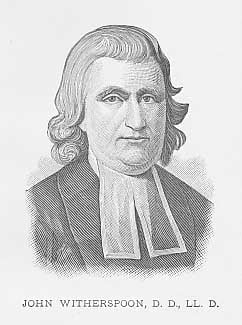
http://www.thisday.pcahistory.org/wp-content/uploads/2012/02/witherspoon.jpgIn our last historical devotional, we saw how the Confession of Faith cautioned synods and council from making pronouncements on political matters. In this devotional, we see a Presbyterian minister enter the pulpit of a Presbyterian congregation in Princeton, New Jersey on May 17, 1776 to bring politics into the pulpit. That Presbyterian minister was John Witherspoon, the president of the College of New Jersey.

The timing is interesting.  Battles up north around Boston have already been fought.   In about three weeks, John Witherspoon will affix his signature to the Declaration of Independence.  As he enters the pulpit of the Presbyterian Church, he is going to speak on “The Dominion of Providence over the Passions of Men. A SERMON preached at Princeton, on the 17th of May, 1776 BEING the General Fast appointed by the CONGRESS through the UNITED COLONIES. To which is added, An Address to the Natives of Scotland residing in America.”  And you thought your pastor had long sermon titles!

Witherspoon in taking politics in the pulpit in essence is going to preach on God’s providence, how that God guides and governs and directs and controls all things, from the greatest to the least. He further uses the appointment of a fast from Congress to proclaim this message at this time. Let me quote one paragraph from it.

     “You are all witnesses, that this is the first time of my introducing any political subject into the pulpit.  At this season, however, it is not only lawful, but necessary; and I willingly embrace the opportunity of declaring my opinion without any hesitation, that the cause in which America is now in arms, is the cause of justice, of liberty, and of human nature.  So far as we have hitherto proceeded, I am satisfied that the confederacy of the colonies, has not been the effect of pride, resentment, or sedition, but of a deep and general conviction, that our civil and religious liberties, and consequently, in a great measure, the temporal and eternal happiness of us and our posterity, depended on the issue. There is not a single instance in history, in which civil liberty was lost, and religious liberty preserved entire.  If, therefore, we yield up our temporal property, we at the same time deliver the conscience into bondage.”

With words like this, no wonder that a speaker in England’s Parliament declared that “Cousin American has run away with a Presbyterian parson.”  And that Presbyterian parson was none other than John Witherspoon. He closed his sermon with the following words, “God grant, that in America true religion and civil liberty may be inseparable, and that the unjust attempts to destroy the one, may, in the issue, tend to the support and establishment of both.”

Words to Live By:  We as American citizens have no right to pray for any kind of temporal prosperity without the necessity as Christian Americans to pray for spiritual revival in our blessed land.   The two ends must go together.

Wednesday, June 27, 2012

PCUSA: Fastest Growing Presbyterian Churches


http://www.pcusa.org/resource/fastest-growing-presbyterian-churches/

Fastest Growing Presbyterian Churches

To learn more about congregations that have been successful in increasing their size, we invited the fastest-growing PC(USA) churches to take part in the U.S. Congregational Life Survey in 2011. Learn how these growing churches and their worshipers differ from those in other PC(USA) churches. What strengths do they have?


Download PDF
(136.1 KB)

Wednesday, April 11, 2012

11 Apr 1933: J.G. Machen v. Robert E. Speer, Liberalism in Presbyterian Missions

http://www.thisday.pcahistory.org/?p=290

Be Ready Always

Professor J. Gresham Machen
(1881-1937)
Princeton Seminary
Westminster Seminary
The day of the debate had brought a crowd of Presbyterian elders to the sanctuary of the Fourth Presbyterian Church on that day of April 11, 1933. The topic was “Modernism on the Mission Field.” 

And the two individuals engaging in the debate were two “heavies” on opposite sides of the issue.

Dr. J. Gresham Machen was the recognized leader of the conservatives in the Presbyterian Church, U.S.A. Founder and president of Westminster Theological Seminary in Philadelphia, Pennsylvania, he was still a member minister of the New Brunswick, New Jersey Presbytery, though he had tried unsuccessfully to transfer to the Philadelphia Presbytery. Against him was Dr. Robert Speer, present head of the Board of Foreign Missions of the Presbyterian Church, U.S.A.

Dr. Machen began his presentation with a proposed overture from the Presbytery of New Brunswick to the General Assembly of 1933. The first two of four parts are the key ones, which I will quote word for word from the April 1933 Christianity Today article, and sum up the other two.

The Rev. Dr.
Charles Elliot Speer
(1867-1947)
Presbyterian Churchman
Secretary of Foreign
Missions (1891-1933?)
Point 1 of his overture was: “To take care to elect to positions of the Board of Foreign Missions only persons who are fully aware of the danger in which the Church stands and who are determined to insist on such verities as the full truthfulness of Scripture, the virgin birth of our Lord, His substitutionary death as a sacrifice to satisfy divine justice, His bodily resurrection and His miracles, as being essential to the Word of God and our Standards, as being necessary to the message which every missionary under our church shall proclaim.”

In essence, this first proposition simply summed up the Declarations of the General Assembly’s five fundamentals which were considered as essential for the Church, its boards, and its ministers. It specifically repudiated the denials of the same by the Auburn Affirmation in 1924.

Proposition 2 of the proposed overture sought to “instruct the Board of Foreign Missions that no one who denies the absolute necessity of acceptance of such verities by every candidate for this ministry can possibly be regarded as a candidate to occupy the position of Candidate Secretary.”

This proposition addressed the important place which the Candidate Secretary has in ascertaining the theological convictions which each missionary candidate has to serve on the Foreign Field. In other words, in people such as Pearl Buck, who was openly denying the exclusiveness of the gospel of Christ, it is obvious that the Candidate Secretary had “missed the boat” in approving her as being a missionary to China.

The third proposition summed up that those who held that the tolerance of opposing views was more important than an unswerving faithfulness in the proclamation of the Gospel as it is contained in the Word of God, show themselves to be unworthy of being missionaries of the cross.

This proposition was aimed at those who had accepted the fundamental viewpoint of the book, “Rethinking Missions,” that denied the exclusivity of the gospel.

The last proposition sought to warn the Board of the great dangers lurking with union enterprises in view of wide-spread error.

Dr. Speer for his part of the “debate” simply dismissed each of the overture propositions. When the vote was taken on Dr. Machen’s proposed overture, it was voted down by the Presbytery of New Brunswick, with a majority voting in favor of confidence in the Board of Foreign Missions. Dr. Machen, Rev. Samuel Craig, and Dr. Casper Wistar Hodge asked that their names be recorded in dissent of the motion.

For a fuller account of the debate, click here.


Tuesday, February 28, 2012

Presbyterians Split: Splinter churches realign mainline Protestantism

RNS is reporting the following at: http://www.religionnews.com/culture/social-issues/splinter-churches-realign-mainline-protestantism

(RNS) There's a popular saying in church-planting circles: It's easier to make babies than to raise the dead.


Lutheran bishops ordain the Rev. John Bardosky in 2011 as the new leader of the North American Lutheran Church, which broke away from the Evangelical Lutheran Church in America over the ELCA's decision to allow noncelibate gay clergy and other issues. RNS photo courtesy Carter Askren / The Metro Lutheran.

That principle applies to denominations as well, said the Rev. Paul Detterman, who helped found the Evangelical Covenant Order of Presbyterians in January.

"We thought it was easier in the long run to create something new rather than to keep on trying to modify existing forms," he said.

The "existing form," in Detterman's case, was the Presbyterian Church (USA), which remains the nation's largest Presbyterian denomination despite a decades-long plunge in membership.

The ECO may steepen that decline. Thousands of conservative Presbyterians, upset over the PC(USA)'s vote to lift its ban on partnered gay and lesbian clergy last year, are eyeing the new group. Planning for the ECO, which will not ordain sexually active gays and lesbians, preceded that vote, Detterman said.

Nonetheless, the ECO represents the third new mainline Protestant denomination since 2008 to split from a national church following elections to permit partnered gay clergy.

The Anglican Church in North America formed in late 2008, five years after the Episcopal Church consecrated an openly gay bishop in New Hampshire. In 2010, a year after the Evangelical Lutheran Church in America voted to allow partnered gay and lesbian clergy, conservatives formed the North American Lutheran Church.

Leaders of all three new denominations say the gay clergy issue was only the breaking point for conservatives, after years of dissatisfaction with overbearing bureaucracies, membership losses and liberal theology. Pessimistic about changing that course from within, some conservatives jumped ship instead.

"When orthodox and conservative Christians made homosexuality their flash-point issue, and they lost those struggles, in many ways they had no choice but to create these new structures," said Mark Tooley, president of the Institute for Religion & Democracy, a conservative Washington-based advocacy group.

The question now is whether these breakaway groups signal a seismic shift in American Protestantism, or just a few fissures in the theological terrain.

In some ways, the rifts are nothing new. American Protestants have been splintering since Roger Williams left Plymouth Colony in the 1630s, said Nancy Ammerman, a sociologist of religion at Boston University.

Yet the schisms counter a 20th-century trend in which ethnic and regional Protestant groups merged to form big-tent denominations such as the ELCA and PC(USA).

"What we may be experiencing at this point is the limit of that movement to draw a lot of diversity under one umbrella," said Ammerman, author of "Pillars of Faith: American Congregations and Their Partners."

Archbishop Robert Duncan, ACNA's leader, said the new denominations herald a burgeoning movement.


Archbishop Robert Duncan of the Anglican Church of North America prepares to be installed as archbishop in a June 24, 2009 ceremony at Christ Church in Plano, Texas. Religion News Service photo courtesy Suzanne Gill/ACNA.

"There is a Reformation going on in the Christian church, particularly in the West, and particularly in the mainline Protestant denominations," he said. Duncan's ACNA seeks to supplant the Episcopal Church as the U.S. branch of the worldwide Anglican Communion.

But some religion scholars say the new denominations are heading down a demographic dead end unless they can broaden their appeal beyond conservatives upset over pro-gay church policies.

"Public opinion about gays and lesbians and gay marriage are changing so dramatically that at some point in the future -- 10 years, let's say -- it's not going to matter very much," said Robert Wuthnow, a sociologist and director of the Center for the Study of Religion at Princeton University.


Wuthnow and other scholars say American Protestantism provides fertile ground for offshoots, with membership losses in one denomination often encouraging the outgrowth of another.

For more, see:
http://www.religionnews.com/culture/social-issues/splinter-churches-realign-mainline-protestantism

Wednesday, May 18, 2011

Greek Orthodox Churchman Does a Slapdown on PCUSA & the Recent Approval of "Same Sex Marriages"

A polite slapdown of the PCUSA's passage of permission of "same sex marriages"  (following TEC, UCC, and ELCA).  It comes from a Greek Orthodox representative to the PCUSA General Assembly 2010.  While offered in 2010, it applies to the recent passage in 2011.