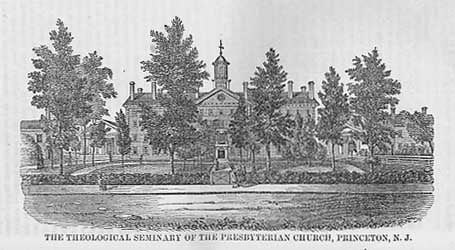
Reformed Churchmen

We are Confessional Calvinists and a Prayer Book Church-people. In 2012, we remembered the 350th anniversary of the 1662 Book of Common Prayer; also, we remembered the 450th anniversary of John Jewel's sober, scholarly, and Reformed "An Apology of the Church of England." In 2013, we remembered the publication of the "Heidelberg Catechism" and the influence of Reformed theologians in England, including Heinrich Bullinger's Decades. For 2014: Tyndale's NT translation. For 2015, John Roger, Rowland Taylor and Bishop John Hooper's martyrdom, burned at the stakes. Books of the month. December 2014: Alan Jacob's "Book of Common Prayer" at: http://www.amazon.com/Book-Common-Prayer-Biography-Religious/dp/0691154813/ref=sr_1_1?ie=UTF8&qid=1417814005&sr=8-1&keywords=jacobs+book+of+common+prayer. January 2015: A.F. Pollard's "Thomas Cranmer and the English Reformation: 1489-1556" at: http://www.amazon.com/Thomas-Cranmer-English-Reformation-1489-1556/dp/1592448658/ref=sr_1_1?ie=UTF8&qid=1420055574&sr=8-1&keywords=A.F.+Pollard+Cranmer. February 2015: Jaspar Ridley's "Thomas Cranmer" at: http://www.amazon.com/Thomas-Cranmer-Jasper-Ridley/dp/0198212879/ref=sr_1_1?ie=UTF8&qid=1422892154&sr=8-1&keywords=jasper+ridley+cranmer&pebp=1422892151110&peasin=198212879

Showing posts with label B.B. Warfield. Show all posts

Sunday, April 20, 2014

20 Apr 1880 AD: Mr. (Rev.Dr.Prof.) B.B. Warfield's Inaugural Address: Princeton Theological Seminary


20 April 1880 AD. Mr. (Rev. Dr. Prof.) B.B. Warfield’s Inaugural Address: Princeton Theological Seminary

The PCA historians tell it at: http://www.thisday.pcahistory.org/2014/04/april-20-2/ Also, while we’ll capture just a portion, the full inaugural speech is at: https://ia600404.us.archive.org/35/items/discoursesoccas00west/discoursesoccas00west_bw.pdf  

April 20: Warfield’s Inaugural Address (1880)
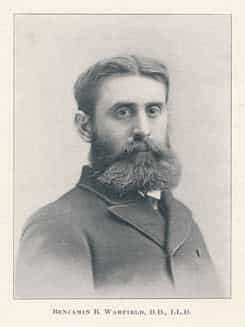

WarfieldBB_1903It was on this day, April 20th, in 1880 that the Rev. Dr. Benjamin Breckinridge Warfield, at the age of twenty-nine, was inaugurated as Professor of New Testament Exegesis and Literature at the Western Theological Seminary, Pittsburgh, Pennsylvania. We take as the text of our post today the introductory part of Warfield’s inaugural lecture. A link follows at the close of this section for those who would like to read the whole of the lecture.

First, Barry Waugh provides us with a fitting introduction, setting the stage for our post today:

“In September of 1878, Benjamin began his career as a theological educator when he became an instructor in New Testament Literature and Exegesis at Western Theological Seminary in Pittsburgh. Western Seminary had been formed by the merger of existing seminaries including Danville Seminary, which R. J. Breckinridge, Benjamin’s grandfather, had been involved in founding. The following year he was made professor of the same subject and he continued in that position until 1887. In his inaugural address for Professor of New Testament Exegesis and Literature, April 20, 1880, he set the theme for many of his writing efforts in the succeeding years by defending historic Christianity. The purpose of his lecture was to answer the question, “Is the Church Doctrine of the Plenary Inspiration of the New Testament Endangered by the Assured Results of Modern Biblical Criticism.” Professor Warfield affirmed the inspiration, authority and reliability of God’s Word in opposition to the critics of his era. He quickly established his academic reputation for thoroughness and defense of the Bible. Many heard of his academic acumen and his scholarship was awarded by eastern academia when his alma mater, the College of New Jersey, awarded him an honorary D. D. in 1880.”


INAUGURAL ADDRESS

BY

PROF. BENJAMIN B. WARFIELD.

Fathers and Brothers:

It is without doubt a very wise provision by which, in institutions such as this, an inaugural address is made a part of the ceremony of induction into the professorship. Only by the adoption of some such method could it be possible for you as the guardians of this institution, responsible for the principles here inculcated, to give to each newly-called teacher an opportunity to publicly declare the sense in which he accepts your faith and signs your standards. Eminently desirable at all times, this seems particularly so now, when a certain looseness of belief (inevitable parent of looseness of practice) seems to have invaded portions of the Church of Christ,—not leaving even its ministry unaffected;—when there may be some reason to fear that “enlightened clerical gentlemen may sometimes fail to look upon subscription to creeds as our covenanting forefathers looked upon the act of putting their names to theological documents, and as mercantile gentlemen still look upon the endorsement of bills.”* [*Peter Bayne in The Puritan Revolution.] And how much more forcibly can all this be pled when he who appears before you at your call, is young, untried, and unknown. I wish, therefore, to declare that I sign these standards not as a necessary form which must be submitted to, but gladly and willingly as the expression of a personal and cherished conviction; and, further, that the system taught in these symbols is the system which will be drawn out of the Scriptures in the prosecution of the teaching to which you have called me,—not, indeed, because commencing with that system the Scriptures can be made to teach it, but because commencing with the Scriptures I cannot make them teach anything else.

This much of personal statement I have felt it due both to you and myself to make at the outset; but having done with it, I feel free to turn from all personal concerns.

In casting about for a subject on which I might address you, I have thought I could not do better than to take up one of our precious old doctrines, much attacked of late, and ask the simple question : What seems the result of the attack? The doctrine I have chosen, is that of “Verbal Inspiration.” But for obvious reasons I have been forced to narrow the discussion to a consideration of the inspiration of the New Testament only; and that solely as assaulted in the name of criticism. I wish to ask your attention, then, to a brief attempt to aupply an answer to the question :

IS THE CHURCH DOCTRINE OF THE PLENARY INSPIRATION OF THE NEW TESTAMENT ENDANGERED BY THE ASSURED RESULTS OF MODERN BIBLICAL CRITICISM?

At the very out-set, that our inquiry may not be a mere beating of the air, we must briefly, indeed, but clearly, state what we mean by the Church Doctrine. For, unhappily, there are almost as many theories of inspiration held by individuals as there are possible states imaginable between the slightest and the greatests influence God could exercise on man. It is with the traditional doctrine of the Reformed Churches, however, that we are concerned; and that we understand to be simply this :—Inspiration is that extraordinary supernatural influence (or, passively, the result of it,) exerted by the Holy Ghost on the writers of the Sacred Books, by which their words were rendered also the words of God, and, therefore, perfectly infallible. In this definition, it is to be noted: 1st, That this influence is a supernatural one—something different from the inspiration of the poet or man of genius. Luke’s accuracy is not left by it with only the safeguards which “the diligent and accurate Suetonius” had. 2d. That it is an extraordinary influence—something different from the ordinary action of the Spirit in the conversion and sanctifying guidance of believers. Paul had some more prevalent safeguard against false-teaching than Luther or even the saintly Rutherford. 3d. That it is such an influence as makes the words written under its guidance, the words of God; by which is meant to be affirmed an absolute infallibility (as alone fitted to divine words), admitting no degrees whatever—extending to the very word, and to all the words. So that every part of Holy Writ is thus held alike infallibly true in all its statements, of whatever kind.

Fencing around and explaining this definition, it is to be remarked further:

1st. That it purposely declares nothing as to the mode of inspiration. The Reformed Churches admit that this is inscrutable. They content themselves with defining carefully and holding fast the effects of the divine influence, leaving the mode of divine action by which it is brought about draped in mystery.

2d. It is purposely so framed as to distinguish it from revelation;—seeing that it has to do with the communication of truth not its acquirement.

3d. It is by no means to be imagined that it is meant to proclaim a mechanical theory of inspiration. The Reformed Churches have never held such a theory* [*See Dr. C. Hodge's Systematic Theology, pFW `57, volume I]; though dishonest, careless, ignorant or over-eager controverters of its doctrine have often brought the charge. Even those special theologians in whose teeth such an accusation has been oftenest thrown (e.g., Gaussen) are explicit in teaching that the human element is never absent. The Reformed Churches hold, indeed, that every word of the Scriptures, without exception, is the word of God; but, alongside of that, they hold equally explicitly that every word is the word of man. And, therefore, though strong and uncompromising in resisting the attribution to the Scriptures of any failure in absolute truth and infallibility, they are before all others in seeking, and finding, and gazing on in loving rapture, the marks of the fervid impetuosity of a Paul—the tender saintliness of a John—the practical genius of a James, in the writings which through them the Holy Ghost has given for our guidance. Though strong and uncompromising in resisting all efforts to separate the human and divine, they distance all competitors in giving honor alike to both by proclaiming in one breath that all is divine and all is human. As Gaussen so well expresses it, “We all hold that every verse, without exception, is from men, and every verse, without exception, is from God;” “every word of the Bible is as really from man as it is from God.”

4th. Nor is this a mysterious doctrine—except, indeed, in the sense in which everything supernatural is mysterious. We are not dealing in puzzles, but in the plainest factcs of spiritual experience. How close, indeed, is the analogy here with all that we know of the Spirit’s action in other spheres! Just as the first act of loving faith by which the regenerated soul flows out of itself to its Saviour, is at once the consciously-chosen act of that soul and the direct work of the Holy Ghost; so, every word indited under the analogous influence of inspiration was at one and the same time the consciously self-chosen word of the writer and the divinely-inspired word of the Spirit. I cannot help thinking that it is through failure to note and assimilate this fact, that the doctrine of verbal inspiration is so summarily set aside and so unthinkingly inveighed against by divines otherwise cautious and reverent. Once grasp this idea, and how impossible is it to separate in any measure the human and divine. It is all human—every word, and all divine. The human characteristics are to be noted and exhibited; the divine perfection and infallibility, no less.

This, then, is what we understand by the church doctrine:—a doctrine which claims that by a special, supernatural, extraordinary influence of the Holy Ghost, the sacred writers have been guided in their writing in such a way, as while their humanity was not superseded, it was yet so dominated that their words became at the same time the words of God, and thus, in every case and all alike, absolutely infallible. 

— We will close there before Professor Warfield begins to get into the heart of his discourse. If you would like to read the whole of his inaugural discourse, click here.

Tuesday, December 18, 2012

Reformed Forum: Life & Ministry of B.B. Warfield

http://reformedforum.org/podcasts/ctc259/?utm_source=feedburner&utm_medium=feed&utm_campaign=Feed%3A+ReformedForum+%28Reformed+Forum+Podcasts%29


The Life and Ministry of B.B. Warfield

Download:
audio
 
In this episode, Jim Cassidy and Mark Winder catch up with John Muether to talk about his forthcoming book on the life of B.B. Warfield, the great old Princeton theologian. We cover various topics including the lion of Princeton’s take on evolution, his care for his wife, his doctrine of Scripture, and his position on the Confession of 1902. We wrap up with drawing practical lessons from his life we can apply today.

Sunday, August 12, 2012

1812, a Very Good Year: Formation of Princeton Seminary

http://www.thisday.pcahistory.org/2012/08/august-12-princeton-theological-seminary/

Eighteen Twelve was a Very Good Year

It was clear that something had to be done. Princeton College was not being the source any longer for Presbyterian ministers, and for that matter, any ministers. The school had turned into a secular school for careers, like law, politics, and education.

The reason for this was varied, Some saw the problem in the new president, Samuel Stanhope Smith. It wasn’t that he had no qualifications for the presidency. He himself was a graduate of the college. He had started what later became Hampden-Sydney College in Virginia. He had tutored under his father-in-law John Witherspoon as the Vice-President of Princeton, when the latter was unable physically to do it. So he had all the academic qualifications.

Of more troublesome however were questions about his lack of Calvinistic distinctives. It seemed that they were in word only as there were suggestions of an emphasis on free will in man plus scientific suggestions in place of supernatural miracles. Add to that a student rebellion, the trustees were beginning to have questions on his ability to solve these challenges in the right way.

With 400 vacant pulpits in the Presbyterian Church, the sentiment began to build for a separate theological seminary separate from Princeton College as early as 1800. By 1805 and 1808, each General Assembly was being besieged with calls for more ministers, on the mission field and in the congregations of the land. An overture to decide what kind of school was sent to the presbyteries. While hardly overwhelming for any one choice, by 1811, over $14,000 had been raised for the prospective seminary. Any professor would have to subscribe to the Westminster Standards, and the Form of Government of Presbyterianism.


On August 12, 1812, while the nation was already at war against Great Britain, people packed the town’s Presbyterian Church for the inauguration of Dr. Archibald Alexander as the first professor of Princeton Theological Seminary. He had been chosen by the General Assembly. He preached his inaugural sermon for the worshipers, including taking his vows regarding the confessional standards and the Presbyterian form of Government. The seminary had begun, with three students. It would soon pick up and begin to send out laborers into the fields, which were white unto harvest.
Words to live by: Every reader of this historical blog should read the fine summary of Dr. David Calhoun’s two-volume work on Princeton Seminary, published by the Banner of Truth Trust in Carlisle, Pennsylvania. Filled with persons, places, and events from the founding of the school in 1812 to 1929, when it ceased to be a Reformed biblical seminary, this school was the pillar of orthodoxy for the Presbyterian Church. When we forget the past, we lose hope for the present and the future. When we study the past, we learn how to live in the present and the future. You will not be able to put down the two books. The contributor promises you that!


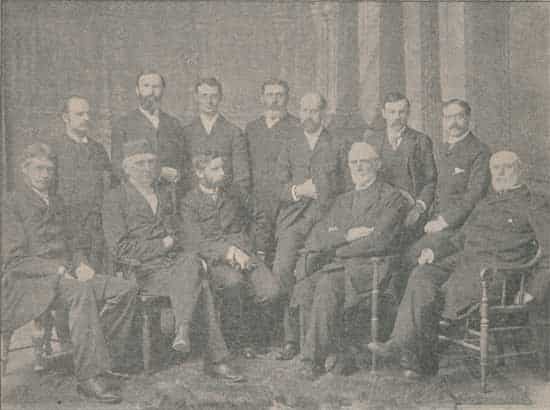
Faculty of the Princeton Theological Seminary, 1896: G.T. Purves, J.D. Davis, G. Vos, B.B. Warfield, W.B. Greene, Jr., J.H. Dulles, H.W. Smith, F.L. Patton, W.M. Paxton, C. Martin, W.H. Green, J. De Witt.

Wednesday, June 27, 2012

Theological Assessment of B.B. Warfield

A wonderful blog, "Pilgrimage to Geneva," although these able thinkers miss it when it comes to the Book of Common Prayer. They get much right, but get this point wrong.  Nontheless, this is a blog to follow.

http://pilgrimagetogeneva.com/2012/06/27/theological-assessment-of-b-b-warfield/

Greenville Presbyterian Theological Seminary
2012 Spring Theology Conference
A Commemoration of Princeton 1812 -2012


Theological Assessment of B. B. Warfield


Dr. Carl Trueman
Professor of Historical Theology and Church History and academic dean/vice president for academic affairs at Westminster Theological Seminary in Philadelphia.

, , , , , , , , , , , , , , , , , , , , , ,

Friday, March 16, 2012

Trueman: Warfield on the Essence of Christianity and the Book of Common Prayer

What Dr. Carl Trueman cites here from B.B. Warfield is precisely what is taught, believed, and delivered in the old 1662 Book of Common Prayer. While Warfield has spoken ably, as per the quote below and as offered by Carl Trueman, there is nothing distinctive here that hasn't been believed, taught and prayed for centuries in that old Book of Common Prayer. A faithful Confessional Anglican will recognize, immediately, the sense and orientation offered by B.B. Warfield...it's Biblical Churchmanship, a point Dr. Trueman commends.  Dr. Trueman's points are offered below at:
http://www.reformation21.org/blog/2012/03/warfield-on-the-essence-of-chr.php

Warfield on the Essence of Christianity

Posted by

I gave a lecture yesterday on the life and theology of B B Warfield, focusing on his engagement with German liberalism as expressed in a number of his book reviews. His book reviews are, I suspect, the most neglected part of his published works but actually contain some of his most astute theological observations.

In the Q and A afterwards, somebody asked if the first paragraph of his first article on 'Miserable Sinner Christianity' was the most brilliant thing which he ever wrote. As usual in such situations, I could not remember the piece, something made only slightly less embarrassing by the fact that Darryl Hart, student of all things old Princeton, was unable to help me. Darryl had followed my lecture with a briliant and provocative analysis of how Princeton Seminary had been crushed by the denomination's drive to be a cultural mover-and-shaker and thus to downplay confessional distinctives for, as we would say today, a place at the table or a voice in the conversation. If it is to be published, it will be a must-read for those enamoured of a confessional evangelicalism which, despite the name, actually does not reflect the priorities, distinctives and ecclesiologies that originally drove the production of confessions in the first place.

After the lecture, I ferreted out the paragraph and here it is. Whether it is the most brilliant thing Warfield ever wrote is not for me to judge; but it is undeniably a brilliant and sobering statement of what Christianity is:

It belongs to the very essence of the type of Christianity propagated by the Reformation that the believer should feel himself continuously unworthy of the grace by which he lives. At the center of this type of Christianity lies the contrast of sin and grace; and about this center everything else revolves. This is in large part the meaning of the emphasis put in this type of Christianity on justification by faith. It is its conviction that there is nothing in us or done by us, at any stage of our earthly development, because of which we are acceptable to God. We must always be accepted for Christ's sake, or we cannot ever be accepted at all. This is not true of us only "when we believe." It is just as true after we have believed. It will continue to be true as long as we live. Our need of Christ does not cease with our believing; nor does the nature of our relation to Him or to God through Him ever alter, no matter what our attainments in Christian graces or our achievements in Christian behavior may be. It is always on His "blood and righteousness" alone that we can rest. There is never anything that we are or have or do that can take His place, or that can take a place along with Him. We are always unworthy, and all that we have or do of good is always of pure grace. Though blessed with every spiritual blessing in the heavenlies in Christ, we are still in ourselves just "miserable sinners": "miserable sinners" saved by grace to be sure, but "miserable sinners" still, deserving in ourselves nothing but everlasting wrath. That is the attitude which the Reformers took, and that is the attitude which the Protestant world has learned from the Reformers to take, toward the relation of believers to Christ.

Sunday, September 18, 2011

The Theology of Calvin - B.B. Warfield

Hat tip to Hudson Barton at Anglo-Reformed on this great American scholar, thinker and Calvinist-of-the-first-order.

http://anglo-reformed.org/the-theology-of-calvin-bb-warfield

The Theology of Calvin - B.B. Warfield

Bbwcolorsh
BENJAMIN B. WARFIELD, D.D., LL.D.
Late Professor at Princeton Theological Seminary


THE subject of this address is the theology of John Calvin and I shall ask leave to take this subject rather broadly, that is to say, to attempt not so much to describe the personal peculiarities of John Calvin as a theologian, as to indicate in broad outlines the determining characteristics of the theology which he taught. I wish to speak, in other words, about Calvinism, that great system of religious thought which bears John Calvin’s name, and which also—although of course he was not its author, but only one of its chief exponents—bears indelibly impressed upon it the marks of his formative hand and of his systematizing genius. Of all the teachers who have wrought into it their minds and hearts since its revival in that tremendous religious upheaval we call the Reformation, this system of thought owes most perhaps to John Calvin and has therefore justly borne since then his name. And of all the services which Calvin has rendered to humanity—and they are neither few nor small—the greatest was undoubtedly his gift to it afresh of this system of religious thought, quickened into new life by the forces of his genius, and it is therefore just that he should be most widely remembered by it. When we are seeking to probe to the heart of Calvinism, we are exploring also most thoroughly the heart of John Calvin. Calvinism is his greatest and most significant monument, and he who adequately understands it will best understand him.


It was about a hundred years ago that Max Göbel first set the scholars at work upon the attempt clearly to formulate the formative principle of Calvinism. A long line of distinguished thinkers have exhausted themselves in the task without attaining, we must confess, altogether consistent results. The great difficulty has been that the formative and distinctive principles of Calvinism have been confused, and men have busied themselves rather in indicating the points of difference by which Calvinism is distinguished from other theological tendencies than in seeking out the germinal principle of which it itself is the unfolding.


The particular theological tendency with which Calvinism has been contrasted in such discussions is, as was natural, the sister system of Lutheranism, with which it divided the heritage of the Reformation. Now undoubtedly somewhat different spirits do inform Calvinism and Lutheranism. And equally undoubtedly, the distinguishing spirit of Calvinism is due to its formative principle and is not to be accounted for by extraneous circumstances of origin or antecedents, such as for example, the democratic instincts of the Swiss, or the superior humanistic culture of its first teachers, or their tendency to intellectualism or to radicalism. But it is gravely misleading to identify the formative principle of either type of Protestantism with its prominent points of difference from the others. They have vastly more in common than in distinction. And nothing could be more misleading than to trace all their differences, as to their roots, to the fundamental place given in the two systems respectively to the principles of predestination and justification by faith.


In the first place, the doctrine of predestination is not the formative principle of Calvinism, it is only its logical implication. It is not the root from which Calvinism springs, it is one of the branches which it has inevitably thrown out. And so little is it the peculiarity of Calvinism, that it underlay and gave its form and power to the whole Reformation movement—which was, as from the spiritual point of view a great revival of religion, so from the doctrinal point of view a great revival of Augustinianism. There was, accordingly, no difference among the Reformers on this point; Luther and Melanchthon and the compromising Bucer were no less zealous for absolute predestination than Zwingli and Calvin. Even Zwingli could not surpass Luther in sharp and unqualified assertion of this doctrine; and it was not Calvin but Melanchthon who paused, even in his first preliminary statement of the elements of the Protestant faith, to give it formal assertion and elaboration.


Just as little can the doctrine of justification by faith be represented as specifically Lutheran. It is as central to the Reformed as to the Lutheran system. Nay, it is only in the Reformed system that it retains the purity of its conception and resists the tendency to make it a doctrine of justification on account of, instead of by, faith. It is true that Lutheranism is prone to rest in faith as a kind of ultimate fact, while Calvinism penetrates to its causes, and places faith in its due relation to the other products of God’s activity looking to the salvation of man. And this difference may, on due consideration, conduct us back to the formative principle of each type of thought. But it, too, is rather an outgrowth of the divergent formative principles than the embodiment of them. Lutheranism, sprung from the throes of a guilt-burdened soul seeking peace with God, finds peace in faith, and stops right there. It is so absorbed in rejoicing in the blessings which flow from faith that it refuses or neglects to inquire whence faith itself flows. It thus loses itself in a sort of divine euthumia, and knows, and will know nothing beyond the peace of the justified soul. Calvinism asks with the same eagerness as Lutheranism the great question. “What shall I do to be saved?” and answers it precisely as Lutheranism answers it. But it cannot stop there. The deeper question presses upon it, “Whence this faith by which I am justified?” And the deeper response suffuses all the chambers of the soul with praise, “From the free gift of God alone, to the praise of the glory of His grace.” Thus Calvinism withdraws the eye from the soul and its destiny and fixes it on God and His glory. It has zeal, no doubt, for salvation but its highest zeal is for the honour of God, and it is this that quickens its emotions and vitalizes its efforts. It begins, it centres and it ends with the vision of God in His glory and it sets itself, before all things, to render to God His rights in every sphere of life-activity.


If thus the formative principle of Calvinism is not to be identified with the points of difference which it has developed with its sister type of Protestantism, Lutheranism, much less can it be identified with those heads of doctrine—severally or in sum—which have been singled out by its own rebellious daughter, Arminianism, as its specially vulnerable points. The “five points of Calvinism,” we have no doubt learned to call them, and not without justice. They are, each and every one of them, essential elements in the Calvinistic system, the denial of which in any of their essential details is logically the rejection of the entirety of Calvinism; and in their sum they provide what is far from being a bad epitome of the Calvinistic system. The sovereignty of the election of God, the substitutive definiteness of the atonement of Christ, the inability of the sinful will to good, the creative energy of the saving grace of the Spirit, the safety of the redeemed soul in the keeping of its Redeemer,—are not these the distinctive teachings of Calvinism, as precious to every Calvinist’s heart as they are necessary to the integrity of the system? Selected as the objects of the Arminian assault, these “five-points” have been reaffirmed, therefore, with the constancy of profound conviction by the whole Calvinistic world. It is well, however, to bear in mind that they owe their prominence in our minds to the Arminian debate, and however well fitted they may prove in point of fact to stand as a fair epitome of Calvinistic doctrine, they are historically at least only the Calvinistic obverse, of “the five points of Arminianism”. And certainly they can put in no claim, either severally or in sum, to announce the formative principle of Calvinism, whose out-working in the several departments of doctrine they rather are—though, of course, they may surely and directly conduct us back to that formative principle, as the only root out of which just this body of doctrine could grow. Clearly at the root of the stock which bears these branches must lie a most profound sense of God and an equally profound sense of the relation in which the creature stands to God, whether conceived merely as creature or, more specifically as sinful creature. It is the vision of God and His Majesty, in a word, which lies at the foundation of the entirety of Calvinistic thinking.


The exact formulation of the formative principle of Calvinism, as I have said, has taxed the acumen of a long line of distinguished thinkers. Many modes of stating it have been proposed. Perhaps after all, however, its simplest statement is the best. It lies then, let me repeat, in a profound apprehension of God in His majesty, with the poignant realization which inevitably accompanies this apprehension, of the relation sustained to God by the creature as such, and particularly by the sinful creature. The Calvinist is the man who has seen God, and who, having seen God in His glory, is filled on the one hand, with a sense of his own unworthiness to stand in God’s sight as a creature, and much more as a sinner, and on the other hand, with adoring wonder that nevertheless this God is a God who receives sinners. He who believes in God without reserve and is determined that God shall be God to him, in all his thinking, feeling, willing—in the entire compass of his life activities, intellectual, moral, spiritual—throughout all his individual, social, religious relations—is, by the force of that strictest of all logic which presides over the outworking of principles into thought and life, by the very necessity of the case, a Calvinist.


If we wish to reduce this statement to a more formal theoretical form, we may say perhaps, that Calvinism in its fundamental idea implies three things. In it, (i) objectively speaking, Theism comes to its rights; (ii) subjectively speaking, the religious relation attains its purity; (iii) soteriologically speaking, evangelical religion finds at length its full expression and its secure stability. Theism comes to its rights only in a teleological view of the universe, which recognizes in the whole course of events the orderly working out of the plan of God, whose will is consequently conceived as the ultimate cause of all things. The religious relation attains its purity only when an attitude of absolute dependence on God is not merely assumed, as in the act, say, of prayer, but is sustained through all the activities of life, intellectual, emotional, executive. And evangelical religion reaches its full manifestation and its stable form only when the sinful soul rests in humble, self-emptying trust purely on the God of grace as the immediate and sole source of all the efficiency which enters into its salvation. From these things shine out upon us the formative principle of Calvinism. The Calvinist is the man who sees God behind all phenomena, and in all that occurs recognizes the hand of God, working out His will; who makes the attitude of the soul to God in prayer the permanent attitude in all its life activities; and who casts himself on the grace of God alone, excluding every trace of dependence on self from the whole work of his salvation.


I think it important to insist here that Calvinism is not a specific variety of theistic thought, religious experience, evangelical faith, but the perfect expression of these things. The difference between it and other forms of Theism, religion, evangelicalism, is a difference not of kind but of degree. There are not many kinds of Theism, religion, evangelicalism. each with its own special characteristics, among which men are at liberty to choose, as may suit their individual tastes. There is but one kind of Theism, religion, evangelicalism, and if there are several constructions laying claim to these names they differ from one another, not as correlative species of a more inclusive genus, but only as more or less good or bad specimens of the same thing differ from one another.


Calvinism comes forward simply as pure Theism, religion. evangelicalism, as over against less pure Theism, religion. evangelicalism. It does not take its position then by the side of other types of these things, it takes its place over them, as what they too ought to be. It has no difficulty thus, in recognizing the theistic character of all truly theistic thought, the religious note in all really religious manifestations, the evangelical quality of all actual evangelical faith. It refuses to be set antagonistically over against these where they really exist in any degree. It claims them in every instance of their emergence as its own, and seeks only to give them their due place in thought and life. Whoever believes in God, whoever recognizes his dependence on God, whoever hears in his heart the echo of the soli Deo gloria of the evangelical profession— by whatever name he may call himself, by whatever logical puzzles his understanding may be confused—Calvinism recognizes such as its own, and as only requiring to give full validity to those fundamental principles which underlie and give its body to all true religion to become explicitly a Calvinist.


Calvinism is born, we perceive, of the sense of God. God fills the whole horizon of the Calvinist’s feeling and thought. One of the consequences which flow from this is the high supernaturalism which informs at once his religious consciousness and his doctrinal construction. Calvinism indeed would not be badly defined as the tendency which is determined to do justice to the immediately supernatural, as in the first so in the second creation. The strength and purity of its apprehension of the supernatural Fact (which is God) removes all embarrassment from it in the presence of the supernatural act (which is miracle). In everything which enters into the process of the recovery of sinful man to good and to God, it is impelled by the force of its first principle to assign the initiative to God. A supernatural revelation in which God makes known to man His will and His purposes of grace; a supernatural record of the revelation in a supernaturally given Book, in which God gives His revelation permanence and extension.—such things are to the Calvinist matters of course. And above all things, he can but insist with the utmost strenuousness on the immediate supernaturalness of the actual work of redemption; this, of course, in its impetration. It is no strain to his faith to believe in a supernatural Redeemer, breaking His way to earth through a virgin’s womb, bursting the bonds of death and returning to His Father’s side to share the glory which He had with the Father before the world was. Nor can he doubt that this supernaturally purchased redemption is applied to the soul in an equally supernatural work of the Holy Spirit.


Thus it comes about that monergistic regeneration—“irresistible grace”, “effectual calling”, our older theologians called it,—becomes the hinge of the Calvinistic soteriology, and lies much more deeply imbedded in the system than many a doctrine more closely connected with it in the popular mind. Indeed, the soteriological significance of predestination itself consists to the Calvinist largely in the safeguard it affords to the immediate supernaturalness of salvation. What lies at the heart of his soteriology is absolute exclusion of creaturely efficiency in the induction of the saving process, that the pure grace of God in salvation may be magnified. Only so could he express his sense of men’s complete dependence as sinners on the free mercy of a saving God; or extrude the evil leaven of synergism, by which God is robbed of His glory and man is encouraged to attribute to some power, some act, some initiative of his own, his participation in that salvation which in reality has come to him from pure grace.


There is nothing therefore, against which Calvinism sets its face with more firmness than every form and degree of auto-soterism. Above everything else, it is determined to recognize God, in His Son Jesus Christ, acting through the Holy Spirit whom He has sent, as our veritable Saviour. To Calvinism, sinful man stands in need, not of inducements or assistance to save himself, but precisely of saving; and Jesus Christ has come not to advise, or urge, or woo, or help him to save himself, but to save him; to save him through the prevalent working on him of the Holy Spirit. This is the root of the Calvinistic soteriology, and it is because this deep sense of human helplessness and this profound consciousness of indebtedness for all that enters into salvation to the free grace of God is the root of its soteriology. that election becomes to Calvinism the cor cordis of the gospel. He who knows that it is God who has chosen him, and not he who has chosen God, and that he owes every step and stage of his salvation to the working out of this choice of God, would be an ingrate indeed if he gave not the whole glory of his salvation to the inexplicable election of the divine love.


Calvinism, however, is not merely a soteriology. Deep as its interest is in salvation, it cannot escape the question—“Why should God thus intervene in the lives of sinners to rescue them from the consequences of their sin?” And it cannot miss the answer—“Because it is to the praise of the glory of His grace”. Thus it cannot pause until it places the scheme of salvation itself in relation with a complete world-view in which it becomes subsidiary to the glory of the Lord God Almighty. If all things are from God, so to Calvinism all things are also unto God, and to it God will be all in all. It is born of the reflection in the heart of man of the glory of a God who will not give His honour to another, and draws its life from constant gaze upon this great image. And let us not fail punctually to note, that “it is the only system in which the whole order of the world is thus brought into a rational unity with the doctrine of grace, and in which the glorification of God is carried out with absolute completeness”. Therefore, the future of Christianity—as its past has done—lies in its hands. For, it is certainly true, as has been said by a profound thinker of our own time, that “it is only with such a universal conception of God, established in a living way, that we can face with hope of complete conquest all the spiritual dangers and terrors of our times”. “It, however,” as the same thinker continues, “is deep enough and large enough and divine enough, rightly understood, to confront them and do battle with them all in vindication of the Creator, Preserver and Governor of the world, and of the Justice and Love of the divine Personality.”


This is the system of doctrine to the elaboration and defence of which John Calvin gave all his powers nearly four hundred years ago. And it is chiefly because he gave all his powers to commending to us this system of doctrine, that we are here today to thank God for giving to the world the man who has given to the world this precious gift.