Reformed Churchmen

We are Confessional Calvinists and a Prayer Book Church-people. In 2012, we remembered the 350th anniversary of the 1662 Book of Common Prayer; also, we remembered the 450th anniversary of John Jewel's sober, scholarly, and Reformed "An Apology of the Church of England." In 2013, we remembered the publication of the "Heidelberg Catechism" and the influence of Reformed theologians in England, including Heinrich Bullinger's Decades. For 2014: Tyndale's NT translation. For 2015, John Roger, Rowland Taylor and Bishop John Hooper's martyrdom, burned at the stakes. Books of the month. December 2014: Alan Jacob's "Book of Common Prayer" at: http://www.amazon.com/Book-Common-Prayer-Biography-Religious/dp/0691154813/ref=sr_1_1?ie=UTF8&qid=1417814005&sr=8-1&keywords=jacobs+book+of+common+prayer. January 2015: A.F. Pollard's "Thomas Cranmer and the English Reformation: 1489-1556" at: http://www.amazon.com/Thomas-Cranmer-English-Reformation-1489-1556/dp/1592448658/ref=sr_1_1?ie=UTF8&qid=1420055574&sr=8-1&keywords=A.F.+Pollard+Cranmer. February 2015: Jaspar Ridley's "Thomas Cranmer" at: http://www.amazon.com/Thomas-Cranmer-Jasper-Ridley/dp/0198212879/ref=sr_1_1?ie=UTF8&qid=1422892154&sr=8-1&keywords=jasper+ridley+cranmer&pebp=1422892151110&peasin=198212879

Showing posts with label Archibald Alexander. Show all posts

Tuesday, August 12, 2014

12 August 1812 A.D. Alexander Inaugurated at Princeton: What Made Princeton Strong?


12 August 1812 A.D.  Alexander Inaugurated at Princeton:  What Made Princeton Strong?

Archivist. “August 12: Alexander Inaugurated at Princeton (1812).”  This Day in Presbyterian History.  12 Aug 2014.  Accessed 12 Aug 2014.

August 12: Alexander Inaugurated at Princeton (1812)


What Made Princeton Strong?

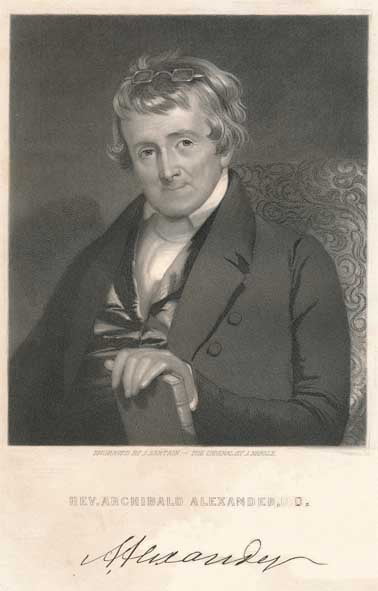
Archibald Alexander served as moderator of the nineteenth General Assembly of the Presbyterian Church in the U.S.A. With his departing sermon at the following year’s Assembly, Alexander made the case for the creation of a seminary, in keeping with a growing sentiment in the Presbyterian Church. Princeton Theological Seminary was founded in 1812 and the General Assembly almost unanimously voted Alexander its first teacher. He accepted and was inaugurated on August 12, 1812. Samuel Miller began teaching in 1813, and together the two men served as the anchors of education for the Presbyterian ministry until Miller’s death in 1849 and Alexander’s in 1851. Charles Hodge was the third professor at Princeton, and Alexander’s son, James Waddel Alexander, also served as professor at Princeton Theological Seminary.

In The Life of Archibald Alexander, pages 332-333, we read:

“The inauguration . . took place on the twelfth day of August, 1812. It was an occasion of great solemnity and feeling. The older ministers, especially those to whom the direction was entrusted, looked with parental yearnings on the infant seminary, and none were more ready to hail with thankfulness and hope the approach of new means for training the ministry, than those excellent men who lamented the scantiness of their own early opportunities. But to none did the service of the day bring greater solicitude than to him who was about to put on armour for which he unaffectedly felt too weak. The first discourse was a sermon by Dr. [Samuel] Miller, of New-York, on the Duty of the Church to take measures for providing an Able and Faithful Ministry; from the words, “And the things which thou hast heard of men, among many witnesses, the same commit thou to faithful men, who shall be able to teach others also;” 2 Timothy, ii. 2. It was an able investigation of the question, what is to be understood by an able and faithful ministry, which was made to include piety, talents, learning and diligence; and of the means which the Church is bound to employ for providing such a ministry.

. . .The Inaugural Discourse of the Professor was founded on the words, “Search the Scriptures,” John v. 39; and was a learned argument in behalf of biblical study. In one respect the whole performance was true to the habit and character of the speaker; for it did not contain, from beginning to end, the faintest allusion to his own personality. All depreciation of censure, and all promise of fidelity, were equally absent. It was followed by a charge to the Professor and Students of Divinity, by the Rev. Philip Milledoler, D.D. . . . It is for the public to determine how far the work in which these good men then engaged, with such earnestness and many prayers, has conduced to the progress of religion and learning in the United States.

Alexander’s Library

It was with an unfeigned reluctance that Dr. Alexander accepted the appointment. No man could entertain a higher estimate of the functions which awaited him; no man of eminence could think more humbly of himself. All his life long, he was free to acknowledge, that his training, however laborious, had lacked much of the rigor and method of the schools; and while he had pursued knowledge with enthusiasm, and in many fields, he knew that it had been with the neglect of certain forms which are supposed to give fitness for the academical chair. Theology had indeed been the study of his life. Its difficult questions had been the constant occupation of his profoundest meditations; and he had during his residence in Philadelphia gathered about him the great masters of Latin theology, whose works appeared in Holland, Switzerland, Germany, and France, in the sixteenth and seventeenth centuries.

A rare occasion for adding to his stock of Dutch theology was afforded by the sale [in 1813] of a library belonging to a learned minister from Holland, the Rev. Mr. Van Harlingen, of Somerset. . . These Reformed divines he regarded as having pushed theological investigation to its greatest length, and compacted its conclusions into the most symmetrical method. He was accustomed to say that in his judgment Reformed theology reached its culminating point about the epoch of the Synod of Dordrecht. To these great authors he turns with unabated zest during the whole of a long and studious life. He once said to the writer, that on a perplexed subject he preferred Latin to English reading; not only because of the complete and ingenious nomenclature which had grown up in the dialectic schools of the church, but because the little effort required for getting the sense kept his attention concentrated. It was indeed almost amusing to observe how he would hang over the massive quarto or folio, with all the awakened interest of a novel-reader. In consequence of the fiery controversy which characterized those times, and the scholastic acumen and philosophic adventure and logical exactness which belonged to the age, he considered these scholars as having anticipated most of the minor questions which have vexed the church in later times.”

Words to Live By:
In his Introduction to Athanasius: On the Incarnation, C.S Lewis wrote these words on the value and place of reading older books.

“There is a strange idea abroad that in every subject the ancient books should be read only by the professionals, and that the amateur should content himself with the modern books. Thus I have found as a tutor in English Literature that if the average student wants to find out something about Platonism, the very last thing he thinks of doing is to take a translation of Plato off the library shelf and read the Symposium. He would rather read some dreary modern book ten times as long, all about “isms” and influences and only once in twelve pages telling him what Plato actually said. The error is rather an amiable one, for it springs from humility. The student is half afraid to meet one of the great philosophers face to face. He feels himself inadequate and thinks he will not understand him. But if he only knew, the great man, just because of his greatness, is much more intelligible than his modern commentator. The simplest student will be able to understand, if not all, yet a very great deal of what Plato said; but hardly anyone can understand some modern books on Platonism. It has always therefore been one of my main endeavours as a teacher to persuade the young that firsthand knowledge is not only more worth acquiring than secondhand knowledge, but is usually much easier and more delightful to acquire.

This mistaken preference for the modern books and this shyness of the old ones is nowhere more rampant than in theology. Wherever you find a little study circle of Christian laity you can be almost certain that they are studying not St. Luke or St. Paul or St. Augustine or Thomas Aquinas or Hooker or Butler, but M. Berdyaev or M. Maritain or M. Niebuhr or Miss Sayers or even myself.

Now this seems to me topsy-turvy. Naturally, since I myself am a writer, I do not wish the ordinary reader to read no modern books. But if he must read only the new or only the old, I would advise him to read the old. And I would give him this advice precisely because he is an amateur and therefore much less protected than the expert against the dangers of an exclusive contemporary diet. A new book is still on its trial and the amateur is not in a position to judge it. It has to be tested against the great body of Christian thought down the ages, and all its hidden implications (often unsuspected by the author himself) have to be brought to light. Often it cannot be fully understood without the knowledge of a good many other modern books. If you join at eleven o’clock a conversation which began at eight you will often not see the real bearing of what is said. Remarks which seem to you very ordinary will produce laughter or irritation and you will not see why—the reason, of course, being that the earlier stages of the conversation have given them a special point. In the same way sentences in a modern book which look quite ordinary may be directed at some other book; in this way you may be led to accept what you would have indignantly rejected if you knew its real significance. The only safety is to have a standard of plain, central Christianity (“mere Christianity” as Baxter called it) which puts the controversies of the moment in their proper perspective. Such a standard can be acquired only from the old books. It is a good rule, after reading a new book, never to allow yourself another new one till you have read an old one in between. If that is too much for you, you should at least read one old one to every three new ones.

Every age has its own outlook. It is specially good at seeing certain truths and specially liable to make certain mistakes. We all, therefore, need the books that will correct the characteristic mistakes of our own period. And that means the old books.”

Sunday, May 25, 2014

25 May 1823 AD: Archibald Alexander Writes a Letter to His Dying Mother


 25 May 1823 A.D.  The Presbyterian Titan, Expositor, Theologian and “old school” Professor of Princeton Theological Seminary, the Rev. Dr. Prof. Archibald Alexander, writes his aging, debilitated and dying mother.

The letter speaks for itself.

“Princeton, May 25, 1823

My Dear Mother

When I last saw you, it was very doubtful whether you would ever rise again from the bed to which you were confined. Indeed, considering your great age, it was not to be expected that you should entirely recover your usual health.  I was much gratified to find that in the near prospect of eternity, your faith did not fail but that you could look death in the face without dismay, and felt willing, if it were the will of God, to depart from this world of sorrow and disappointment.  But it has pleased your Heavenly Father to continue you a little longer in the world.  I regret to learn that you have endured much pain from a disease of your eyes, and that you have been less comfortable than formerly. Bodily affliction, you must expect to endure as long as you can continue in the world…While your Heavenly Father continues you in the troublesome world, he will, I trust, enable you to be resigned and contented and patient under the manifold afflictions which are incident to old age.

The great secret of true comfort lies in a single word, TRUST.  Cast your burdens on the Lord, and he will sustain them.  If your evidences of being in the favour of God are obscured, if you are doubtful of your acceptance with him, still go directly to him by faith; that is, trust in his mercy and in Christ’s merits.  Rely simply on his word of promise.  Be not afraid to exercise confidence.  There can be no deception in depending entirely on the Word of God.  It is not presumption to trust in him when he has commanded us to do so.  We dishonor him by our fearfulness and want of confidence.  We thus call in question his faithfulness and his confidence.  Whether your mind is comfortable or distressed, flee for refuge to the outstretched wings of his protection and mercy.  There is all fullness in him; there is all willingness to bestow what we need.  He says, “My grace is sufficient for thee.  My strength is made perfect in weakness.  As the day is so shall thy strength be.  I will never leave thee nor forsake thee.  Though I walk through the valley of the shadow of death,  I will fear no evil; for thou are with me; thy rod and thy staff they comfort me.”  Be not afraid of the pangs of death.  Be not afraid that your Redeemer will then be afar off. Grace to die comfortable is not commonly given until the trial comes. Listen not to the tempter, when he endeavors to shake your faith, and destroy your comfort. Resist him, and he will flee from you…My sincere prayer is, that your sun may set in serenity; that your remaining days, by the blessing of God’s providence and grace, may be rendered tolerable and even comfortable.

It is not probable that we shall ever meet again in this world; and yet, as you have already seen one of your children go before you, you may possibly live to witness the departure of more of us…May we all be ready! And may we all meet around the throne of God, where there is not separation for ever and ever! Amen!

I remain your affectionate son,

A.A.

2 Timothy 1.3: “Night and day I constantly remember you in my prayers.”

Resources

Alexander, James. The Life of Archibald Alexander, D.D.  Harrisonburg, VA: Sprinkle, 1991.

Questions:

  • You are a Rector or Pastor at the bedside of a terminally ill cancer patient.  What do you say to them? 
  • You are a rank-and-file Churchman speaking with a friend.  How do you summarize the Gospel? 

Thursday, April 17, 2014

17 Apr 1772 AD: Princeton's Mr. (Rev.Dr.Prof.) Archibald Alexander Born


17 April 1772 A.D.  Mr. (Rev. Dr. Prof.) Archibald Alexander Born


The Rev. Archibald Alexander, D.D., LL.D. (April 17, 1772 – Oct. 22, 1851)

AlexanderArchibaldThe Rev. Dr. Archibald Alexander was born near Lexington, Va., on April 17, 1772. His classical and theological studies were pursued under the direction of the Rev. William Graham, of Liberty Hall, afterward Washington College. He was licensed to preach the gospel at the early age of nineteen. After spending a year or more in missionary labor according to the rules of the Synod, he was ordained and installed pastor of Briery Church, November 7, 1794. In 1796 he was chosen President of Hampden-Sydney College at the age of twenty-four. On May 20, 1807, he was installed pastor of the Pine Street Church, Philadelphia. In the same year, being thirty-five, he was elected Moderator of the General Assembly, and in his sermon made the suggestion of a Theological Seminary. In 1812 he was appointed Professor in the Theological Seminary just established at Princeton. Here he remained for the rest of his life.

Dr. Alexander was seized with his final illness in the summer of 1851. He died on October 22, 1851.

Dr. Alexander’s published writings are too numerous to recite here. We may only mention “History of the Colonization Society,” “Evidences of the Christian Religion,” “Thoughts on Religion,” “Counsels to the Aged,” “Practical Sermons.” He also published numerous tracts and was a frequent contributor to the Princeton Review.

Words to Live By: Our Lord calls us to bear the fruit of the Spirit in this life, giving evidence of the reality of our saving faith in Christ. We are not saved by our faithfulness, nor by our works, but if our trust in Christ as Savior is real, there will be evidence of that reality in our lives. We will die more and more to sin, and live more and more to righteousness.

17 Apr 1772: Princeton Seminary's 1st President & Professor, Archibald Alexander, Born

17 April 1772 A.D.  Princeton Divine, Mr. (Rev. Dr. Prof.) Archibald Alexander, was born.  A theologian, scholar and Princeton Seminary’s first Principal.


Wiki tells it this way.


Archibald Alexander (April 17, 1772 – October 22, 1851)[1] was an American Presbyterian theologian and professor at the Princeton Theological Seminary. He served for 9 years as the President of Hampden-Sydney College in Virginia and for 27 years as Princeton Theological Seminary's first principal from 1812 to 1840.


Contents 
Biography


Alexander was born at South River, Rockbridge,and raised under the tuition and ministry of Presbyterian minister William Graham (1745–1799), a man who had been trained in theology by John Witherspoon. His grandfather, of Scottish descent, came from Ireland to Pennsylvania in 1736, and after a residence of two years removed to Virginia. William, father of Archibald, was a farmer and trader. At the age of ten Archibald was sent to the academy of William Graham at Timber Ridge meetinghouse (since developed into Washington and Lee University), at Lexington. At the age of seventeen he became a tutor in the family of General John Posey, of The Wilderness, twelve miles west of Fredericksburg, but after a few months resumed his studies with his former teacher. At this time a remarkable movement, still spoken of as "the great revival," influenced his mind and he turned his attention to the study of divinity. He was licensed to preach October 1, 1791, ordained by the presbytery of Hanover 9 June 1794, and for seven years was an itinerant pastor in Charlotte and Prince Edward counties.


By the time he was 21 Alexander was a preacher of the Presbyterian Church. He was appointed the president of Hampden-Sydney College,[2] where he served from 1797 to 1806 and from there he was called to the Third Presbyterian Church of Philadelphia. The Princeton Theological Seminary was established at Princeton, New Jersey in 1812 and Alexander was appointed its first professor, inaugurated on August 12, 1812. In 1824, he helped to found the Chi Phi Society along with Robert Baird and Charles Hodge. In 1843 he returned to Washington College to deliver an alumni address, which was one of his many publications.


Samuel Miller became the second professor at the seminary and for 37 years Alexander and Miller were considered together as pillars of the Presbyterian Church in maintaining its doctrines. Charles Hodge, a famous student and successor of Alexander, named his son Archibald Alexander Hodge after his mentor.


Family


On April 5, 1802, Alexander married Janetta Waddel, the daughter of a Presbyterian preacher, James Waddel (1739–1805), whose eloquence was described in William Wirt's Letters of a British Spy (1803).[3]


His eldest son, James Waddel Alexander (1804–1859) was a Princeton graduate and Presbyterian minister. He wrote the life of his father, and edited his posthumous works. His second son, William Cowper Alexander (1806–1874) served as president of the New Jersey State Senate and as the first president of the Equitable Life Assurance Society. His third son was Joseph Addison Alexander (1809–1860), a biblical scholar.


His grandson, William C. Alexander (1848–1937), was an executive with the Equitable Life Assurance Society, author, and founder of Pi Kappa Alpha Fraternity. His great-grandson, James Waddell Alexander II (1888–1971), was a noted mathematician and topologist.


Archival Collections


The Presbyterian Historical Society in Philadelphia, Pennsylvania has a collection of Archibald Alexander’s personal papers dating from 1819 to 1851 including outgoing correspondence, manuscript articles and lecture notes.[4]


Works

Christ's gracious invitation
  • Biographical sketches of the founder, and principal alumni of the Log college : together with an account of the revivals of religion, under their ministry
  • Outlines of moral science
  • Love to an unseen saviour
  • A history of the Israelitish nation, from their origin to their dispersion at the destruction of Jerusalem by the Romans
  • A history of colonization on the western coast of Africa
  • Some problems of philosophy
  • An address to candidates for the ministry : on the importance of aiming at eminent piety in making their preparation for the sacred office
  • A day at a time : and other talks on life and religion
  • Suggestions in vindication of Sunday-schools, but more especially for the improvement of Sunday-school books, and the enlargement of the plan of instruction
  • The evidences of Christianity
  • The glory in the grey: forty-two talks on every-day life and religion by Arch. Alexander
  • Theories of the will in the history of philosophy
  • Thoughts on the education of pious and indigent candidates for the ministry
  • Thoughts on religious experience
  • Thoughts on religious experience' To which is added an appendix, containing "Letters to the aged," &c., &c
  • A discourse occasioned by the burning of the theatre in the city of Richmond, Virginia, on the twenty-sixth of December, 1811. By which lawful calamity a large number of lives were lost. Delivered in the Third Presbyterian church, Philadelphia, on the eighth day of January, 1812, at the request of the Virginia students attached to the medical class in the University of Pennsylvania
  • The canon of the Old and New Testaments ascertained
  • The canon of the Old and New Testaments ascertained; or, The Bible, complete, without the Apocrypha and unwritten traditions
 (Entered, according to the Act of Congress, in the year 1851 by A.W. Mitchell in the office of the Clerk of the District Court for the Eastern District of Pennsylvania.)
     Evidences of the authenticity, inspiration and canonical authority of the Holy Scriptures
  • Practical sermons to be read in families and social meetings
  • Practical truths
  • A brief compend of Bible truth
  • A brief outline of the evidences of the Christian religion
  • A dialogue between a Presbyterian and a "Friend"
  • A theory of conduct
  • A Memorial of Mrs. Margaret Breckinridge
  • Love to an unseen saviour
  • Remarks on a paragraph in the Rev. Doctor Davidson's History of the Presbyterian Church in Kentucky : in reference to the character of the late Mr. John Lyle, ruling elder in the Timberridge Church, Virginia
  • The way of salvation familiarly explained : in a conversation between a father and his children
  • A pocket dictionary of the Holy Bible. Containing, a historical and geographical account of the persons and places mentioned in the Old and New Testaments: and also a description of other objects, natural, artificial, civil, religious, and military; together with a copious reference to texts of Scripture under each important word
  • "Thomas Aquinas and the Encyclical Letter", The Princeton review 1, Jan-Jun 1880: 245–261  Check date values in: |date= (help)[5]
  • "Reminiscences of Patrick Henry", Southern literary messenger; devoted to every department of literature and the fine arts 16 (6), June 1850: 366–368 [6]
Sermons


References


1.      Jump up ^ Carey, Patrick W.; Joseph T. Lienhard (2000). Biographical Dictionary of Christian Theologians. Westport, CT: Greenwood Press. pp. 12–13. ISBN 978-0-313-03344-5.  Cite uses deprecated parameters (help)


2.      Jump up ^ Benedetto, Robert (2010). Historical Dictionary of the Reformed Churches (2nd ed.). Blue Ridge Summit, PA: Rowman & Littlefield. pp. 6–7. ISBN 978-0-8108-7023-9. 


3.      Jump up ^ http://upload.wikimedia.org/wikipedia/commons/thumb/4/4c/Wikisource-logo.svg/12px-Wikisource-logo.svg.png Chisholm, Hugh, ed. (1911). "Alexander, Archibald". Encyclopædia Britannica (11th ed.). Cambridge University Press 


4.      Jump up ^ Archibald Alexander’s personal papers dating from 1819 to 1851


5.      Jump up ^ "Thomas Aquinas and the Encyclical Letter", The Princeton review 1, Jan-Jun 1880: 245–261  Check date values in: |date= (help)


6.      Jump up ^ "Reminiscences of Patrick Henry", Southern literary messenger; devoted to every department of literature and the fine arts 16 (6), June 1850: 366–368 


Attribution


PD-icon.svg This article incorporates text from a publication now in the public domain: Wilson, James Grant; Fiske, John, eds. (1891). "article name needed". Appletons' Cyclopædia of American Biography. New York: D. Appleton

External links