29 January 1536 A.D. Queen Catherine of
Aragon Buried at Peterborough Cathedral, UK
Grueninger, Natalie. “The death of Catherine of Aragon.” On the
Tudor Trail. 7 Jan 2011. http://onthetudortrail.com/Blog/2011/01/07/the-death-of-catherine-of-aragon/. Accessed 7 Jan 2015.
The death of Catherine of Aragon
‘The most virtuous woman I have ever known and
the highest hearted, but too quick to trust that others were like herself, and
too slow to do a little ill that much good might come of it.’
(Eustace
Chapuys describing Catherine of Aragon after her death)
Catherine
of Aragon by Michael Sittow c. 1502
On the 13th December 1535, Chapuys wrote that
Catherine of Aragon ‘has recovered and is now well’ (Tremlett, Pg. 417) but on
the 29th December Dr Ortiz, Catherine’s doctor, sent an urgent
message to Chapuys alerting him to the fact that she had ‘had a serious
relapse’ and that he should immediately seek permission to visit Catherine at
Kimbolton Castle.
This Chapuys did with great haste, seeking permission from
Henry the very next day at Greenwich. Henry gave Chapuys permission to visit
Catherine but he was not as generous with Mary, instead turning down her
request to visit her mother on her deathbed (Tremlett, Pg. 418).
So, 50-year-old Catherine was forced to spend her final
days without the support and company of her beloved daughter but she did
receive a surprise visit from her loyal friend, Maria de Salinas. Salinas had
gone to great lengths to be by her mistress’ side. She disguised herself and
fabricated a story about having fallen off her horse and claimed to desperately
need a place in which to recover. Tremlett describes how Salinas begged the men
who were running the household to not throw her out into the cold and assured
them that the letter licensing her to enter Kimbolton was on its way (Pg. 419).
The charade must have been convincing because the steward allowed Salinas
to enter and she proceeded directly to Catherine’s chamber.
Chapuys arrived the following day. By this time Catherine
was very ill, she had difficulty sitting up, hadn’t eaten or slept very much in
days and complained of a terrible pain in her stomach. Although very good
friends, Chapuys and Catherine conducted their meeting in the presence of
several witnesses to ensure that Henry VIII could not claim that they had
plotted against him even at this late stage.
Chapuys visited Catherine every afternoon for the following
four days over which time Catherine’s health began to improve. She was now able
to hold down her food and on the fourth day, Chapuys thought it safe to return
to London (Tremlett, Pg. 421).
On the 6th of January all was well but that
evening things took a turn for the worse. Catherine’s condition deteriorated
and she knew her end was near. According to Giles Tremlett, Catherine’s famous
last letter that she is said to have dictated to her husband from her deathbed
‘is almost certainly fictitious’ (Pg. 422). He does though concede that the
letter may have reflected what she was feeling in the early hours of the 7th
of January. This is what was penned:
My most dear Lord, King, and
Husband, The hour of my death now approaching, I cannot choose but, out of the
love I bear you, to advise you of your soul’s health, which you ought to prefer
before all considerations of the world or flesh whatsoever. For which yet you
have cast me into many calamities, and yourself into many troubles. But I
forgive you all, and pray God to do so likewise. For the rest, I commend unto
you Mary, our daughter, beseeching you to be a good father to her. I must
entreat you also to look after my maids, and give them in marriage, which is
not much, they being but three, and to all my other servants, a year’s pay
besides their due, lest otherwise they should be unprovided for until they find
new employment. Lastly, I want only one true thing, to make this vow: that, in
this life, mine eyes desire you alone, May God protect you.
Death now had a firm grip on Catherine and the bishop of
Llandaff administered extreme unction. Prayer had been Catherine’s companion
all her life and now in her final moments it was her only consolation.
On the 7th January at approximately two o’clock,
Catherine of Aragon, left all her worldly troubles behind. Henry’s Spanish
Queen was no more and Henry’s court was left to celebrate.
Eric Ives claims that the news of Catherine’s death was
greeted at court ‘by an outburst of relief and enthusiasm for the Boleyn
marriage’ (Pg. 295). This seems very plausible considering that their great
enemy was now dead and that Queen Anne Boleyn was pregnant with the heir to the
Tudor throne.
At hearing the news of his first wife’s death, Henry cried,
‘God be praised that we are free from all suspicion of war!’ (Ives, Pg. 295).
Anne was overjoyed and rewarded the messenger who brought the news to Greenwich
a ‘handsome present’ – for the first time in her reign; Anne was now the one
and only Queen of England.
Ives describes the events of the day after Catherine’s
death in his biography ‘The Life and Death of Anne Boleyn’,
“The next day, Sunday, the king and queen appeared in
joyful yellow from top to toe, and Elizabeth was triumphantly paraded to
church. After dinner Henry went down into the Great Hall, where the ladies of
the court were dancing, with his sixteen-month-old daughter in his arms,
showing her off to one and another. After several days of such paternal
enthusiasm, he evidently decided that something more masculine was called for,
and the tiltyard was soon busy with his favourite form of self-exhibition.”
(Pg. 295)
Although Alison Weir initially claimed that Henry and Anne
wore yellow ‘as a mark of respect for the woman that Henry insisted had been
his sister-in-law’ as yellow was the colour of royal mourning in Spain (Pg.
299), after further research, Alison found the claim to be unsubstantiated
and corrected this error in The Lady in the Tower . Here she plainly
states,
‘It is a misconception that yellow was the colour of
Spanish Royal mourning: Anne’s choice of garb was no less than a calculated
insult to the memory of the woman she had supplanted.’ (Pg. 18)
Although the court seemed happy and relieved at the news of
Catherine’s death, not everybody was celebrating. Chapuys was greatly mourning
Catherine’s passing and some people even suspected that she had been poisoned,
on Henry’s orders, although this seems highly unlikely and in one historians
words ‘ludicrous’.
Antonia Fraser argues that Henry was aware that Catherine
was gravely ill and that ‘God was likely to carry off Catherine soon enough
without extra help’, she also states that Henry VIII regarded poison ‘with
moral repugnance’ and preferred to punish those that went against his authority
in public using other weapons (i.e. Axe and rope) rather than using poison in
secret (Pg. 228).
In Tremlett’s biography, ‘Catherine of Aragon: Henry’s
Spanish Queen’, he states that she almost certainly died of cancer (Pg. 424).
The embalmer whose job it was to prepare Catherine’s corpse ‘found all the
internal organs as healthy and normal as possible, with the exception of the
heart, which was quite black and hideous to look at’ (Pg. 424). Tremlett
describes how the embalmer cut Catherine’s heart in half and washed it in an
attempt to cleanse the heart of its black appearance. He also commented on
another ‘strange black body’ attached to it that Tremlett believes was caused
by a ‘secondary melanotic sarcoma’ (Pg. 424).
The fact remained that although not everybody was rejoicing
at Catherine’s passing, her death failed to produce any rebellion against
Henry.
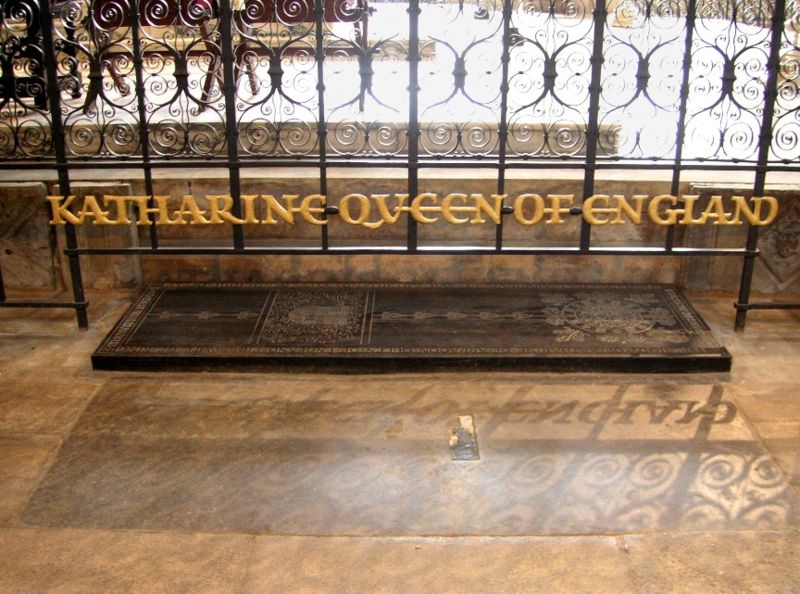
Catherine
of Aragon's tomb at Peterborough Cathedral
Catherine was buried at Peterborough Abbey, later
cathedral, on 29th January and was given a funeral ceremony
befitting her position as ‘dowager princess’.
Alison Weir describes the funeral in The Six Wives of
Henry VIII:
“The Chief mourners were lady Bedingfield, the young
Duchess of Suffolk and the Countess of Cumberland, Eleanor Brandon, the king’s
niece…The funeral sermon was preached by John Hilsey, who had replaced Fisher
as Bishop of Rochester; he was a staunch King’s man, and alleged, against all
truth, that Katherine had acknowledged at the end that she had never been the
rightful Queen of England. Then the woman who had in reality stoutly maintained
to the last that she had been the King’s wife was buried as Dowager Princess of
Wales in the abbey church.” (Pg. 300)
Henry VIII did not attend the funeral and instead remained
at Greenwich where he wore ‘black mourning clothes and attended a solemn mass’
(Weir, Pg. 300). Henry VIII also refused to allow Mary to attend her mother’s
funeral. He had denied her leave to visit her mother on her deathbed and he now
deprived her of this final moment.
Chapuys chose not to attend, as they were not burying
Catherine as Queen.
It seems though that Catherine had the last laugh because
on the very day of her burial, Queen Anne Boleyn miscarried of her saviour.
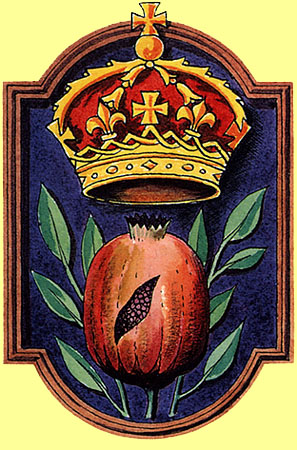
Catherine
of Aragon's badge
Today a wooden plaque on Catherine’s tomb describes her as:
‘A queen cherished by the English people for her loyalty, piety, courage and
compassion’.
Catherine of Aragon always- Humble and Loyal.
References
Fraser, A. The Six Wives of Henry VIII, 1992.
Ives, E. The Life and Death of Anne Boleyn, 2004.
Tremlett, G. Catherine of Aragon: Henry’s Spanish Queen,
2010.
Weir, A. The Six Wives of Henry VIII, 2007.