Reformed Churchmen

We are Confessional Calvinists and a Prayer Book Church-people. In 2012, we remembered the 350th anniversary of the 1662 Book of Common Prayer; also, we remembered the 450th anniversary of John Jewel's sober, scholarly, and Reformed "An Apology of the Church of England." In 2013, we remembered the publication of the "Heidelberg Catechism" and the influence of Reformed theologians in England, including Heinrich Bullinger's Decades. For 2014: Tyndale's NT translation. For 2015, John Roger, Rowland Taylor and Bishop John Hooper's martyrdom, burned at the stakes. Books of the month. December 2014: Alan Jacob's "Book of Common Prayer" at: http://www.amazon.com/Book-Common-Prayer-Biography-Religious/dp/0691154813/ref=sr_1_1?ie=UTF8&qid=1417814005&sr=8-1&keywords=jacobs+book+of+common+prayer. January 2015: A.F. Pollard's "Thomas Cranmer and the English Reformation: 1489-1556" at: http://www.amazon.com/Thomas-Cranmer-English-Reformation-1489-1556/dp/1592448658/ref=sr_1_1?ie=UTF8&qid=1420055574&sr=8-1&keywords=A.F.+Pollard+Cranmer. February 2015: Jaspar Ridley's "Thomas Cranmer" at: http://www.amazon.com/Thomas-Cranmer-Jasper-Ridley/dp/0198212879/ref=sr_1_1?ie=UTF8&qid=1422892154&sr=8-1&keywords=jasper+ridley+cranmer&pebp=1422892151110&peasin=198212879

Showing posts with label Mary 1. Show all posts

Tuesday, March 4, 2014

4 Mar 1554: Queen Mary 1 Issued Her Anti-Reformed Edict

4 March 1554. On this day, Queen Mary 1 issued her edict:

• Anglo-Italian worship shall be reinstated in England
• Protestantism is full of heresies
• The Edwardian and Cranmerian Book of Common Prayer is full of “heresies” (note the plural, “heresies,” a system of thought).

The story is told on pages 127-128 in Rusten, E. Michael and Rusten, Sharon. The One Year Christian History. Carol Stream, IL: Tyndale House Publishers, 2003.
http://www.amazon.com/The-Year-Christian-History-Books/dp/0842355073/ref=sr_1_1?ie=UTF8&qid=1393302630&sr=8-1&keywords=rusten+church+history.

Backstory.

Mary was born in 1516 to Henry VIII and Catherine of Aragon, herself the daughter of a Spanish King, Ferdinand II. She was raised a full Romanist under Anglicanism 1.0—that is, Anglicanism in full communion with Rome. Henry VIIIl had initiated Anglicanism 2.0, that is, Anglicanism without the Pope but with Roman doctrine. 


 As King Henry VIII’s reprobatish and multiple matrimonial disputes emerged, daughter-bastard Mary was separated from her mother, Catherine of Aragon. Both went in different directions and never saw one another again. It’s a sad family picture.

Imagine the bitterness and anger!

Mary was declared a bastard by her Royal father. Thomas Cranmer, the Archbishop of Canterbury (the church controlled family courts), complied. So did the Parliament. Henry’s marriage to Catherine was declared null.  That made the daughter a bastard, a legal term and category in family law.

But, as history moved forward, Mary was in and out of the dynastic will. Old Henry rewrote the will in 1544 to arrange for a new dynastic succession: Edward VI (a son by another Henrician arrangement), Mary (by Catherine) and then Elizabeth (a daughter by another Henrician arrangement). If one of these three offspring had issue, then the issue would accede to the throne. If one of the offspring had no issue, it went to the next Tudor.

Edward VI, the first in the 1544 will, came to the throne. Rusten oddly claims—wihout support—that he died of “congenital syphilis” (127). Protestant reforms were implemented during Edward’s reign including the Reformed Book of Common Prayer. He died young and had no issue, so the second came to the throne.

The second to the throne, Mary, fleeted up. Rusten again claims that Mary had “congenital syphilis” resulting in chronic headaches, bad eye sight, rhinitis and bad breath.” She had more than bad breath, however.

Mary abhorred the Protestant heretics and their heresies. She:

• Reinstated the Romanist Mass in Latin

• Outlawed the heretics

• Revived the 1401 law revived (De Haeretico Comburendo)--the one authorizing the burning of heretics

• Burned close to 300 Protestants at the stake.

• Cleansed England of Reformed Churchmen, forced about 800 Protestants to flee England for the Continent (which was a blessing in one sense...they received further education in theology and established salutary connections).

• Died on time in 1558.

A few questions:

• For Mr. Jorge (Pope Francis 1) Bertoglio, what say you of this? Didn’t Mr. Carol (Pope JP2) Wotyla issue a vague statement in Czechoslovakia over the Huss’ burning? Is that it? Is this story told in your RCIA courses? Is the story told in RCIA courses on the English Reformation?  Should Rome be called upon to issue a full report along with institutional mea culpas?

• For ACNA, Pope Leo XIII declared in 1896 that Anglican orders are invalid? What say you Bishops? Have you confronted this and commented on it?


• Should this story be told or forgotten?

• What do the Tracto-friend operatives say about this?

• How should this affect ecumenical discussions? Paper-overs? Fly-byes? Excision from text-books?

• Has God forgotten what happened? If God has forgotten the story, shouldn’t we forget it?

• Does this story get told by Romanists, Anglicans or American evangelicals?


Revelation 6: 9-17

1599 Geneva Bible (GNV)

9 [a]And when he had opened the fifth seal, I saw under the altar the souls of them that were killed for the word of God, and for the testimony which they maintained.
10 And they cried with a loud voice, saying, How long, Lord, which art holy and true! dost not thou judge and avenge our blood on them, that dwell on the earth?
11 And long [b]white robes were given unto every one, and it was said unto them, that they should rest for a little season until their fellow servants, and their brethren that should be killed even as they were, were [c]fulfilled.
12 [d]And I beheld when he had opened the sixth seal, and lo, there was a great earthquake, and the Sun was as black as [e]sackcloth of hair, and the Moon was like blood.
13 And the stars of heaven fell unto the earth, as a fig-tree casteth her green figs, when it is shaken of a mighty wind.
14 And heaven departed away, as a scroll, when it is rolled, and every mountain and isle were moved out of their places.
15 [f]And the kings of the earth, and the great men, and the rich men, and the chief captains, and the mighty men, and every bondman, and every free man, hid themselves in dens, and among the rocks of the mountains,
16 And said to the mountains and rocks, [g]Fall on us, and hide us from the presence of him that sitteth on the throne, and from the wrath of the Lamb.
17 For the great day of his wrath is come, and who can stand?

Footnotes:

a. Revelation 6:9 The fifth sign is that the holy martyrs which are under the altar, whereby they are sanctified, that is, received into the trust and tuition of Christ (into whose hands they are committed) shall cry out for the justice of God, in an holy zeal to advance his kingdom and not of any private perturbation of the mind, in this and the next verse, and that God will, in deed, sign and word comfort them, verse 11.
b. Revelation 6:11 As before 3:4.
c. Revelation 6:11 Until their number be fulfilled.
d. Revelation 6:12 The sixth sign, the narration whereof hath two parts, the sign, and the event. The sign is, that the earth, heaven, and the things that are in them for the horror of the sins of the world upon those most heavy foretellings of God, and complaints of the Saints shall be shaken most vehemently, trembling in horrible manner, and losing their light in this verse: falling from on high, verse 13, withdrawing themselves and flying away for the greatness of the trouble, verse 14. So boldly do all creatures depend upon the will of God, and content themselves in his glory.
e. Revelation 6:12 So they called in old time those woven works that were of hair.
f. Revelation 6:15 The event of the sign aforegoing: that there is no man that shall not be astonished at that general commotion, fly away for fear and hide himself in this verse, and wish unto himself most bitter death for exceeding horror of the wrath of God, and of the Lamb, at which before he was astonished. Now this perplexity is not of the godly, but of the wicked, whose portion is in this life, as the Psalmist speaketh, Ps. 17:14. Not that sorrow which is according unto God, which worketh repentance unto salvation, whereof a man shall never repent him, but that worldly sorrow that bringeth death, 2 Cor. 7:9, as their wishings do declare: for this history is of the whole world, severed from the history of the Church, as I have showed before, Rev. 4:1.
g. Revelation 6:16 These are words of such as despair of their escape: of which despair there are two arguments, the presence of God and the Lamb provoked to wrath against the world in this verse, and the conscience of their own weakness, whereby men feel that they are no way able to stand in the day of the wrath of God, verse 17, as it is said, Isa. 14:27.

Wednesday, August 14, 2013

Dynastic Succession of the Tudors to the Stuarts

Elton, G.R. The Tudor Constitution: Documents and Commentary (2nd Ed.). Cambridge: Cambridge University Press, 1995. 

It is available at: 

http://www.amazon.com/The-Tudor-Constitution-Documents-Commentary/dp/052128757X/ref=sr_1_4?ie=UTF8&qid=1374782952&sr=8-4&keywords=G.R.+Elton. From the amazon.com website, the following commendation is made: “There is no alternative in sight which comes close to conveying the story of the English Reformation in narrative power and substantial information.” Heiko A. Oberman, University of Arizona.

(A rich plethora of other volumes are on offer from Mr. Elton.)

Structure of the book over 482 pages and 10 chapters:

1. Crown
2. Council
3. Seals and Secretary
4. Financial Administration
5. Ancient Courts
6. Conciliar Courts
7. Ecclesiastical Courts
8. Parliament
9. Church
10. Local Courts

Each chapter above consists of two things: (1) Mr. Elton’s introductory commentary and (2) a long list of documents from 1485-1601, including landmark legal rulings. This volume will bring the Royal, Parliamentary, legal and ecclesiastical institutions into considerations on the English Reformation.

Of course, as a premier historian, Mr. Elton includes a scholarly bibliography.

Mr. Elton notes there has been a “spectacular expansion of Tudor studies” in the last 50 years.

We bring preliminary musings.

"To rule or not to rule? Rule by military victory, dynastic succession, or both in some combination? Or, with other factors like a Parliament and the Church too?"

The Tudors had been “victors in civil war.” Henry VII had satisfied the first duty of kingship: “govern effectively and to the satisfaction of the greater part of the realm” (1).

The Tudors were never “altogether free from dynastic worries” having observed other “disturbed dynastic successions.” It was “hereditary right” that played the largest part. Of course, wars could alter that.

Henry VII “took the simple line of describing himself as king once he had overthrown Richard III” (1). Or, might makes right. This was not a legal basis, but one of a "victor in war." Nonetheless, heirs “harnessed the dynastic principle.”

Henry’s 1st Parliament was proof enough. “Only a true king can summon a true Parliament.”

Following victory in war and the calling of the Parliament, it was not a far leap to this theological conclusion: “All Tudors rested the title on accomplished fact, which, they argued announced God’s choice.” There there. That's that. Never mind elections as we know them.

In 1495, Henry VII was safe on the throne, all “pretenders overcome,” and “European recognition” achieved. But doubts “could not be avoided” (2).

In 1502, the presumptive Tudor heir, Arthur Tudor, died. Arthur's early death was unexpected at the nubile age of 15 after a brief marriage lasting 20 weeks with Catherine of Aragon.

Upon the death of Arthur, the next presumptive heir in dynastic succession, young Prince Henry, assumed the royal duties of his brother. He would have several years in that role.

Upon the death of Henry VII in 1509, Prince Harry fleeted up and became Henry VIII. To establish, or reaffirm, the Tudor relationship with Spain, Henry VIII declared that he would marry Catherine of Aragaon.  Never mind the troubled issues of the Papal dispensation from Julius II.  Harry would marry Catherine.

Henry VIII came to the throne at age 18 as “an adult and to the music of general acclamation” (2).

But, dynastic issues remained. Catherine was not breeding heirs for Henry.

He divorced Catherine (or had his marriage annulled) and married the pregnant Ann Boleyn. Mr. Cranmer was in the mix as we've been noting.

With "dynastic issues" at bar, the "First Act of Succession" was passed. Mary was "bastardized." That was that. Thereby, "the future issue" of Henry and Ann would be legitimated.

The marriage to Ann went south. Ann lost her head. Henry took up with Jane Seymour. The dynastic issue gets more complicated.

A “Second Act of Succession” was ordered up—now Mary and Elizabeth were bastards. And that was that. Two bastards, not one.

The "Second Act of Succession" provided for the "future issue" from old Harry and Jane Seymour. Any future issue would be legitimate, "dynastically."

Of note, in this act, there was an allowance to the King “to bequeath by will” the throne as if “the crown were a piece of property.” This will be effected when the Stuarts fleet up in 1603 to the English throne. It is undoubted that "dynastic issues" were involved in poor Harry's matrimonial crusades.

In 1544, a “Third Act of Succession” was declared. This reaffirmed and reiterated that the King could determine dynastic succession by will.

In this "Third Act," the succession was outlined: Edward, Mary, and Elizabeth in that order (“the previous bastardizations being now ignored”). Might makes right, right?

In December 1546, Henry "refines" the will. He provides another potential line of succession.

If the Edwardian, Marian and Elizabethan succession should fail to have issue, the throne would devolve to the issue of Henry VIII’s oldest sister, Margaret Tudor (the Stuart line).

The question of “succession remained a vital issue” during Elizabeth 1’s reign (3). With Edward and Mary dead and Elizabeth childless, who's next? Henry had the foresight to anticipate this.

Henry VIII’s will came into “operation without trouble or question.”

James 1st will come to the English throne in 1603. He was the son of Henry VIII's eldest sister.

"To rule or not to rule? Rule by military victory, dynastic succession, or both in some combination? Or, with other factors like a Parliament and the Church too?"


Friday, August 10, 2012

Katherine Parr: A Protestant and Reformed Queen (1512-1548)

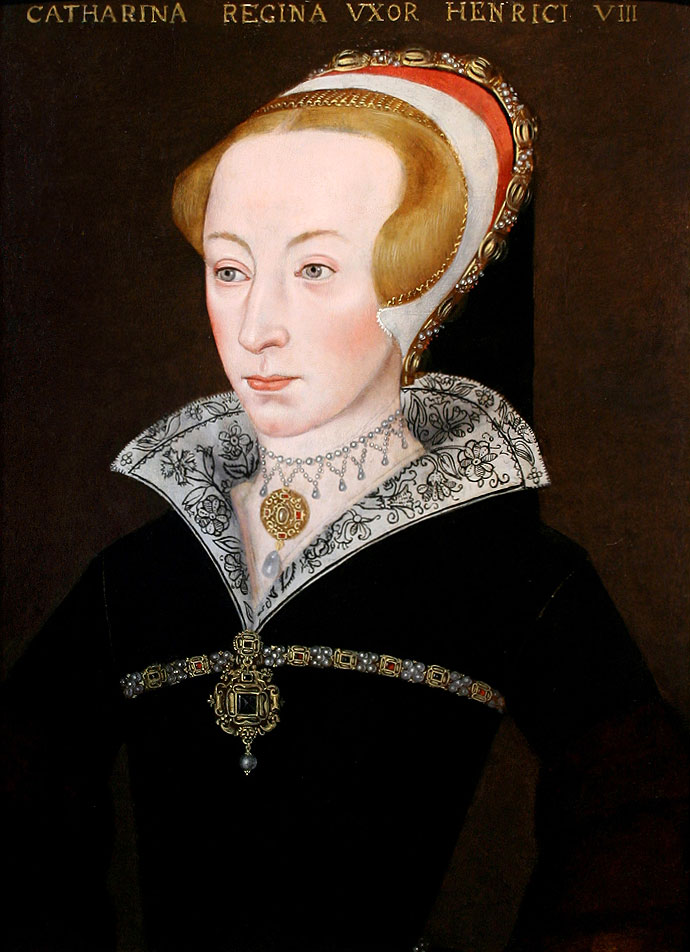
Portrait of Katherine Parr

Katherine Parr (c.1512-1548)
http://www.luminarium.org/encyclopedia/katherineparr.htm


Katherine Parr,1 the last of the six wives of Henry VIII, was born around 1512, three years into the reign of King Henry VIII, who had succeeded his father, King Henry VII, to the throne of England in 1509. She was the first child of Sir Thomas Parr, of Kendal, and Maud, daughter of Sir Thomas Green, who was then seventeen years of age. Lady Parr next had a son, William, and a second daughter, Anne, but the family's happiness was short-lived. Sir Thomas Parr died in 1517, when Katherine was but five years of age, and Lady Parr was left to raise three small children alone.

Lady Parr, despite her years, was a formidably determined woman, who devoted herself to bringing her children up well. She was deeply religious and taught her children to have the same reverence for God. The children grew up under a strict discipline, and were well educated in scripture and languages. The daughters were also taught the skills needed to run a noble household, and the traditionally feminine arts of music and dance. Katherine was groomed to be an exemplary noblewoman, with a love of learning and a modest demeanor, which were to serve her well throughout her life.

Around 1524, Lady Parr began a negotiation with Lord Dacre for a match between Katherine and Henry Scrope. An agreement was not reached, however, due to a disagreement over the dowry. This was fortuitous, because Henry Scrope died the following year. Out of the many suitors for Katherine's hand, Lady Parr finally chose Edward de Burgh, or Borough, grandson of 2nd Baron Burgh, whom Katherine married by 1529.2 The marriage was not long; Edward died a few years later, leaving Katherine a young widow. Lady Parr herself had passed away in 1531, leaving a considerable fortune to Katherine. In 1534, Katherine married John Neville, Lord Latimer. He had been twice married; first to Dorothy de Vere, grand-daughter to the 12th Earl of Oxford, with whom he had two children, and afterwards to Elizabeth Musgrave who had died soon after the marriage. As Lady Latimer, Katherine moved to her husband's household at Snape Castle in Yorkshire. The couple took frequent trips to London, and were well-received at court.

From the autumn of 1542, Lord Latimer's health began to fail. In early 1543, when Latimer's impending demise became apparent, King Henry VIII began to court Katharine. In February, he gave her a gift of clothes, an improper gesture to a married woman; this distressed her, but who dared return a King's gift, especially when the King in question was the irascible Henry VIII? After Lord Latimer's death in March, 1543, Katherine inherited the estates of Nunkmonton and Hamerton, provided she take care of the bringing up of her stepdaughter, Margaret. Her husband's bequest, combined with the inheritance from her mother, made her a woman of great means.

Katherine Parr stayed on at court, not for Henry, but because of a flirtation with the dashing
Sir Thomas Seymour. He was thirty-seven to her thirty-one, brother of the late Queen Jane, and uncle to Prince Edward. They were mutually attracted and began to discuss marriage. The King, however, wanted Katherine for himself and was jealous. Katherine was not interested; she was in love with Seymour, and had no interest in becoming Queen, or indeed wife number six to a man of questionable track record. In May 1543, King Henry, customarily ruthless, sent Seymour to Brussels on a permanent embassy, and began his advances in earnest. Around July, the King proposed to Katharine. Feeling she hadn't much choice, she finally acquiesced. The marriage took place in a private ceremony on July 12, 1543, at Hampton Court.

Queen Katharine was nearly universally liked. She was learned, with a keen intellect; she was virtuous, a great conversationalist, and she treated everyone with respect and warmth, regardless of station. Katharine was determined to reunite King Henry with his children, who lived far removed from court, and to be a good stepmother to them. She persuaded the King to have the children visit.
Lady Elizabeth, who was ten, took to her immediately—here at last was a mother-figure who was offering a warm and loving presence, and who appreciated and encouraged the intelligence and education of the bright girl. Elizabeth was already well-versed in the classics and spoke several languages—impressive not only for her age, but for her sex, who were not usually afforded the same rigorous curricula as their male counterparts. Queen Katharine took it upon herself to oversee the child's education and was, in turn, rewarded with unqualified admiration by the precocious princess. Elizabeth would write Katharine many warm letters, from 'Your Majesty's very dear Elizabeth,' and there seems to have been genuine fondness on both sides. At the end of 1544, when Elizabeth was only eleven, she sent Queen Katherine her translation of Queen Marguerite of Navarre's "Mirror of the Sinful Soul." In covers beautifully embroidered by the young princess, it was accompanied by a thoughtful letter.

Queen Katherine and the
Lady Mary were near in age, and Katherine never attempted to mother her. Instead, she befriended her and treated her as a princess—not something Mary had experienced in a long while, since she and her mother, Catharine of Aragón, had been effectively banished from court during the divorce proceedings. Queen Katherine's gentle manner did much to banish some of the resentment Mary must have harbored toward her father. It was probably thanks to Queen Katherine that Mary and Elizabeth were again added to the line of succession in the new Act of Succession of 1544. The heir was still Prince Edward, after whom were to come any children by the King and Queen Katherine, followed by children from marriages after Katherine, should they take place, then Lady Mary, and finally little Lady Elizabeth. It is known that Queen Katherine had pleaded for Lady Mary to follow in succession to Edward, but Henry could only be budged so much.

In July, 1544, Henry set to invade France. In an unprecedented display of trust, he appointed Queen Katherine regent in his absence. The King, whose leg and overweight had been troubling him greatly since the previous Christmas, was much improved by the physical activity of war. London, however, was not faring as well. Queen Katherine and the children had to set out in August for a progress to the countryside to avoid the plague which ravaged London that summer. On September 14, 1544, the city of
Boulogne fell to the English siege. At the end of September, King Henry returned in triumph and all was well for a time. In October, Thomas Seymour's embassy ended, and he returned to court. Taking no chances, Henry appointed him Lord High Admiral of England; a post that would keep him safely away from the court, and thus the Queen.

The Queen had been charged by the King to supervise the education of Elizabeth and Edward, a responsibility she acquitted admirably. The children had a strict and extensive course of studies, not only in the letters, but also in religion and music, needlepoint and dance for Elizabeth, and swordsmanship for Edward. The Queen herself also never ceased to study. With the King's permission, she published Prayers and meditations, which she had collected and edited, in November, 1545. The book was applauded by both the universities of Oxford and Cambridge, and she was petitioned to become their patroness. The Queen accepted both requests, and also patronized poor students by paying their tuition at Stoke College. She further made sure all the children of her tenant farmers were schooled, at her own personal expense.
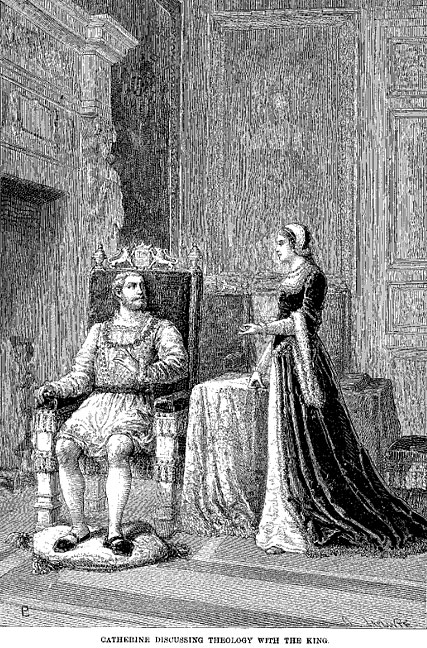
Katherine Parr discussing theology with the King
On Christmas, 1545, the King was ailing. Henry had long been grossly overweight, and an old wound in his leg had never healed, causing infection upon infection, which in turn caused him great pain. The Queen tried to take the King's mind off his aches with lively debates over theology, a pastime the King greatly enjoyed. Katherine by this time almost certainly held some protestant views but, for all his renouncing of the Pope's powers, Henry could not stand Lutherans. The Queen had to tread carefully, for there were those at court who bore enmity towards her, namely the new Lord Chancellor Wriothesley and Bishop Gardiner, who would do their best to eradicate her, should she slip. The Queen was then writing her second book, The Lamentations of a Sinner, and the King was equal parts proud and jealous of her erudition.

In February, 1546, the King was told that a Protestant woman,
Anne Askew, had named the Queen as a protestant. The King ordered Anne Askew questioned again, and she was savagely racked and tortured by Wriothesley, personally, in the Tower. She would not, however, renounce her Protestant faith, nor implicate anyone else. In June, she was sentenced to death and burned at the stake. Her death was relatively quick compared to most—someone had paid the executioner to hang a bag of gunpowder at her neck, so she could die of the explosion, instead of waiting to die by suffocation or the boiling of one's own blood. Wriothesley was ready to attack.
Katherine Parr - Philip Mould, Ltd. During the summer of 1546, after one particularly heated argument on theological matters between the King and Queen, Gardiner caught the King's ear and suggested that the King should look beware cherishing "a serpent within his own bosom."3 Gardiner did his best to persuade the King that the Queen was a heretic, and the King agreed to draw up a warrant for her arrest, should proof arise. He continued to have debates with the Queen over matters of religion, and Katherine, suspecting nothing, obliged. Eventually, the King did indeed sign the warrant, but the Queen received word from a servant. The night before her impending arrest, the King again tried to bait her into a conversation on religion. Katherine played the modest wife, and responded that the only reason she ever discussed such matters was that it seemed to alleviate the King's pains, but that she would always refer herself to his better judgement, as her lord and head. The King, hearing this, was mollified. He realized what Gardiner and Wriothesley were doing and aimed to shame them for it.

Next day, the King invited the Queen to the garden, and as Wriothesley approached with a contingent of the guard, intent on arresting the Queen, the King called him "knave, fool, and beast," and ordered him "to get out of his presence."4 When the Queen, feigning innocence of the Chancellor's duplicity, tried to excuse his behavior, Henry replied, "Ah! Poor soul! thou little knowest, Kate, how little he deserveth this grace at thy hands."5 Little the King knew, how much she indeed knew of how close she had come to following the fates of his previous wives.

In the fall of 1546, King Henry grew steadily worse. It became apparent, even to Henry himself, that the end was near. In December, he dictated his will. The kingdom was to go to Edward, and a generous amount of money and goods to the Queen. He wished to be buried next to Queen Jane at
Windsor. The King improved somewhat in the beginning of January, 1547, but on the eve of the 28th of January, he called his family to his side for a final goodbye. King Henry VIII, aged fifty-five, died at two a.m., most likely of a blood clot that had travelled from his leg to his heart.

Edward was crowned
King Edward VI, on January 31, 1547. Since he was a minor, he was under the control of his regency Council. Neither the Dowager Queen Katherine, nor his sisters, were permitted to visit the King. This grieved both Katharine and the young King, but there was little to be done. Katherine announced that she would retire from the court to her house, Old Manor, at Chelsea. Meanwhile, Seymour returned to court. He was created Baron Seymour of Sudeley Castle in Gloucestershire, and confirmed in his post as Lord High Admiral for life, as well as admitted into the Order of the Garter. His aggravation over not being allowed into the regency Council was alleviated only somewhat by the new title granted to him; he had hopes of even higher. He secretly began to court the thirteen year-old Lady Elizabeth, thinking to advance himself by that means. Elizabeth, though perhaps flattered, turned him down. Seymour, bemused, set his sights on his Katharine Parr.

The Dowager Queen, Katharine Parr, still harbored feelings for the man she had once thought to marry, and when he renewed his suit, she accepted. The Council would be unlikely to grant a petition for the Dowager to marry so soon after Henry's death, so Seymour went straight to King Edward. The young King, who was fond of both his uncle Thomas and, naturally, of the Queen, consented. The couple married in secret some time by the end of April, 1547, most likely at the Queens estates at Chelsea. The King and Council were not told of the marriage until the end of May. The Council were livid and censured Lord Sudeley. The King, despite exhortations to the contrary by his Council, wrote to the Queen. He concluded
the letter with, "I do love and admire you with my whole heart. Wherefore, if there be anything wherein I may do you a kindness, either in word or deed, I will do it willingly."6 After such words, what could the Council do?

The reception from the Lady Mary was quite the opposite. Seymour had written to Mary, hoping Mary could help further his cause with the Council. Mary was outraged at his forwardness and lack of taste and sent back an acerbic reply saying she would not intervene. Mary, who once had born such respect for her father's wife, now thought that by marrying improperly soon after the passing of Henry, and to a man of such character, Katherine would not be a good moral example for Elizabeth. She asked Elizabeth to cease contact with Katherine, but Elizabeth sent a lukewarm reply; she had after all long loved Katherine almost as a mother. In November, 1547, Katherine published her second book, The Lamentations of a Sinner. It was an enormous success, widely praised. At this time, she invited Elizabeth to come stay with her, which she did in early 1548, enough time having passed for their renewed closeness not to elicit mutters.

Unfortunately, Katherine knew nothing of her husband's past courting of Elizabeth. The situation was tricky: Elizabeth was all of fourteen, and Seymour, who styled himself her "stepfather," began once again to pay attention to her. Katherine suspected nothing, and Seymour was very good at keeping what he did not wish known secret. Elizabeth also let on nothing, for fear of hurting Katherine, who was so happy in her new marriage and her country life.
Lady Jane Grey, Elizabeth's cousin, also joined the household in January, 1548. Queen Katherine had promised to provide for her education, and it would be good for Elizabeth to have company her own age. Elizabeth requested to have Roger Ascham as tutor to her and Jane, and Queen Katherine, who had corresponded with Ascham since the publication of her first book, heartily approved. Ascham was a famed scholar, and a magnificent teacher—he polished the already well-learned, intelligent girls into brilliance. Ascham's tutelage was rigorous and exacting. Elizabeth, later as Queen, would never forget to extol the virtues of her old tutor. Queen Katherine's house came to be known as a respected place of learning for young women.
In March, 1548, Katherine Parr was finally pregnant with her own child. All the years of caring for others' children, she was going to have one with the man she loved. In the midst of all the preparations for the baby and the exuding happiness, Katherine had no idea that her husband was meeting with Elizabeth clandestinely. Elizabeth's governess later testified in front of the Privy Council that the Admiral would enter Elizabeth's chamber some mornings, wearing nothing but a nightshirt. On occasion he would climb in with her and tickle her. Mrs. Ashley, her lady in waiting, was scandalized and resolved not to leave her alone with the Admiral.

Katherine finally started suspecting something out of the ordinary was going on. In April, she walked in on Elizabeth and the Admiral embracing. Instead of confronting them, she walked out. In May, Elizabeth was sent away to one of her own estates. Before leaving, Elizabeth was summoned to Katherine who was very cold towards her. Tradition has it that she told Elizabeth, "God has given you great qualities. Cultivate them always, and labour to improve them, for I believe you are destined by Heaven to be Queen of England."7 Elizabeth left in shame and wrote an apologetic letter in June. Katherine Parr had always been a gentle person, and she wrote a kind letter of reply, even though she was in considerable pain, having hurt her wrist. Elizabeth in turn wrote a
relieved letter of thanks. At this time, Katherine also reconciled with Mary, who wrote Katherine a letter of congratulations on her impending motherhood.

On August 30, 1548, Katherine gave birth to a daughter whom she named Mary, after the Lady Mary. Katherine, however, had puerperal fever; infection of the uterus after childbirth, which most often led to death. The Queen was delirious with a fever for a week, until it became apparent she would not recover. She wrote a dying will leaving everything to her husband. The Queen died on September 7, 1548. She was buried at Chelsea. Queen Katherine Parr was mourned by her stepchildren, by Lady Jane Grey, and all who had known her. When Lord High Admiral Thomas Seymour was executed for treason in 1549, baby Mary was taken in by her mother's friend, Lady Suffolk. She is thought to have died in childhood.

Queen Katherine Parr was the only one of Henry VIII's wives to have survived him. She also has the questionable distinction of being England's most-married Queen. All who knew her praised her for her learning, her character, her godliness, gentleness and charity. She had great talent as a writer, and had she lived two hundred years later, she may have been a formidable presence. Yet perhaps her most lasting legacy was her shaping and nurturing of the learning and character of the little girl who would bring England to another Golden Age: the girl who would become
Queen Elizabeth I.
Notes:

1 Her name has been alternately spelled Catharine, Catherine, Katharine, Kateryn, or Katherine,
the last being the strongest contender. In her mother's will, (Testamenta Vetusta, v.2,
p651),
her name is spelled "Katherine".

2 Starkey, 697; Porter, 49-59; [Thanks to Meg McGath]

3 Reported by
John Foxe as said by Gardiner. Quoted
in Weir, 519.

4 Memoirs of the Court of Henry the Eighth, Vol II,
by Mrs. A. T. Thomson. London: Longman, Rees, &c., 1826. 570.

5 Memoirs of Henry the Eighth of England by
H. W. Herbert. New York: Miller, Orton & Mulligan, 1856. 440.

6 Letters of the Kings of England, Vol II,
by J. O. Halliwell-Phillipps. London: Henry Colburn, 1848. 34.

7 Weir, 554.