Reformed Churchmen

We are Confessional Calvinists and a Prayer Book Church-people. In 2012, we remembered the 350th anniversary of the 1662 Book of Common Prayer; also, we remembered the 450th anniversary of John Jewel's sober, scholarly, and Reformed "An Apology of the Church of England." In 2013, we remembered the publication of the "Heidelberg Catechism" and the influence of Reformed theologians in England, including Heinrich Bullinger's Decades. For 2014: Tyndale's NT translation. For 2015, John Roger, Rowland Taylor and Bishop John Hooper's martyrdom, burned at the stakes. Books of the month. December 2014: Alan Jacob's "Book of Common Prayer" at: http://www.amazon.com/Book-Common-Prayer-Biography-Religious/dp/0691154813/ref=sr_1_1?ie=UTF8&qid=1417814005&sr=8-1&keywords=jacobs+book+of+common+prayer. January 2015: A.F. Pollard's "Thomas Cranmer and the English Reformation: 1489-1556" at: http://www.amazon.com/Thomas-Cranmer-English-Reformation-1489-1556/dp/1592448658/ref=sr_1_1?ie=UTF8&qid=1420055574&sr=8-1&keywords=A.F.+Pollard+Cranmer. February 2015: Jaspar Ridley's "Thomas Cranmer" at: http://www.amazon.com/Thomas-Cranmer-Jasper-Ridley/dp/0198212879/ref=sr_1_1?ie=UTF8&qid=1422892154&sr=8-1&keywords=jasper+ridley+cranmer&pebp=1422892151110&peasin=198212879

Showing posts with label J. Gresham Machen. Show all posts

Sunday, June 29, 2014

29 June 1936 A.D. News Article (Wilmington, DE): Remember What It Cost


29 June 1936 A.D.  News Article (Wilmington, DE):  Remember What It Cost


Archivist.  “June 29: Remember What It Cost.”  This Day in Presbyterian History.  29 Jun 2014.  http://www.thisday.pcahistory.org/2014/06/june-29/.  Accessed 29 Jun 2014.

June 29: Remember What It Cost


Keeping in mind that newspapers were little different then than now, subject to the same human foibles*, nonetheless the following coverage of the modernist controversy and the resulting denominational split is interesting, as it offers some different perspectives on what a division means to those involved.

[*There are two errors mainly in the text below, both of which will be noted in brackets in their first appearance.]

This article is from a Wilmington, DE newspaper, dated June 29, 1936, and is found preserved in one of seven scrapbooks gathered by the Rev. Henry G. Welbon, covering the modernist controversy in the years 1935-1939. The photographs have been added and were not part of the original article.


Dissension with all the heartaches and strained loyalties that civil war brings, is definitely wedged in the Presbyterian Church in the U.S.A.

Where it will lead and the effect of the wedge, no one knows.

But this much is already evident in the Presbytery of New Castle, which embraced Delaware and parts of Maryland: families are divided, parents against children, husbands against wives, and friend with friend.

This is a time when members of congregations are torn between loyalty to their established church, when men are being accused of dogmatism, heresy, apostasy and free will.

Out of the seething cauldron has been born a new church, the Presbyterian Church in [sic; should be "of"] America, in contrast to the old Presbyterian Church in the U.S.A.

The nature of the wedge that is lodged in the church of the U.S.A. today is itself controversial.

Question Not Doctrinal

Those who are remaining loyal say the split is on a church constitutional question and among the loyalists are both fundamentalists and modernists.

“The matter now and never has been a controversy between ‘fundamentalists’ and ‘modernists’ the general council of the Presbyterian Church in the U.S.A. states.

It is a question the general council states, of whether ministers shall disobey the established constitution of a church and agree to the will of the majority.

The secessionists–all fundamentalists–say the differences are based upon doctrinal questions and liberty of conscience.

In any case, the immediate cause of the secession and the controversy has been the Independent Board of [sic; should be "for"] Presbyterian Foreign Missions, a board with no official connection with the Presbyterian Church in the U.S.A.

The leading personality in the Independent Board of Presbyterian Foreign Missions has been the Rev. Dr. J. Gresham Machen of the Presbytery of New Brunswick, N.J.

Four Judicatories in Church

For those not familiar with Presbyterian Church government, it should be explained that the judicatory and administrative bodies of the church are: First, the session, composed of representatives of a congregation, governing the church; second, the Presbytery governing a group of sessions in a district; third, the synod, a group of Presbyteries and fourth, the General Assembly which is the national ruling body of the Presbyterian Church which also is the supreme court and lawmaking body of the entire church.

Also as part of the story of the Independent Board of Presbyterian Foreign Missions is Pearl Buck, a missionary in China, whom it was charged was too much a modernist.

Dr. Machen Heads Movement

Though she resigned, the charges persisted from the militant fundamentalists of the Presbyterian Church against the alleged modernism in the foreign mission groups. In 1933, Dr. Machen introduced into the Presbytery of New Brunswick a proposed resolution to be presented to General Assembly relating to what he called “modernism” in the Presbyterian Board of Foreign Missions.

A large majority of the Presbytery of New Brunswick refused to send this resolution to General Assembly but similar resolutions did reach General Assembly in 1933. The assembly received it and Dr. Machen was heard by the committee to which the resolutions had been presented for consideration.

By a vote of 43 to 2, the committee reported unfavorably and expressed its confidence in the Board of Foreign Missions and by a nearly unanimous vote, the General Assembly approved the report of this committee.

But Dr. Machen did not pause there. Accepting neither the views of the committee nor the “judgment of the General Assembly,” he was influential in the establishment of the Independent Board of Presbyterian Foreign Missions, incorporated in December of 1933, with Dr. Machen as president. It is not a recognized body of the Presbyterian Church in the U.S.A., being just what its name indicates, “independent.”

H. S. Laird Member of Board

To this board came the Rev. Harold S. Laird, pastor of the First and Central Presbyterian Church of Wilmington, an ardent fundamentalist.

But before he joined the independent board, he consulted with his session. He did not join against their counsel.

Another point, not widely known, is that Mr. Laird during his pastorate at First and Central Presbyterian Church never solicited for the Independent Board of Presbyterian Foreign Missions.

“It was only after much earnest prayer and careful consideration,” he said, “that I came to the conviction that this movement was of God, and being thus convinced, I agreed to throw what little influence I have in the church to the lifting high of this standard. This was my primary motive in allowing myself to be elected a member of the Independent Board for Presbyterian Foreign Missions.

“It is from this board that I was ordered to resign. I believe the board is of God and I also believe that my call to membership on that board was of God. Under such circumstances, how can I resign? Shall I obey man rather than God?”

Taking note of this independent board and that ministers and elders were prominent in its membership, the General Assembly directed that all ministers and laymen affiliated with the board sever their connections with the organization.

Those who declined to obey this direction were ordered tried by their Presbyteries. A number were found guilty and either rebuked or suspended.

Mr. Laird tried before the Presbytery of New Castle, protested that his affiliation with the independent board had been guided by his conscience and that in refusing to sever his connection, he was placing the word of God above the courts of man.

Rebuked, But Not Suspended.

Mr. Laird, however, was found guilty, with one dissenting vote in his favor. He was ordered rebuked but allowed to remain [in] his pulpit.

But Mr. Laird continued in the membership of the independent board. The Presbytery recently suspended him from the ministry–an act regarded as illegal by Mr. Laird who immediately renounced the authority of the Presbytery.

Words to Live By
Unity is a precious thing, to be cultivated and prized. But Christian unity must be centered on the saving Gospel of our Lord Jesus Christ. Where we have that unity, it is glorious. Without Jesus Christ as our Cornerstone, there can be no Church.

Luke 12:49-53 (ESV)
49 “I came to cast fire on the earth, and would that it were already kindled!
50 I have a baptism to be baptized with, and how great is my distress until it is accomplished!
51 Do you think that I have come to give peace on earth? No, I tell you, but rather division.
52 For from now on in one house there will be five divided, three against two and two against three.
53 They will be divided, father against son and son against father, mother against daughter and daughter against mother, mother-in-law against her daughter-in-law and daughter-in-law against mother-in-law.”

Psalm 133 (KJV)
1 Behold, how good and how pleasant it is for brethren to dwell together in unity!
2 It is like the precious ointment upon the head, that ran down upon the beard, even Aaron’s beard: that went down to the skirts of his garments;
3 As the dew of Hermon, and as the dew that descended upon the mountains of Zion: for there the Lord commanded the blessing, even life for evermore.

Sunday, March 30, 2014

30 March: Prof. J. Gresham Machen's "My Idea of God"


30 March: “My Idea of God” by J. Gresham Machen

The PCA historians tell the story at: http://www.thisday.pcahistory.org/2014/03/march-30-my-idea-of-god-by-j-gresham-machen/    
30 March, 2014

Not a sermon for this Lord’s Day, but rather a testimony, this is one of Dr. Machen’s lesser known works. This brief testimony, titled “My Idea of God,” appeared in a book of the same name, a gathering of statements largely philosophical, which only served to make Machen’s testimony stand out all the more.

Editor’s preface:—

machen02

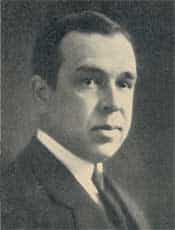
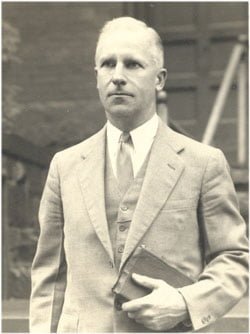
JOHN GRESHAM MACHEN was born in Baltimore in 1881. After graduating from Johns Hopkins and Princeton Universities and the Princeton Theological Seminary, he studied in Marburg and Gottingen Universities, and was ordained to the Presbyterian ministry in 1914. Since 1914 he has been associate professor of New Testament literature in Princeton Seminary, doing work betimes with the French Army and the A.E.F., in France and Belgium, during the World War.

Besides textbooks of Greek and many articles in reviews, Dr. Machen has written two books of unusual quality for general readers, Christianity and Liberalism (in which he holds that liberal Christianity is not Christianity at all, but a confection of modern theories exactly opposed to the Christian faith, with which there can be neither compromise nor unity) and What Is Faith? which inspired an extraordinary symposium in The British Weekly.

In the recent discussion which has agitated the Churches – now happily subsiding – Dr. Machen was the outstanding exponent of the conservative attitude, adding to a vital mind a lucid logic and a cogent style which left no shadow upon his meaning. His essay has value equally for its directness and its sincerity.


MY IDEA OF GOD


by J. GRESHAM MACHEN, D.D. PRINCETON THEOLOGICAL SEMINARY

IF my idea of God were really mine, if it were one which I had evolved out of my own inner consciousness, I should attribute very little importance to it myself, and should certainly expect even less importance to be attributed to it by others. If God is merely a fact of human experience, if theology is merely a branch of psychology, then I for my part shall cease to be interested in the subject at all. The only God about whom I can feel concerned is one who has objective existence, an existence independent of man.

But if there be such a really and independently existent Being, it seems extremely unlikely that there can be any knowledge of Him unless He chooses to reveal Himself: a divine Being that could be discovered apart from revelation would be either a mere name for an aspect of man’s nature – the feeling of reverence or loyalty or the like – or else, if possessing objective existence, a mere passive thing that would submit to human investigation like the substances that are analyzed in the laboratory. And in either case it would seem absurd to apply to such a Being the name of “God.”

A really existent God, then, if He be more than merely passive, if He be a living God, can be known only through

His revelation of Himself. And it is extremely unlikely that such revelation should have come to me alone. I reject, therefore, the whole subjectivizing tendency in religion that is so popular at the present time – the whole notion that faith is merely an “adventure” of the individual man. On the contrary, I am on the search for some revelation of God that has come to other men as well as to me, and that has come into human life, not through a mere analysis of human states of consciousness but distinctly from the outside. Such revelation I find in the Christian religion.

The idea of God, therefore, which I shall here endeavor to summarize is simply the Christian idea. I have indeed been enabled to make it my own; I love it with all my heart; but I should not love it if I thought that it had been discovered merely in the depths of my own soul. On the contrary, the very thing that I love about it is that it comes to me with an external authority which I hold to be the authority of God Himself.

At this point, however, there will no doubt be an objection. We have spoken about the knowledge of God; but in reality the knowledge of God, it is often said, is unnecessary to our contact with Him, or at least it occupies merely a secondary place, as the symbolic and necessarily changing expression of an experience which in itself is ineffable. Such depre-. ciation of knowledge in the sphere of religion has been widely prevalent in the modern world, and at no time has it been more prevalent than now. It underlies the mysticism of Schleiermacher and his many successors; it underlies the Ritschlian rejection of “metaphysics”; it underlies the popular exaltation of “abiding experiences” at the expense of the mental categories in which they are supposed to be expressed; and in general it is at the roots of the entire separation between religion and theology, experience and doctrine, faith and knowledge, which is so marked a characteristic of the religious teaching of the present day.

In opposition to this entire tendency, I for my part must still insist upon the primacy of the intellect. It may seem strange that the intellect should have to be defended by one who has so slight an experimental acquaintance with it as I; but reason in our days has been deposed from her queenly throne by pragmatism the usurper, and, wandering in exile as she does, cannot be too critical of any humble persons who rally to her defense. And, as a matter of fact, the passionate anti-intellectualism of the present age is having its natural fruit in a lamentable intellectual as well as moral decline. Such decadence can be checked – I, for my part, believe – only by a reemphasis upon truth as distinguished from practice, and in particular only by a return from all anti-intellectual mysticism or positivism to the knowledge of God.

Certainly, unless our contact with God is based upon knowledge of Him it ceases to possess any moral quality at all. Pure feeling is non-moral; what makes my affection for a human friend, for example, such an ennobling thing is the knowledge which I possess of the character of my friend. So it is also with our relation to God: religion is moral and personal only if it is based upon truth.

If then, in order that there may be a moral and personal relation to God, there must be knowledge of Him, how may that knowledge be attained? I have no new ways to suggest: the only ways of knowing God which I can detect are found in nature, in conscience, and in the Bible.

God is revealed, I hold, in the first place through the things that He has made. “The heavens declare the glory of God, and the firmament showeth His handiwork.” This revelation of God through nature is commonly called – or used to be commonly called – “natural religion.” And natural religion is by no means altogether dead. Modern men of science, if they be thoughtful, admit that there is a mystery in the presence of which the wisdom of the wisest men is dumb; the true man of science stands at length before a curtain that is never lifted, a mystery that rebukes all pride. But this revelation through nature is far richer than many men of science suppose; in reality it presents to us not merely a blank mystery, but the mighty God. The revelation comes to different men in different ways. For example, when I viewed the spectacle of the total eclipse of the sun at New Haven on the twenty-fourth of January I925, I was confirmed in my theism. Such phenomena make us conscious of the wonderful mechanism of the universe, as we ought to be conscious of it every day; at such moments anything like materialism seems to be but a very pitiful and very unreasonable thing. I am no astronomer, but of one thing I was certain: when the strange, slow-moving shadow was gone, and the world was bathed again in the wholesome light of day, I knew that the sun, despite its vastness, was made for us personal beings and not we for the sun, and that it was made for us personal beings by the living God.

In the second place, God is revealed by His voice within us. I am perfectly well aware that that voice is not always heard. Conscience has fallen on evil days: it is drowned by a jargon of psychological terms; it is supposed to be rendered unnecessary by an all-embracing network of legislative enactments.

The categories of guilt and retribution are in many quarters thought to be out of date, and scientific sociology is substituted for the distinction between right and wrong. But I for my part am not favorably impressed with the change; self-interest seems to me to be but a feeble substitute for the moral law, and its feebleness, despite bureaucratic regulation of the details of human life and despite scientific study both of individual human behavior and of the phenomena of human society, seems to be becoming evident in an alarming moral decline. The raging sea of passion cannot, I think, be kept back permanently by the flimsy mud embankments of utilitarianism; but recourse may again have to be had to the solid masonry of the law of God.

In the third place, God is revealed in the Bible. He is revealed in the Bible in a way which is entirely distinct from those ways that have just been mentioned. The Bible tells us things about God of which no slightest hint is found either in nature or in conscience. Of those things we shall speak in a moment.

But first it should be observed that, in addition to that fresh information, the Bible also confirms the revelation which has already been given. The confirmation is certainly necessary; for the revelation of God both in nature and in conscience has been sadly obscured. In comparing the fortieth chapter of Isaiah or the first verse of Genesis or the teaching of Jesus with the feeble and hesitant theism which is the highest that philosophy has to offer, and in comparing the unaided voice of conscience with the fifty-first Psalm or the searching law presented in the Sermon on the Mount, one feels that in the Bible a veil has been removed from the eyes of men. The facts were already there, and also the gift of human reason for the apprehension of them; but the light of reason somehow was obscured until in the Bible men were enabled to see what they ought to have seen before.

Thus, in these three ways there is attained, I hold, a genuine and objective knowledge of God. Certainly that knowledge does not remove the feeling of wonder which is dear to the mystic’s heart. Indeed, it ought to accentuate that feeling a thousandfold. There is nothing in the knowledge of God which should stifle, but everything which should awaken, the “numinous” quality in religion of which Otto speaks. God has gently pulled aside the curtain which veils His Being from the gaze of men, but the look thus granted beyond only reveals anew the vastness of the unknown. If a man’s knowledge of God removes his sense of wonder in the presence of the Eternal, then he has not yet known as he ought to know.

Yet partial knowledge is not necessarily false, and there are certain things which are known about God.

At the very centre of those things stands that which is most often denied to-day; the very centre and core of Christian belief is found in the awful transcendence of God, the awful separateness between God and the world. That is denied by modern men in the interests of what is called, by a perversion of a great truth, the “immanence” of God. We will have nothing to do – men say – with the far-off God of historic theology; instead we will worship a God who exists only in and with the world, a God whose life is found only in that life which pulsates through the life of every one of us. Pantheism, in other words, is substituted for theism, on the ground that it brings God nearer to man.

But has it really the desired effect? I, for my part, think not. Far from bringing God nearer to man, the pantheism of our day really pushes Him very far off; it brings Him physically near, but at the same time makes Him spiritually remote; it conceives of Him as a sort of blind vital force, but ceases to regard Him as a Person whom a man can love. Destroy the free personality of God and the possibility of fellowship with Him is gone; we cannot love a God of whom we are parts.

Thus, I for my part cling with all my heart to what are called the metaphysical attributes of God – His infinity and omnipotence and creatorhood. The finite God of Mr. H.G. Wells seems to me to be but a curious product of a modern mythology; He is to my mind not God, but a god; and in the presence of all such imaginings I am obliged to turn, very humbly but very resolutely, toward the dread, stupendous mystery of the Infinite, and say with Augustine: “Thou hast made us for Thyself, and our heart is restless until it finds its rest in Thee.”

This devotion to the so-called metaphysical attributes of God is unpopular at the present day. There are many who tell us that we ought to cease to be interested in the question how the world was made, or what will be our fate when we pass through the dark portals of death. Instead, we are told, we ought to worship a God who is not powerful but merely good. Such is the “ethical theism” of Dr. McGiffert and many others; Jesus, it seems, was quite wrong in the stress that He undoubtedly laid upon the doctrine of heaven and hell and the sovereignty of God. We moderns, it seems, can find a higher, disinterested worship – far higher than that of Jesus – in reverence for goodness divested of the vulgar trappings of power.

It sounds noble at first. But consider it for a moment, and its glory turns to ashes and leaves us in despair. What is meant by a goodness that has not physical power? Is not “goodness” in itself the merest abstraction? Is it not altogether without meaning except as belonging to a person? And does not the very notion of a person involve the power to act? Goodness divorced from power is therefore no goodness at all. The truth is that overmuch abstraction has here destroyed even that which is intended to be conserved. Make God good and not powerful, and both God and goodness have been destroyed.

In the presence of all such abstractions, the heart of man turns with new longing to the Living and Holy God, to the God who is revealed in nature, in the dread voice of conscience, and in the Bible. But as one turns to such a God, there is no comfort but only despair; the whole human race is separated from God by an awful abyss. Strange indeed, to us Christians, seems the complacency of the world; the very root of our religion is found in the consciousness of sin.

But at that point, on the basis of such presuppositions, there comes the really distinctive revelation that the Bible contains. It is not a revelation of things that already were true, but the explanation of an act. The Christian religion is based not merely upon permanent truths of religion, but upon things that happened in Palestine nineteen hundred years ago; it is based not merely upon knowledge of what God is, but also on a record of what God did. Into our sinful world – the Christian holds – there came in God’s good time a Divine Redeemer.

His coming, marked by a stupendous miracle, was a voluntary act of condescension and love. During the days of His flesh, He proclaimed by His word and example the law of God. He proclaimed it in a new and terrible way that of itself could only deepen our despair. But with His proclamation of’ the law there went His proclamation of the gospel; with His pronouncement of the Divine judgment upon sin there went His offer of Himself as Saviour. When that offer was received in faith, there was not only cure of bodily ills, but also forgiveness in the presence of God.

At first faith was implicit; men trusted themselves to Jesus without fully knowing how it was that He could save. But even while He was on earth He pointed forward with ever increasing clearness to the redeeming work which He had come into the world to do. And at last, on the cross, that work was done. The Divine Saviour and Lord, for the love wherewith He loved us, bore all the guilt of our sins, made white and clean the dark page of our account, and reconciled us to God. There is the centre of our religion. But how pitiful are my words! I may perhaps make men understand what we think, yet I can never quite make them sympathize with what we feel. The holy and righteous God, the dreadful guilt and uncleanness of sin, the wonder of God’s grace in the gift of our Saviour Jesus Christ, the entrance through Christ into the very house of God, the new birth by the power of God’s Spirit, the communion with the risen and ascended Lord through His Holy Spirit present in the Christian’s heart – these are the convictions upon which rest our very lives.

If these convictions are false, they must be given up. But so long as we think them true we must act in accord with them, and it is morally wrong to ask us to do otherwise. At this point appears the profoundly unethical character of most of the proposals for Church union that are being made at the present day. The right way to combat us who call ourselves evangelical Christians is to combat honestly and openly our central convictions as to God and sin and redemption, not to ask us to hold those convictions and then act contrary to them. So long as we think as we do, we cannot, if we love our fellow men, allow them, so far as our testimony is concerned, to remain satisfied with the coldness of what we regard as a baseless and fatal optimism. We must endeavor, by the preaching of the law of God and of the gospel of His love, to bring them into the warmth and joy of the household of faith.

[This work by Dr. J. Gresham Machen was first issued as a chapter in the book, My Idea of God, published by Little, Brown and Company, Boston, 1927, and appeared on pages 39 – 50 of that volume.] To view or download a PDF of this work, click here.

Saturday, March 29, 2014

29 Mar 1935: Prof. J. Gresham Machen, the Mensch, Adjudged Guilty at Trial


29 March 1935.  Prof. J. Gresham Machen, the Mensch, adjudged guilty at trial.

The PCA Historians tell the story at: http://www.thisday.pcahistory.org/2014/03/march-29-2/

The Strange Church Trial of a Spiritual Giant.


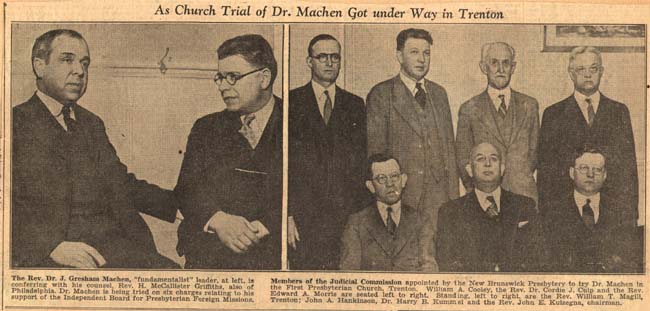
It all happened around seventy-seven years ago.  Back in March of 1935, Dr. J. Gresham Machen was before a church court of his peers seeking to defend himself against the serious charges of denying his ordination vows, disapproval of the government and discipline of the church, advocating a rebellious defiance against the lawful authority of the church, and we could go on and on in the charges leveled against this spiritual giant.  You would think that he was guilty of the most aggravated doctrinal error or moral shortcomings.  But in reality, it came down to a single issue—that of refusing to obey the 1934 mandate of the General Assembly of the Presbyterian Church in the U.S.A. to cease and desist from supporting an independent board of missionaries, of which board he was the president.


The trial itself was a farce in every sense of the word.  Machen’s defense first tried to challenge certain members of the judicial commission itself as biased, seeking to have them recuse themselves, since at least two of these men had signed the theologically liberal Auburn affirmation.  That was denied.  Then the question of jurisdiction was argued, but that also was not sustained.


http://www.thisday.pcahistory.org/wp-content/uploads/2012/03/machentrial01.jpg


At the third session, upon hearing Dr. Machen declare himself “not guilty,” the Commission ruled that certain matters were out-of-bounds in the arguments of the defense case.  Those included questions which surrounded the existence of the Auburn Affirmation, signed in 1924.  They next ruled out any question concerning the nature and conduct of the official Board of Foreign Missions, which had prompted much of the problem when it gave its endorsement to the book entitled Rethinking Missions.  Further, arguments stemming from the reorganization of Princeton Seminary and the founding of Westminster Theological Seminary were also outlawed by the commission.  All of these were part and parcel of Dr. Machen’s defense, since they provided the background of the origin of the Independent Board of Presbyterian Foreign Missions.


All these rulings paled into insignificance, so to speak, however, when we consider the last ruling of the judicial commission.  It stated that the legality of the Thirty-Fourth General Assembly’s Mandate for the ministers, members, and churches to cease supporting the Independent Board and only support the official Board of Foreign Missions could not be questioned.


It was obvious that with all of these rulings, that there was only one verdict which could come forth from this judicial commission, and that was guilty.  And so on this date, March 29, 1935, the judgment of “Guilty” was rendered by this seven member Judicial Commission of the Presbyterian Church, U.S.A.   Appeals to the higher courts were in vain, and J. Gresham Machen was suspended by the church.