20
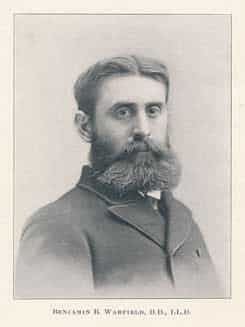
April 1880 AD. Mr. (Rev. Dr. Prof.) B.B. Warfield’s Inaugural
Address: Princeton Theological Seminary
April 20: Warfield’s
Inaugural Address (1880)
 It was on this day, April
20th, in 1880 that the Rev. Dr. Benjamin Breckinridge Warfield, at the age of
twenty-nine, was inaugurated as Professor of New Testament Exegesis and
Literature at the Western Theological Seminary, Pittsburgh, Pennsylvania. We
take as the text of our post today the introductory part of Warfield’s inaugural
lecture. A link follows at the close of this section for those who would like
to read the whole of the lecture.
First, Barry Waugh provides us
with a fitting introduction, setting the stage for our post today:
“In September of 1878,
Benjamin began his career as a theological educator when he became an
instructor in New Testament Literature and Exegesis at Western Theological
Seminary in Pittsburgh. Western Seminary had been formed by the merger of
existing seminaries including Danville Seminary, which R. J. Breckinridge,
Benjamin’s grandfather, had been involved in founding. The following year he
was made professor of the same subject and he continued in that position until
1887. In his inaugural address for Professor of New Testament Exegesis and
Literature, April 20, 1880, he set the theme for many of his writing efforts in
the succeeding years by defending historic Christianity. The purpose of his
lecture was to answer the question, “Is the Church Doctrine of the Plenary
Inspiration of the New Testament Endangered by the Assured Results of Modern
Biblical Criticism.” Professor Warfield affirmed the inspiration, authority and
reliability of God’s Word in opposition to the critics of his era. He quickly
established his academic reputation for thoroughness and defense of the Bible.
Many heard of his academic acumen and his scholarship was awarded by eastern
academia when his alma mater, the College of New Jersey, awarded him an
honorary D. D. in 1880.”
INAUGURAL ADDRESS
BY
PROF. BENJAMIN B. WARFIELD.
Fathers and Brothers:
It is without doubt a very
wise provision by which, in institutions such as this, an inaugural address is
made a part of the ceremony of induction into the professorship. Only by the
adoption of some such method could it be possible for you as the guardians of
this institution, responsible for the principles here inculcated, to give to
each newly-called teacher an opportunity to publicly declare the sense in which
he accepts your faith and signs your standards. Eminently desirable at all
times, this seems particularly so now, when a certain looseness of belief
(inevitable parent of looseness of practice) seems to have invaded portions of
the Church of Christ,—not leaving even its ministry unaffected;—when there may
be some reason to fear that “enlightened clerical gentlemen may sometimes fail
to look upon subscription to creeds as our covenanting forefathers looked upon
the act of putting their names to theological documents, and as mercantile gentlemen
still look upon the endorsement of bills.”* [*Peter Bayne in The Puritan
Revolution.] And how much more forcibly can all this be pled when he who
appears before you at your call, is young, untried, and unknown. I wish,
therefore, to declare that I sign these standards not as a necessary form which
must be submitted to, but gladly and willingly as the expression of a personal
and cherished conviction; and, further, that the system taught in these symbols
is the system which will be drawn out of the Scriptures in the prosecution of
the teaching to which you have called me,—not, indeed, because commencing with
that system the Scriptures can be made to teach it, but because commencing with
the Scriptures I cannot make them teach anything else.
This much of personal
statement I have felt it due both to you and myself to make at the outset; but
having done with it, I feel free to turn from all personal concerns.
In casting about for a subject
on which I might address you, I have thought I could not do better than to take
up one of our precious old doctrines, much attacked of late, and ask the simple
question : What seems the result of the attack? The doctrine I have chosen, is
that of “Verbal Inspiration.” But for obvious reasons I have been forced to
narrow the discussion to a consideration of the inspiration of the New
Testament only; and that solely as assaulted in the name of criticism. I wish
to ask your attention, then, to a brief attempt to aupply an answer to the
question :
IS THE CHURCH DOCTRINE OF THE
PLENARY INSPIRATION OF THE NEW TESTAMENT ENDANGERED BY THE ASSURED RESULTS OF
MODERN BIBLICAL CRITICISM?
At the very out-set, that our
inquiry may not be a mere beating of the air, we must briefly, indeed, but
clearly, state what we mean by the Church Doctrine. For, unhappily, there are
almost as many theories of inspiration held by individuals as there are
possible states imaginable between the slightest and the greatests influence
God could exercise on man. It is with the traditional doctrine of the Reformed
Churches, however, that we are concerned; and that we understand to be simply
this :—Inspiration is that extraordinary supernatural influence (or,
passively, the result of it,) exerted by the Holy Ghost on the writers of the
Sacred Books, by which their words were rendered also the words of God, and,
therefore, perfectly infallible. In this definition, it is to be noted:
1st, That this influence is a supernatural one—something different from the
inspiration of the poet or man of genius. Luke’s accuracy is not left by it
with only the safeguards which “the diligent and accurate Suetonius” had. 2d.
That it is an extraordinary influence—something different from the ordinary
action of the Spirit in the conversion and sanctifying guidance of believers.
Paul had some more prevalent safeguard against false-teaching than Luther or
even the saintly Rutherford. 3d. That it is such an influence as makes the
words written under its guidance, the words of God; by which is meant to be
affirmed an absolute infallibility (as alone fitted to divine words), admitting
no degrees whatever—extending to the very word, and to all the words. So that
every part of Holy Writ is thus held alike infallibly true in all its
statements, of whatever kind.
Fencing around and explaining
this definition, it is to be remarked further:
1st. That it purposely
declares nothing as to the mode of inspiration. The Reformed Churches admit
that this is inscrutable. They content themselves with defining carefully and
holding fast the effects of the divine influence, leaving the mode of divine
action by which it is brought about draped in mystery.
2d. It is purposely so framed
as to distinguish it from revelation;—seeing that it has to do with the
communication of truth not its acquirement.
3d. It is by no means to be
imagined that it is meant to proclaim a mechanical theory of inspiration. The
Reformed Churches have never held such a theory* [*See Dr. C. Hodge's Systematic
Theology, pFW `57, volume I]; though dishonest, careless, ignorant or
over-eager controverters of its doctrine have often brought the charge. Even
those special theologians in whose teeth such an accusation has been oftenest
thrown (e.g., Gaussen) are explicit in teaching that the human element
is never absent. The Reformed Churches hold, indeed, that every word of the
Scriptures, without exception, is the word of God; but, alongside of that, they
hold equally explicitly that every word is the word of man. And, therefore,
though strong and uncompromising in resisting the attribution to the Scriptures
of any failure in absolute truth and infallibility, they are before all others
in seeking, and finding, and gazing on in loving rapture, the marks of the
fervid impetuosity of a Paul—the tender saintliness of a John—the practical
genius of a James, in the writings which through them the Holy Ghost has given
for our guidance. Though strong and uncompromising in resisting all efforts to
separate the human and divine, they distance all competitors in giving honor
alike to both by proclaiming in one breath that all is divine and all is human.
As Gaussen so well expresses it, “We all hold that every verse, without
exception, is from men, and every verse, without exception, is from God;”
“every word of the Bible is as really from man as it is from God.”
4th. Nor is this a mysterious
doctrine—except, indeed, in the sense in which everything supernatural is
mysterious. We are not dealing in puzzles, but in the plainest factcs of
spiritual experience. How close, indeed, is the analogy here with all that we
know of the Spirit’s action in other spheres! Just as the first act of loving
faith by which the regenerated soul flows out of itself to its Saviour, is at
once the consciously-chosen act of that soul and the direct work of the Holy
Ghost; so, every word indited under the analogous influence of inspiration was
at one and the same time the consciously self-chosen word of the writer and the
divinely-inspired word of the Spirit. I cannot help thinking that it is through
failure to note and assimilate this fact, that the doctrine of verbal
inspiration is so summarily set aside and so unthinkingly inveighed against by
divines otherwise cautious and reverent. Once grasp this idea, and how
impossible is it to separate in any measure the human and divine. It is all
human—every word, and all divine. The human characteristics are to be noted and
exhibited; the divine perfection and infallibility, no less.
This, then, is what we
understand by the church doctrine:—a doctrine which claims that by a special,
supernatural, extraordinary influence of the Holy Ghost, the sacred writers
have been guided in their writing in such a way, as while their humanity was
not superseded, it was yet so dominated that their words became at the same
time the words of God, and thus, in every case and all alike, absolutely
infallible.
— We will close there before
Professor Warfield begins to get into the heart of his discourse. If you would
like to read the whole of his inaugural discourse, click
here.