Reformed Churchmen

We are Confessional Calvinists and a Prayer Book Church-people. In 2012, we remembered the 350th anniversary of the 1662 Book of Common Prayer; also, we remembered the 450th anniversary of John Jewel's sober, scholarly, and Reformed "An Apology of the Church of England." In 2013, we remembered the publication of the "Heidelberg Catechism" and the influence of Reformed theologians in England, including Heinrich Bullinger's Decades. For 2014: Tyndale's NT translation. For 2015, John Roger, Rowland Taylor and Bishop John Hooper's martyrdom, burned at the stakes. Books of the month. December 2014: Alan Jacob's "Book of Common Prayer" at: http://www.amazon.com/Book-Common-Prayer-Biography-Religious/dp/0691154813/ref=sr_1_1?ie=UTF8&qid=1417814005&sr=8-1&keywords=jacobs+book+of+common+prayer. January 2015: A.F. Pollard's "Thomas Cranmer and the English Reformation: 1489-1556" at: http://www.amazon.com/Thomas-Cranmer-English-Reformation-1489-1556/dp/1592448658/ref=sr_1_1?ie=UTF8&qid=1420055574&sr=8-1&keywords=A.F.+Pollard+Cranmer. February 2015: Jaspar Ridley's "Thomas Cranmer" at: http://www.amazon.com/Thomas-Cranmer-Jasper-Ridley/dp/0198212879/ref=sr_1_1?ie=UTF8&qid=1422892154&sr=8-1&keywords=jasper+ridley+cranmer&pebp=1422892151110&peasin=198212879

Showing posts with label Sudan. Show all posts

Tuesday, December 20, 2011

Sudanese Anglicans Toss/Disinvite TEC's Leader, Katherine Jefferts Schori

Sudan’s Anglicans Un-invite U.S. Episcopal Church

The group also recognized the New Anglican Church in North America

Jeff Walton
December 16, 2011


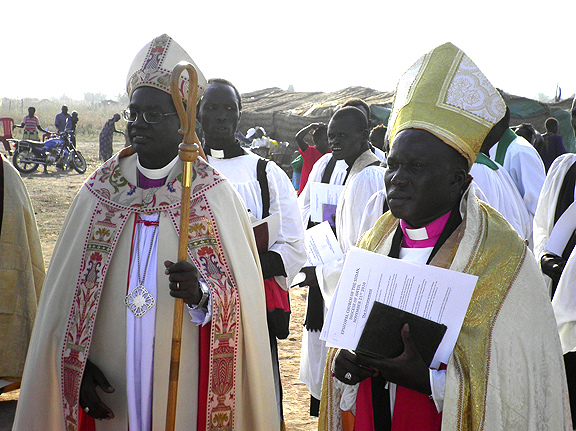
Sudanese Christians have endured decades of persecution but remained resilient even in their darkest days. (Photo credit:
Council of Anglican Provinces of Africa)
Episcopal Church of Sudan (ECS) officials have withdrawn an invitation for a visit by the head of the U.S.-based Episcopal Church (TEC) because of TEC’s liberal stances on sexual issues. It is a stinging rebuke of the official American branch of the global Anglican Communion. Equally striking, the Sudanese have recognized the Anglican Church in North America (ACNA), the Episcopal Church’s conservative American rival.

With about 4.5 million members, the growing church in Sudan outnumbers the declining U.S. based denomination, which has fewer than 2 million. Overwhelmingly poor and besieged for years by war and persecution, mostly from the Islamist regime in Khartoum, ECS is strongly theologically conservative, like most African churches. Many Anglican churches in Africa and elsewhere in the Global South have distanced themselves from TEC even as they remain in the global Anglican Communion of about 80 million believers.
The statement of recognition is a significant move for the Sudanese bishops, who, unlike other Anglican provinces in Africa, had been reluctant to distance themselves from TEC, even as they openly criticized TEC moves. Sudanese Archbishop Daniel Deng Bul Yak briefly visited the Episcopal Church’s 2009 General Convention in Anaheim, California.
In a letter dated December 15 and addressed to TEC Presiding Bishop Katharine Jefferts Schori, Sudanese Archbishop Deng Bul Yak wrote of the decision of the Sudanese House of Bishops to withdraw the invitation, citing Episcopal Church disregard for biblical teaching on human sexuality.

“We acknowledge your personal efforts to spearhead prayer and support campaigns on behalf of the ECS and remain very grateful for this attention you and your church have paid to Sudan and South Sudan,” the Archbishop wrote. “However, it remains difficult for us to invite you when elements of your church continue to flagrantly disregard biblical teaching on human sexuality.”

In an attached statement dated December 12 further explaining the Sudanese province’s position, the Sudanese House of Bishops reaffirmed their opposition to homosexual practices that they originally issued at the 2008 Lambeth Conference in Britain, which brings together Anglican bishops every 10 years.

“We reject homosexual practice as contrary to Biblical teaching and can accept no place for it within ECS,” the December 12 statement read. “We strongly oppose developments within the Anglican Church in USA and Canada in consecrating a practicing homosexual as bishop and in approving a rite for the blessing of same-sex relationships.” The December statement was ratified at a meeting of the Sudanese House of Bishops in November.

Adding to their 2008 statement, the Sudanese bishops in their latest declaration shared how they were “deeply disappointed” by the Episcopal Church’s refusal to “abide by Biblical teaching on human sexuality and their refusal to listen to fellow Anglicans.” Specifically citing the 2010 consecration of Suffragan Bishop Mary Glasspool by the Diocese of Los Angeles, the bishops protested against the continued ordination of homosexual priests and bishops as well as blessing same sex relations.

“[The Episcopal Church] has pushed itself away from God’s Word and from Anglican Communion,” the Sudanese determined. “TEC is not concerned for the unity of the Communion.”

“The Episcopal Church of Sudan is recognizing the Anglican Church in North America (ACNA) fully as true faithful Orthodox Church and we will work with them to expand the Kingdom of God in the world,” the statement announced. The bishops wrote that they would also work with those parishes and dioceses in TEC “who are Evangelical Orthodox Churches and faithful to God.”

“We will not compromise our faith on this and we will not give TEC advice anymore, because TEC ignored and refused our advices,” the Sudanese bishops concluded.

Wednesday, June 29, 2011

"Islamist Love" in the Sudan: Sudan Ablaze

http://fcasa.wordpress.com/2011/06/29/sudan-ablaze-diocese-reports-the-church-of-england-newspaper-june-24-2011/

Sudan ablaze, diocese reports: The Church of England Newspaper, June 24, 2011


Sudan Archbishop Daniel Deng and Bishop Abraham Nhial of Aweil in 2009
First published in The Church of England Newspaper.

Soldiers loyal to the Islamist government in Khartoum have burned the town of Abyei in Sudan’s South Kordofan state, driving its inhabitants into the bush at the height of the rainy season.

In an email sent to the Anglican Church in North America, the secretary of the Diocese of Aweil, the Rev Stephen Muo on 17 June reported the “whole town was completely set on fire.”

“All the civilians are now down on the streets and in bushes, with no food, no shelters, no water and no medical assistant. [The] majority are still under the trees with children, sick people and elderly people. Aweil Diocese is left with no choice but raise the voice of voiceless for relief assistant,” Mr Muo said.

Fighting erupted last month after northern troops loyal to Sudan’s President Omar al-Bashir wrested control of the town of Abyei from troops of the Sudan People’s Liberation Army (SPLA) of southern leader Salva Kiir. The battle has spread across the surrounding South Kordofan State and forced tens of thousands of civilians to flee south from the fighting.

The BBC reported on 14 June that Mr Bashir and Mr Kiir had agreed to a deal brokered by US Secretary of State Hillary Clinton, former South African President Thabo Mbeki and Ethiopia’s Prime Minister Meles Zenawi to pull their troops back from the disputed region. The deal will also see Ethiopian troops under UN command deployed to Abyei, which will become a demilitarised zone, to help mediate the deal.

However, heavy fighting is continuing across South Kordofan state.

Last week Dr Rowan Williams released a statement deploring the “mounting level of aggression and bloodshed” in South Sudan.

“Numerous villages have been bombed. More than 53,000 people have been driven from their homes. The new Anglican cathedral in Kadugli has been burned down,” the Archbishop reported, adding Kadugli had also been “overrun by the army, and heavy force is being used by government troops to subdue militias in the area, with dire results for local people. Many brutal killings are being reported.”

Dr Williams urged a multi-national response to the crisis and urged Prime Minister David Cameron’s government “which has declared its commitment to a peaceful future for Sudan,” to “play an important part” in ending the conflict.

The Diocese of Aweil has asked for “for urgent support for the civilians who are now lying on the ground without medical attention, shelters, food and water.”

Bishop Abraham Nhial of Aweil asked Christians to “remember in your prayers and advocacy for our brothers and sisters of Abyei who are still missing, those in the bush, and those on the streets in Southern Sudan towns. As always, your prayers are needed for the people of Abyei and the world.”