21
April 1649 AD: Rev.
Francis Mackemie, Oliver Cromwell, and Maryland’s Toleration Law
The PCA historians tell the
story at: http://www.thisday.pcahistory.org/2014/04/april-21-3/
April
21: Rev. Francis Makemie
Maryland Toleration Law Opens up
Colony for Reformed Preaching
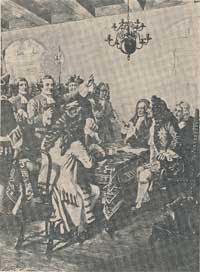 April 21 was
an important date in 1649 for
the Reformed faith in the colony of Maryland. Originally, Maryland was a
colony established as a refuge for English Catholics. But as more non-Catholics
came into the colony, and indeed it became a Protestant colony, the Maryland
Assembly on this date established the Maryland Toleration Law, or as it is
sometimes known as The Act Concerning Religion.
April 21 was
an important date in 1649 for
the Reformed faith in the colony of Maryland. Originally, Maryland was a
colony established as a refuge for English Catholics. But as more non-Catholics
came into the colony, and indeed it became a Protestant colony, the Maryland
Assembly on this date established the Maryland Toleration Law, or as it is
sometimes known as The Act Concerning Religion.
What it did was to mandate religious tolerance for
trinitarian Christians. That adjective “trinitarian” is important. If a citizen
of the colony denied the deity of Jesus Christ, for example, then the
punishment was seizure of their land, and even death. Thus Unitarians, or
Jews, or atheists were threatened by this law. It was meant more so as a
protection for the Roman Catholics as it was for the Protestants, and
specifically the Reformed faith.
It wouldn’t last long on the books, being repealed in
1654 by Oliver Cromwell’s influence upon the colony, and specifically the
Anglican Church. It would be returned to the law books, but then repealed
forever in 1692. It is interesting though that a part of it was found in the
First Amendment of the U.S. Constitution, which states “Congress shall make no
law respecting an establishment of religion, or prohibiting the free exercise thereof;
or abridging the freedom of speech, or of the press; or the rights of the
people peaceably to assemble, and to petition the Government for a redress of
grievances.” The phrase “the free exercise thereof,” comes from the Maryland
Act of Toleration.
What interests us in this Act of Toleration is that it
allowed “the father of Presbyterianism” in the colonies, Francis Makemie, the
freedom to preach in Maryland. Arriving in the Maryland colony in 1683, he
didn’t have to seek permission from the governor of the colony to proclaim the
richness of free grace. Further, those of the Reformed faith who were driven
out from the Virginia Colony’s control by the Anglicans, could come to Maryland
to practice their Reformed faith. Makemie went on to establish several Presbyterian
churches in Maryland.
No comments:
Post a Comment